

Germany Opportunity Card 2026: Complete Guide to Chancenkarte & EU Blue Card
Thinking about moving to Germany for work but don't have a German job offer yet?
The Germany Opportunity Card (Chancenkarte) could be one of the routes worth exploring in 2026. It allows eligible non-EU nationals to enter Germany for job searching, giving them time to meet employers locally rather than securing a qualifying job before arrival.
But there is an important distinction: the Opportunity Card is primarily a job-search residence route, while the EU Blue Card is designed for people who already have a qualifying job offer.
Here is what you need to know about the Germany Opportunity Card 2026, including eligibility, the points system, financial requirements, part-time work and the route from Chancenkarte to an EU Blue Card.
What Is the Germany Opportunity Card?
The Opportunity Card, or Chancenkarte, is a German residence title that allows eligible third-country nationals to stay in Germany for up to one year while looking for qualified employment.
There are two main routes:
Recognised qualification route: If your foreign academic or vocational qualification is fully recognised in Germany, you can qualify without using the points system.
Points route: If your qualification is not fully recognised in Germany, you may qualify by meeting the basic requirements and obtaining at least 6 points.
A fully recognised qualification can therefore make the process considerably different from the points-based route.
Germany Opportunity Card Requirements in 2026
For the points-based route, you generally need:
A foreign academic degree or vocational qualification recognised by the country where it was obtained.
For vocational qualifications, training must generally have lasted at least two years.
German language skills of at least A1, or English at least B2.
At least 6 points under the Opportunity Card points system.
Proof that you can financially support yourself during your stay.
For foreign university qualifications, applicants may need appropriate evidence of comparability, such as an anabin result or a Statement of Comparability from ZAB, depending on their circumstances.
Germany Opportunity Card Points System 2026
The points system is often where applicants get confused. Here is the official structure:
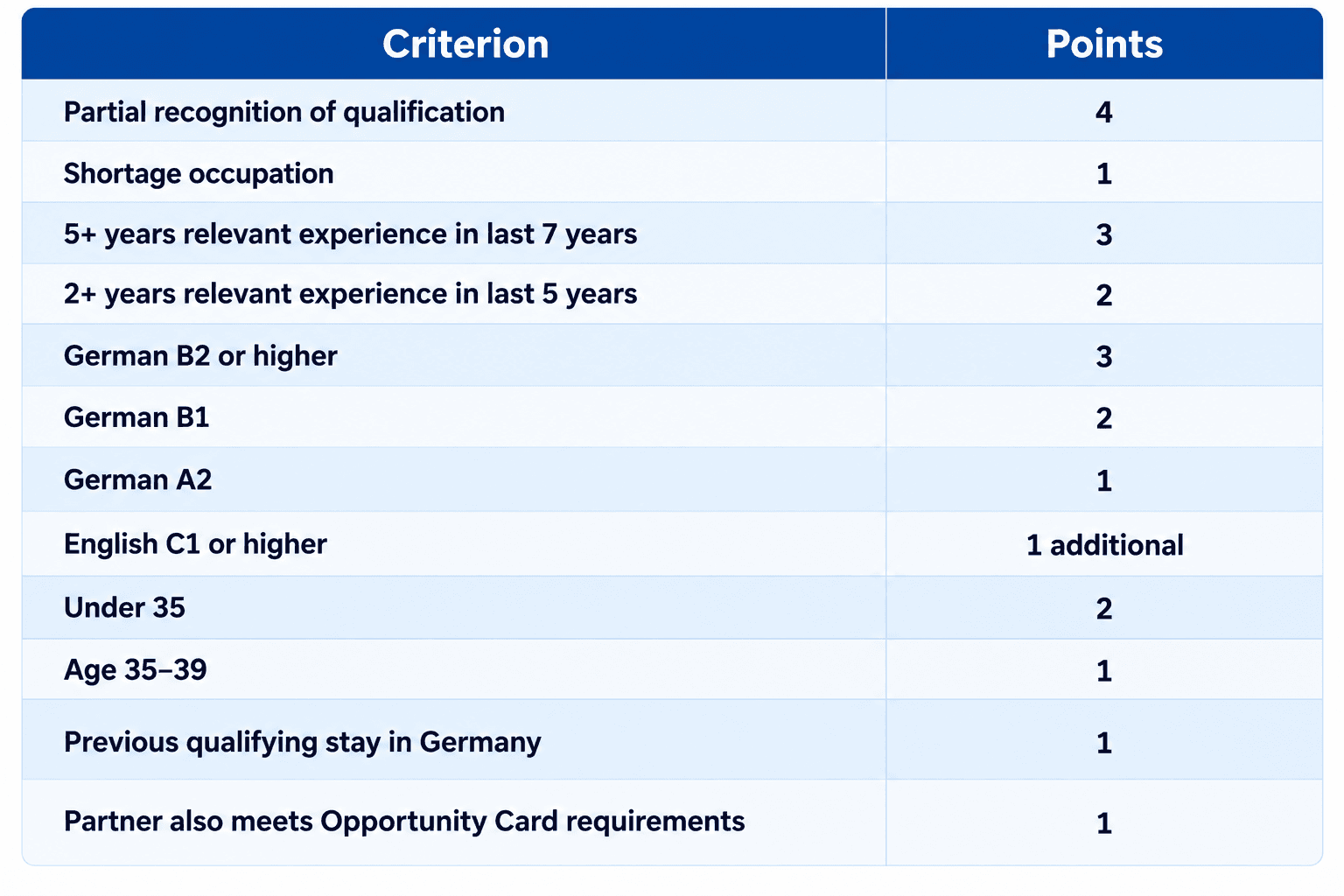
You need at least 6 points.
One important detail: the experience points must relate to your formal qualification and must have been acquired after obtaining that qualification. Also, tourist stays in Germany do not count toward the previous-stay point.
Example
Suppose an applicant is 29, has five years of relevant professional experience, German B1 and works in a shortage occupation.
That could give:
2 points for age + 3 points for experience + 2 points for German B1 + 1 point for shortage occupation = 8 points.
The applicant would therefore clear the 6-point threshold, assuming all other mandatory requirements are satisfied.
How Much Money Do You Need for the Opportunity Card?
Financial proof is mandatory.
For 2026, the official minimum for a blocked account is €1,091 net per month. For a full 12-month period, that works out to approximately €13,092.
A Declaration of Commitment (Verpflichtungserklärung) from an eligible person in Germany can also be used in appropriate cases.
There is also an important practical point: income from permitted part-time employment can potentially be considered when proving financial resources, depending on the amount earned.
Can You Work on the Germany Opportunity Card?
Yes.
While searching for qualified employment, Opportunity Card holders can work in secondary employment for up to 20 hours per week in total.
They can also undertake job trials for up to two weeks per employer, provided the trial is connected to the search for qualified employment, vocational training or a qualification measure.
This is one of the practical advantages of the Chancenkarte: you can be physically present in Germany, meet employers and gain work experience while continuing your search.
Opportunity Card vs EU Blue Card
The two routes serve different purposes.
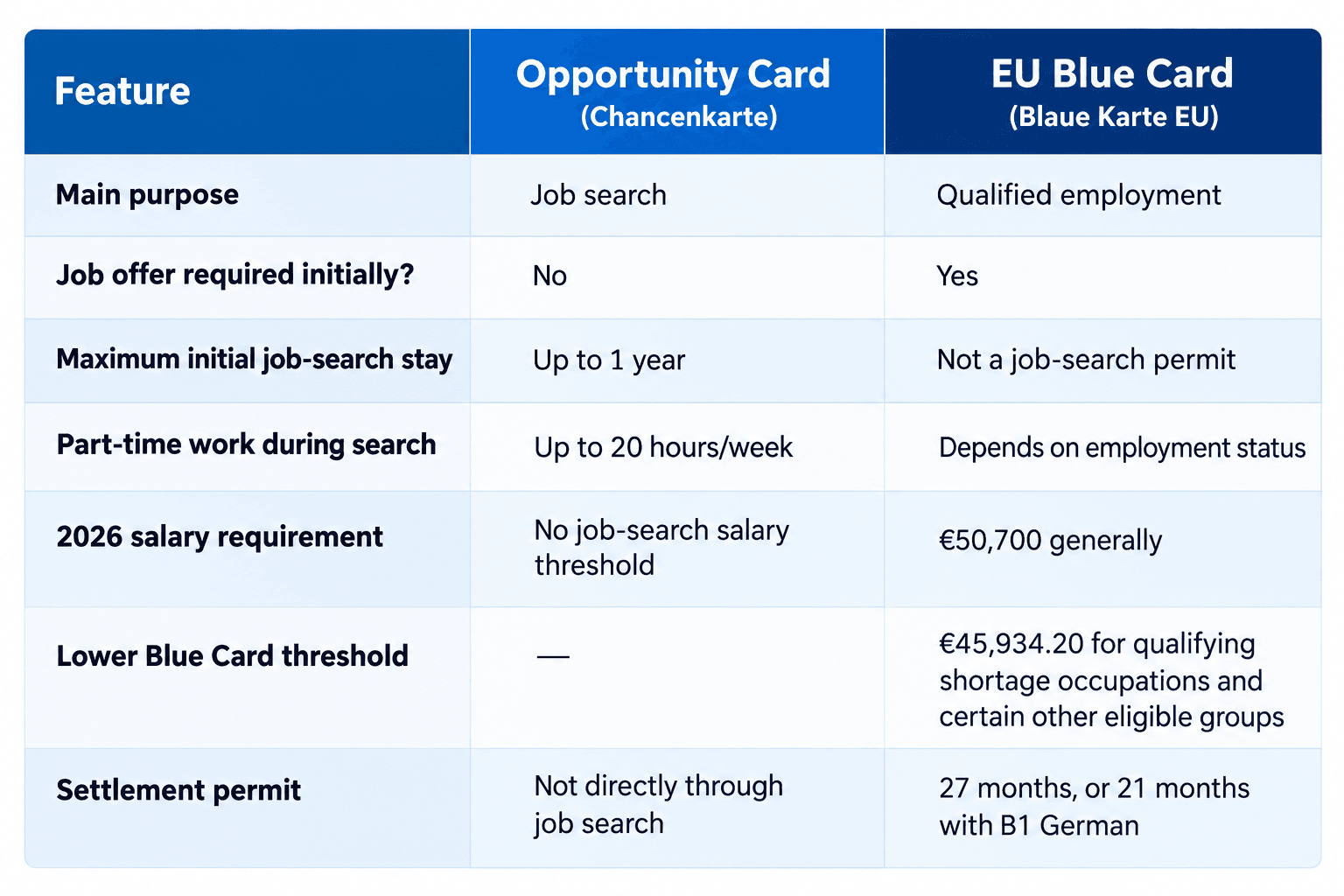
The EU Blue Card requires a qualifying job and an appropriate qualification or qualifying pathway. Germany's rules also allow certain IT specialists without a university degree to qualify for a Blue Card if they have at least three years of comparable professional experience and meet the other requirements.
What Is the 2026 EU Blue Card Salary?
For 2026, the standard minimum gross annual salary is:
€50,700
For qualifying shortage occupations, the lower threshold is:
€45,934.20 gross per year
The lower threshold can also apply to certain new entrants to the labour market, including people who obtained their academic qualification within the previous three years.
The shortage-occupation list is broader than just software developers. It includes areas such as academic STEM professions, certain IT and service-management roles, doctors, pharmacists, nursing and midwifery professionals, architects and certain teaching and education professions.
Related Blog
Can You Move From the Opportunity Card to an EU Blue Card?
Yes, provided you obtain a qualifying job and meet the requirements for the Blue Card.
You do not generally need to leave Germany simply because you entered using the Opportunity Card. Once you have suitable employment, you can apply to the competent Ausländerbehörde for the appropriate residence title.
The exact residence permit depends on the job, qualification and other requirements, so securing an employment contract does not automatically mean every applicant qualifies specifically for a Blue Card.
How Fast Can an EU Blue Card Lead to Permanent Residence?
This is one of the strongest features of the EU Blue Card.
A Blue Card holder can generally apply for a settlement permit after 27 months of qualified employment if the required German language level is A1.
With B1 German, the required period can fall to 21 months, provided the other settlement-permit requirements are met.
If you're also exploring education as a route into the German labour market, our guide to the 18-month post-study work visa in Germany explains another pathway available to international graduates.
For students researching German universities, you can also explore our Best Universities in Germany guide before choosing where to study.
What If You Don't Find a Job Within One Year?
The Opportunity Card is not an unlimited job-search visa.
The initial Opportunity Card is issued for a maximum of 12 months. If you find qualified employment, you can apply for an appropriate residence title.
In certain circumstances, an Opportunity Card extension of up to two additional years may be possible when the applicant has found qualified employment but does not meet the requirements for another suitable residence title.
If no appropriate extension or alternative residence status is available, you must leave Germany before your authorised stay ends.
Final Takeaway
The Germany Opportunity Card 2026 is not simply a replacement for a traditional work visa. Its main advantage is that it creates a legal route for eligible international professionals to enter Germany first and search for qualified employment locally.
The key numbers to remember are:
6 points — minimum for the points route
€1,091/month — 2026 financial proof benchmark
20 hours/week — permitted secondary employment
12 months — initial job-search period
€50,700 — standard 2026 EU Blue Card salary threshold
€45,934.20 — lower threshold for qualifying cases
21 months — possible Blue Card settlement timeline with B1 German
Before applying, always verify your individual situation through Germany's official immigration information and the competent German mission or foreigners authority, because qualification recognition, occupation, nationality and personal circumstances can affect the correct route.