

Germany Chancenkarte 2026: Points, Eligibility, Cost & How to Apply
Thinking about moving to Germany without having a job offer first?
Germany's Chancenkarte, also known as the Opportunity Card, gives eligible non-EU/EFTA nationals a pathway to come to Germany and look for qualified employment.
But there is a catch: you must meet specific qualification, language, financial and, in some cases, points-system requirements.
And this is where many applicants get confused.
How many points do you need?
Does your degree have to be recognised?
How much money do you need?
Can you work while searching for a job?
And can you apply without knowing German?
This guide explains the Germany Chancenkarte point system, eligibility requirements, costs and application process in simple terms.
Important: Immigration rules and financial requirements can change. The information below reflects official German government guidance available for 2026. Always verify your individual case with the responsible German mission before applying.
What Is the Germany Chancenkarte?
The Chancenkarte is a German residence route designed to help qualified people from outside the EU/EFTA enter Germany to search for suitable employment.
Unlike some traditional employment routes, you don't necessarily need a German job offer before travelling.
The Opportunity Card can generally be issued for up to one year, provided you can financially support yourself during your stay. During that period, holders can work up to 20 hours per week in secondary employment and can also take part in short work trials under the applicable rules.
There are two main ways to qualify.
Route 1: Recognised Skilled Worker
If you have a foreign academic or vocational qualification that is fully recognised in Germany, you may qualify as a skilled worker.
In this route, you do not need to use the points system.
You also don't have to prove the specific language requirement applicable to the points route, although German can significantly improve your chances of finding employment.
Route 2: The Points System
If your qualification isn't fully recognised in Germany, you may qualify through the Chancenkarte points system.
You need:
A qualifying foreign academic degree or vocational qualification
The required language level
At least 6 points
Proof that you can financially support yourself in Germany
Germany Chancenkarte Point System Explained
Here's where the process becomes interesting.
You can earn points from several factors.
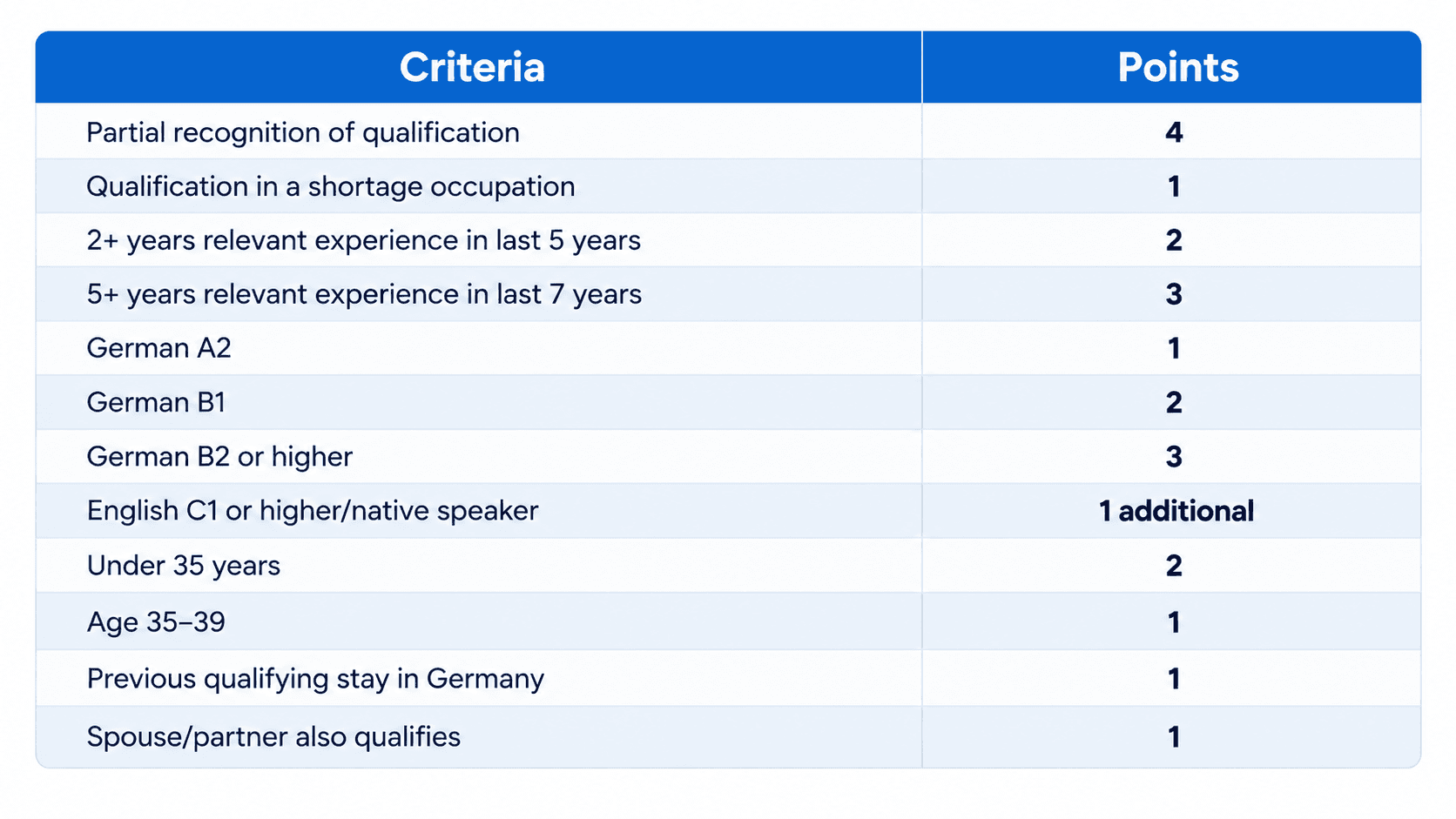
You need at least 6 points under the points route.
Example: How Could Someone Reach 6 Points?
Imagine a 30-year-old applicant with:
2 years of relevant professional experience = 2 points
German B1 = 2 points
Under 35 = 2 points
Total = 6 points
That could satisfy the points threshold, assuming the applicant also meets the underlying qualification, language and financial requirements.
This is why you shouldn't look at age or work experience separately. Your entire profile matters.
What Qualifications Do You Need?
For the points-based route, your qualification must generally be a state-recognised academic degree or vocational qualification.
For vocational qualifications, the training normally needs to have lasted at least two years.
Depending on your qualification, evidence may involve the anabin database, a Statement of Comparability from ZAB, or the relevant vocational qualification assessment. The exact evidence depends on the type of qualification.
Don't assume that simply having a degree automatically means you qualify.
Check how your specific qualification is assessed before planning your application.
What Language Level Is Required?
You don't necessarily need fluent German to enter through the points route.
The basic language gateway is:
German A1 OR English B2.
However, stronger language skills can give you additional points.
For example:
German A2 → 1 point
German B1 → 2 points
German B2+ → 3 points
English C1+ → additional 1 point
There's an important practical distinction here.
Meeting the visa requirement and finding a job are not the same thing.
You may qualify with relatively basic German, but many German employers may still prefer candidates who can communicate comfortably in German.
So if Germany is your long-term career destination, learning German beyond the minimum can be a serious advantage.
How Much Money Do You Need for the Chancenkarte?
You must demonstrate that you can financially support yourself during your stay.
For 2026, the official Make it in Germany guidance states that applicants can demonstrate this through a blocked account containing at least €1,091 net per month, or through an accepted declaration of commitment.
For a full 12-month stay, that monthly figure means you should plan for approximately €13,092 in financial proof, before considering other expenses such as visa fees, travel, insurance and accommodation costs.
Don't use older articles quoting €1,027 per month without checking the year. That figure applied to the earlier requirement and should not be presented as the current 2026 amount.
Can You Work in Germany With a Chancenkarte?
Yes, but there are limits.
Opportunity Card holders can generally work up to 20 hours per week in secondary employment while searching for qualified work. Work trials are also possible under the applicable conditions.
The purpose of the card is still job searching, not unrestricted full-time employment.
Once you find a suitable qualified position, you may be able to switch to another residence title if you meet its requirements.
How to Apply for the Germany Chancenkarte
The application process can vary depending on where you live, but the general process looks like this:
Step 1: Check Your Qualification
Determine whether your academic or vocational qualification is recognised or assessable for the relevant route.
Step 2: Calculate Your Points
If you're using the points route, calculate your score carefully.
Don't count points without being able to provide evidence.
Step 3: Prepare Language Proof
Collect the appropriate certificate for German and/or English where required.
Step 4: Prepare Financial Proof
Arrange the required blocked account or another accepted form of financial support.
Step 5: Prepare Your Documents
Depending on your situation, this may include:
Passport
Qualification documents
Recognition/assessment documents
Language certificate
Proof of professional experience
Financial proof
Health insurance and other required documents
Your responsible German mission will provide the definitive document requirements for your case.
Step 6: Submit Your Application
Germany's Consular Services Portal now allows many visa applications to be started online. You still generally need an in-person appointment for biometric data, document checks where required, and payment of the visa fee.
Is the Chancenkarte Worth It?
It can be—but it's not a guaranteed job visa.
The Opportunity Card gives you the chance to search for employment from inside Germany, which can be valuable for candidates whose profiles are stronger when they can meet employers directly.
But you should not travel assuming that a job will automatically appear within a few weeks.
Before applying, ask yourself:
Do my skills match jobs currently available in Germany?
Is my qualification relevant to those jobs?
Can I financially support myself while searching?
Would improving my German significantly increase my options?
If the answer to these questions is yes, the Chancenkarte may be worth exploring.
For students considering Germany as an education destination, our guides on Study in Germany for International Students and Germany University Admission Requirements can help with the academic side of the journey.
Final Thoughts
The Germany Chancenkarte 2026 is not a shortcut to permanent employment.
It's better understood as an opportunity to enter Germany, search for qualified work and potentially transition to an appropriate employment residence title.
The most important things to get right are your qualification, language evidence, points calculation and financial proof.
And remember one important rule:
Don't apply based on a random points calculator alone.
Your documents must support the claims you make.
Check your eligibility carefully, use official German sources, and confirm the latest requirements with the relevant German authorities before submitting your application.
Frequently Asked Questions
How many points are needed for the Germany Chancenkarte?
Applicants using the points route need at least 6 points, in addition to meeting the underlying qualification, language and financial requirements.
Can I apply for the Chancenkarte without a job offer?
Yes. The Opportunity Card is specifically designed to allow eligible applicants to come to Germany to search for suitable employment.
Is German mandatory for the Chancenkarte?
For the points route, you need at least German A1 or English B2. However, German language skills above A1 can earn additional points.
How much money is required for the Chancenkarte in 2026?
The official 2026 figure is €1,091 net per month for financial proof through a blocked account, subject to the applicable requirements.
Can I work while holding the Chancenkarte?
Yes. Holders can generally work up to 20 hours per week in secondary employment while searching for qualified work.
Does the Chancenkarte guarantee a job in Germany?
No. It provides a pathway to enter Germany for job searching; employment still depends on your qualifications, experience, language skills, the labour market and individual employer decisions.