
Why Study in Germany in 2026? The Economic & Career ROI for International Students
Thinking about studying abroad in 2026 but worried about the cost? Germany deserves a serious look.
For many international students, countries such as the US, UK, and Australia are attractive because of their globally recognized universities. But there is one major challenge: the overall cost of studying and living can become extremely high.
Germany offers a different proposition.
Many public universities charge little or no tuition for most students, while students still get access to internationally recognized degrees, strong research infrastructure, and a job market that needs skilled professionals.
But is Germany actually a better investment for your future?
For the right student, it can be.
From affordable public universities and working-student opportunities to the post-study job-search period, Germany can offer a strong combination of education, career opportunities, and long-term value.
Let's look at what that really means for international students in 2026.
Why Is Germany Becoming So Popular Among International Students?
Choosing a country for higher education is no longer just about university rankings.
Students are increasingly asking a more practical question:
"What will I get back for the money I spend on my degree?"
This is where Germany becomes interesting.
Compared with countries where international tuition fees can exceed $40,000 per year, many German public universities offer programs with no traditional tuition fee, although students still need to pay semester contributions and cover their living expenses.
The bigger advantage is that your investment isn't limited to the degree itself.
A German degree can potentially give you access to:
Internationally recognized qualifications
Working-student opportunities during your studies
Strong industry connections
A large European job market
A post-study period to search for qualified employment
Potential pathways toward long-term residence
So, if you're comparing study-abroad destinations based on career ROI rather than just university rankings, Germany should be on your shortlist.
For a deeper breakdown of eligibility, finances, and the application process, read our Study in Germany Guide for International Students.
Is Studying in Germany Really Cheaper Than Other Countries?
For many students, yes — especially when comparing public universities.
However, "tuition-free" does not mean "free education."
You still need money for accommodation, food, health insurance, transportation, semester contributions, and other daily expenses.
The difference is that your tuition burden at many public universities can be significantly lower than what you may face in countries such as the US, UK, or Australia.
What About the Career ROI?
This is where the calculation becomes more interesting.
Imagine two students spending heavily on an international degree. One graduates with a large tuition burden and limited opportunities to work during or after the degree. The other studies at a low-tuition public university and gets opportunities to gain relevant work experience while studying.
The second student may have a very different financial outcome.
Germany's strong industrial and technology sectors also create demand for graduates in areas such as:
Computer Science
Software Engineering
Data Science
Mechanical Engineering
Automotive Engineering
Electrical Engineering
Artificial Intelligence
Renewable Energy
Your actual career prospects will still depend on your qualification, German-language skills, experience, specialization, and the job market at the time you graduate.
What Happens After You Graduate?
One of Germany's biggest attractions for international graduates is the opportunity to remain in the country after completing a degree while searching for qualified employment.
International graduates can generally receive an 18-month residence permit for looking for qualified employment after completing their studies, subject to the applicable immigration requirements.
This period can be extremely valuable.
Instead of having to leave immediately after graduation, you have time to:
Improve your CV.
Apply for relevant jobs.
Attend interviews.
Build professional connections.
Gain experience through internships or other relevant opportunities.
Transition into a suitable work residence status once you secure employment.
For students planning their education around a long-term European career, this can make Germany considerably more attractive.
Can Germany Lead to Permanent Residency?
Potentially, yes.
Graduates who move into qualified employment may have pathways toward permanent residence. The exact timeline depends on the residence status, employment, contributions, and other legal requirements.
For certain skilled workers, permanent residence can become possible after a relatively short period of qualified employment.
Don't treat "21–24 months" as an automatic guarantee. Immigration rules and individual eligibility matter, so always verify the current requirements before making a decision.
Public vs. Private Universities in Germany: Which One Should You Choose?
This is one area where international applicants often make the wrong assumption.
A private university may be easier to enter, but easier admission does not automatically mean better career value.
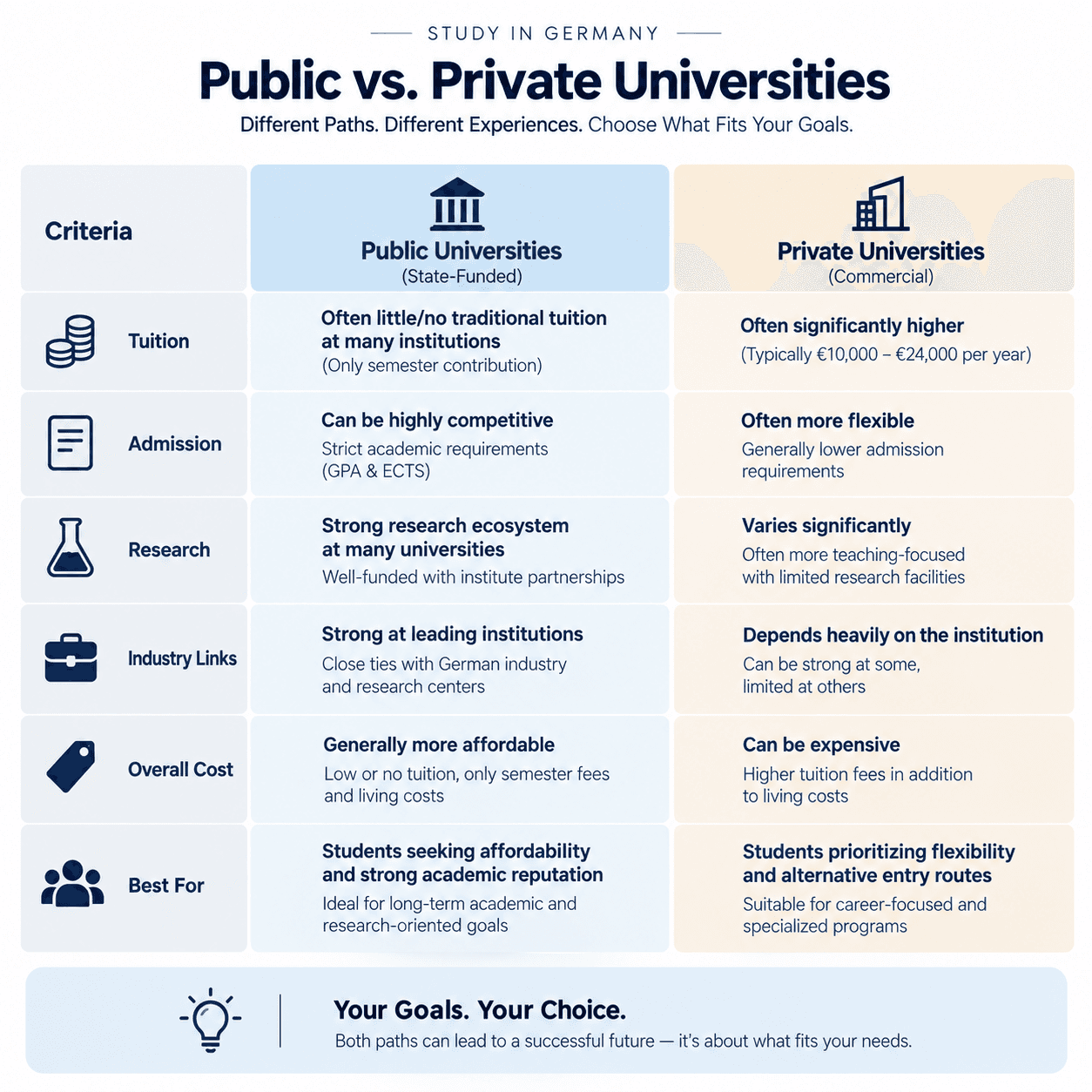
There are good private universities in Germany, so it would be unfair to say that every private university is weak.
The smarter approach is to evaluate the specific university and program rather than assuming public or private automatically tells you everything.
Before paying an agent or university, check accreditation, degree recognition, curriculum, graduate outcomes, tuition fees, and employer reputation.
Which German Universities Should You Consider?
If you're targeting English-taught programs, several well-known institutions deserve research.
1. Technical University of Munich (TUM)
TUM is particularly well known for engineering, technology, computer science, and research.
It's a strong option for students targeting areas such as robotics, AI, software, and automotive technology.
2. RWTH Aachen University
RWTH Aachen has a particularly strong reputation in engineering and technical disciplines.
Students interested in mechanical engineering, materials, automotive technology, and related fields often consider it among their top choices.
3. Technical University of Berlin
TU Berlin is another major technical university, with programs and research spanning technology, computer science, engineering, and urban planning.
4. University of Stuttgart
Located in one of Germany's major industrial regions, the University of Stuttgart is especially interesting for students targeting engineering, automotive, technology, and related careers.
5. Hochschule Darmstadt
Hochschule Darmstadt, also known as h_da, can appeal to students looking for a more practically oriented approach, particularly in technology and applied disciplines.
Important: Don't choose a university simply because it appears on a "top 5" list. Your course curriculum, admission eligibility, location, tuition, language, and career goals matter more than a generic ranking.
If you're considering a career transition before studying abroad, you can also read our guide on How to Switch From Non-Tech to Tech Roles.
What Are the Biggest Mistakes International Students Make?
Getting admission is only one part of the process.
Many applicants lose time or money because they overlook basic requirements.
1. Ignoring ECTS and Subject Requirements
A good GPA does not automatically mean you're eligible.
German universities can have very specific academic requirements for master's programs. They may assess whether your previous degree contains the required subjects and credits.
For example, a Computer Science master's program may expect previous coursework in areas such as algorithms, mathematics, programming, databases, or theoretical computer science.
Always compare your transcript with the program's official admission requirements.
2. Applying Too Late
German universities commonly have different deadlines for winter and summer semesters.
Many programs start in the winter semester, but deadlines vary by university and program.
Don't wait until the last minute.
Start researching programs months before the intended intake and check the official university website for the exact deadline.
3. Trusting Unverified Agents
You do not necessarily need an agent to apply to a German university.
Depending on the university and program, applications may be handled through the university's own portal or through Uni-Assist.
If someone promises guaranteed admission to a public university, treats a large payment as a requirement for "special access," or refuses to show you the official university information, that's a serious warning sign.
4. Thinking Tuition-Free Means Cost-Free
This is probably the most common misunderstanding.
Even if your university charges no traditional tuition fee, you still need to demonstrate that you can financially support yourself.
Living expenses can include:
Rent
Food
Health insurance
Transportation
Study materials
Semester contributions
Personal expenses
Financial requirements can also change over time, so don't blindly rely on an old blog post or social-media video.
Can International Students Work While Studying in Germany?
Yes, international students can generally work alongside their studies, subject to the applicable residence and working rules.
Working as a student can be more than just a way to earn money.
A relevant working-student position (Werkstudent) can help you build German workplace experience, develop professional connections, and strengthen your CV before graduation.
Pay varies by role, company, experience, location, and other factors. Technology and engineering students may find opportunities that pay competitively, but you should not assume a fixed hourly rate for every job.
The best strategy is to look for work that connects to your degree.
A relevant job can potentially give you both income and career experience.
Is Germany a Good Choice for Your Career in 2026?
There is no universal answer.
Germany can be an excellent choice if you want:
A relatively affordable European education
Strong technical and research-oriented universities
Opportunities to gain work experience while studying
Access to a large European economy
A structured route from graduation toward employment
But Germany isn't effortless.
You may face competitive admissions, documentation requirements, housing challenges, bureaucracy, and the need to learn German for many everyday and professional situations.
The students who benefit most are usually those who treat Germany as a long-term career plan, not simply as a cheap destination for a foreign degree.
Frequently Asked Questions
Can I study in Germany completely in English?
Yes. Germany has a large number of English-taught degree programs, particularly at the master's level.
However, not knowing German can still make everyday life, networking, internships, and some job opportunities more difficult.
Learning German alongside your degree can therefore be a smart career investment.
What GPA do I need for a public university in Germany?
There is no single GPA requirement for every public university or program.
Some highly competitive programs may require a strong academic record, while other programs may use different admission criteria.
Instead of relying on a general "2.5 GPA rule," check the exact admission requirements of each program you're applying to.
Is Germany actually tuition-free for international students?
Many public universities do not charge traditional tuition fees for many programs, but this does not apply universally.
There can also be semester contributions and, depending on the university/state and your circumstances, tuition charges.
Always verify the current fee structure directly with the university.
How much money do I need to study in Germany?
Your required financial proof depends on the current immigration rules and your individual situation.
A blocked account requirement has historically been used as part of the student visa process, but the amount can change.
For that reason, don't rely on an outdated figure such as €11,904 or €992 per month without checking the latest official requirement.
Final Verdict: Is Studying in Germany Worth It?
For many international students, Germany can offer an unusually strong education-to-career value proposition.
The biggest attraction isn't simply that some public universities have low tuition.
It's the combination of affordable education, strong technical universities, opportunities for relevant work experience, and the possibility of continuing into qualified employment after graduation.
But don't choose Germany just because someone told you it's "free."
Choose it if the program matches your academic background, the university fits your career goals, you can realistically manage the living costs, and you're prepared to compete in the German job market.
Do your research early, compare programs carefully, verify every requirement through official sources, and treat your degree as the first step of your career — not the final goal.
If you're planning your Germany study journey, start with our Study in Germany Guide for International Students and understand the admission requirements before you begin your application.