

The Complete Guide to Werkstudent (Working Student) Jobs in Germany: Pay, Taxes & Rules
For many international students, studying in Germany is only one part of the experience. Once classes begin, another question usually follows:
“Can I work while studying in Germany?”
The answer is yes, and one of the most attractive options for university students is a Werkstudent job.
A Werkstudent position allows you to work for a company while continuing your studies. More importantly, it can give you something that a regular part-time job often cannot: professional experience directly related to your degree.
A computer science student might work as a junior software developer. A business student could work in consulting, finance, operations, or marketing. An engineering student might join a company's development or research team.
But before accepting a Werkstudent position, you need to understand the rules around working hours, residence permits, taxes, social security, salary, and your student status.
Here's what you need to know.
What Is a Werkstudent Job in Germany?
A Werkstudent is a university student who works alongside their studies, usually in a role that provides relevant professional experience.
The important concept behind the arrangement is the Werkstudentenprivileg, a special social-security treatment for students.
Under the rules, students who remain primarily focused on their studies can generally be exempt from contributions to statutory health, long-term care, and unemployment insurance for their student employment. The statutory pension insurance contribution generally still applies.
This makes a Werkstudent position particularly attractive because you're not simply earning money—you can also build experience that supports your career after graduation.
For example:
Computer Science → Software Development
Business → Finance or Operations
Mechanical Engineering → Product Development
Marketing → Digital Marketing
Data Science → Data Analytics
That connection between your studies and your work is one of the biggest reasons students actively look for Werkstudent positions.
Who Can Work as a Werkstudent?
The exact rules depend on your student status, residence status, working hours, and the type of employment.
For international students from outside the EU/EEA/Switzerland, your residence permit is particularly important.
Students from third countries studying in Germany under a study residence permit can work under specific conditions. Current official guidance allows them to work up to 140 full days or 280 half-days per year, while another route allows employment of up to 20 hours per week during the lecture period.
Because these rules can interact with the type of employment and your residence status, don't assume that every student job is automatically covered in exactly the same way.
Always check the conditions attached to your residence permit and your specific employment situation.
The 20-Hour Rule Explained
The 20-hour rule is one of the most important concepts for Werkstudent jobs.
During the university lecture period, working up to 20 hours per week is generally consistent with the principle that studying remains your main activity. The German pension insurance system explains that the Werkstudent privilege generally applies when weekly working hours do not exceed 20 hours.
Here's the basic idea:
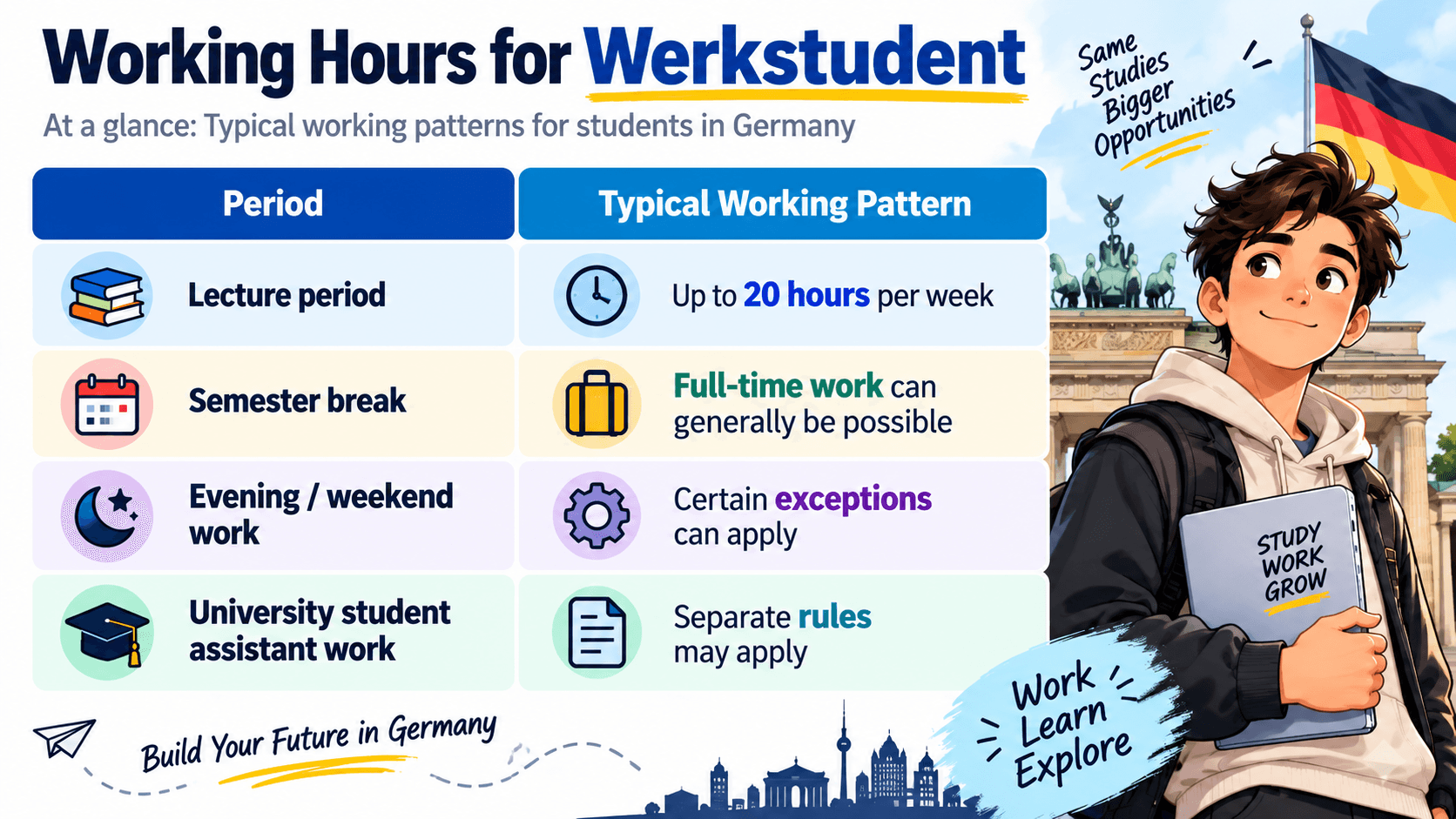
During the semester break, students can generally work without the same 20-hour restriction under the student employment rules.
However, don't interpret this as “I can always work 40 hours whenever I want.”
The details depend on your employment arrangement and, for international students, your residence status.
What About the 140 Full-Day / 280 Half-Day Rule?
This is especially important for students from outside the EU/EEA/Switzerland.
Current German government guidance states that third-country students can work up to:
140 full working days per year, or
280 half working days per year
without approval from the Federal Employment Agency under the relevant student residence rules.
A working day of up to four hours counts as a half working day under the official guidance.
There is also an alternative route for working up to 20 hours per week during the lecture period, so students should understand which rule applies to their particular employment arrangement rather than simply adding the limits together.
If you're an international student, check your residence permit before starting a job.
That's one area where guessing can create unnecessary problems.
How Much Does a Werkstudent Earn in Germany?
This is one of the first things students want to know.
There isn't one fixed nationwide Werkstudent salary.
Your hourly rate can depend on:
Your field of study
Previous experience
Technical skills
Location
Company size
Industry
German-language ability
Responsibilities of the position
A student with basic administrative responsibilities may earn considerably less than someone working in software engineering, data science, engineering, or another specialized field.
Instead of choosing a salary figure simply because it appears online, look at the actual job advertisement and current market rates for your field and city.
More importantly, don't evaluate an offer based only on the hourly wage.
Consider the complete opportunity:
Pay + relevant experience + mentorship + skills + networking + potential full-time opportunity
A slightly lower-paying position that gives you strong experience in your target industry can sometimes be more valuable than a higher-paying job that has little connection to your future career.
What Taxes Do Werkstudents Pay?
This is where many students get confused.
Being a student does not automatically mean that you pay no income tax.
Your tax situation depends on your income and other individual circumstances.
For 2026, Germany's basic tax-free allowance, known as the Grundfreibetrag, is €12,348. Income tax is calculated based on taxable income, and other factors can affect the final amount.
If your employer withholds wage tax during the year, you may be able to recover some or all of it through a tax return, depending on your total taxable income and deductible expenses.
This is why you shouldn't automatically assume:
“I'm a student, so I never pay tax.”
A better approach is:
Check your payslip → track your annual income → file a tax return when appropriate.
If your circumstances are complicated—for example, multiple jobs or other income—consider getting advice from a qualified tax professional.
What Social Security Contributions Does a Werkstudent Pay?
This is one of the biggest financial advantages of the Werkstudent arrangement.
When the Werkstudent rules apply, students are generally exempt from contributions to:
Statutory health insurance
Long-term care insurance
Unemployment insurance
However, pension insurance contributions generally still apply. The Deutsche Rentenversicherung gives an example of a student working 20 hours per week who pays the employee pension contribution while the other listed social-insurance contributions are not deducted under the Werkstudent privilege.
This doesn't mean your health insurance disappears.
You still need appropriate health insurance as a student; the Werkstudent privilege concerns the social-security contributions connected with your employment.
Werkstudent vs. Regular Student Job
Not every student job is the same. Imagine two students. One works at a restaurant on weekends.
The other works 16 hours a week as a junior data analyst at a technology company. Both are earning money.
But the second student is also building experience that can potentially strengthen their post-graduation job applications.
That's why a Werkstudent role can be especially useful for international students.
You're effectively getting paid while building a professional track record.
Where Can You Find Werkstudent Jobs?
Don't rely on a single job website.
Search across multiple channels, including:
Search terms such as:
“Werkstudent Software Engineering”
“Werkstudent Marketing”
“Working Student Data Analyst”
StepStone
Search for Werkstudent + your field.
Indeed Germany
Try combinations of your degree, skills, and “Werkstudent.”
University Career Portals
Many German universities maintain their own job boards or career services.
Also check companies directly.
If there's a company you'd like to work for, visit its careers page and search for:
Working Student
Werkstudent
Student Assistant
Studentische Aushilfe
Working Student Intern
Don't search only for jobs with the exact word Werkstudent. Some international companies advertise similar positions in English.
How to Make Your Werkstudent CV Stand Out
You don't need ten years of experience to get a Werkstudent job.
But you do need to show that you can contribute.
Your CV should quickly answer three questions:
What are you studying?
What can you do?
Why are you relevant to this position?
For example, a computer science student could highlight:
Programming languages
University projects
GitHub projects
Internships
Relevant coursework
Cloud or database skills
Technical certifications
A marketing student could emphasize:
Content creation
SEO
Analytics
Social media
Campaign projects
University marketing projects
Relevant tools
Don't fill the CV with every subject you've studied.
Prioritize evidence that matches the job.
Do You Need German for a Werkstudent Job?
Not always.
Germany has many international companies and teams where English is the main working language, particularly in areas such as technology, research, engineering, and multinational business environments.
But that doesn't mean German is irrelevant.
Even when a job is advertised in English, German language skills can expand the number of companies and roles available to you.
If you're starting from zero, don't wait until you're fluent.
Even developing your German gradually toward A2 or B1 can make everyday life and workplace communication easier.
Think of German as an additional career advantage rather than an all-or-nothing requirement.
Can a Werkstudent Job Lead to a Full-Time Career?
Absolutely—but don't treat it as guaranteed.
A good Werkstudent position can help you build:
Industry experience
Professional references
Company-specific knowledge
Technical skills
Workplace communication
Professional contacts
A stronger CV
And there's another advantage.
Your employer gets to see how you actually work.
That can be valuable when the company has graduate or junior-level positions available after you finish your degree.
However, don't assume that every Werkstudent position automatically turns into a full-time offer.
The company's hiring needs, your performance, available positions, and your qualifications all matter.
So treat the job as experience first and a potential opportunity second.
5 Mistakes International Students Should Avoid
1. Ignoring Your Residence Permit
Don't assume that rules you read online automatically apply to your situation.
Check your residence permit and current official requirements before starting work.
2. Focusing Only on Salary
€1 more per hour isn't necessarily worth giving up better experience, mentorship, or career relevance.
3. Ignoring Your Studies
Your university education remains the reason you're in Germany as a student.
Don't let a part-time job undermine your academic progress.
4. Applying With the Same CV Everywhere
A generic CV makes it harder for recruiters to see why you're suitable.
Adapt it to each position.
5. Waiting Until Graduation to Gain Experience
If your schedule and residence status allow it, gaining relevant experience during your studies can make the transition into the German job market much easier.
A Simple Strategy to Get Your First Werkstudent Job
If you're starting from scratch, don't apply randomly to 100 positions.
Try this instead.
Step 1: Choose Your Target Field
Decide whether you're looking for roles in:
IT, engineering, finance, marketing, business, data, research, operations, or another area.
Step 2: Build a Relevant CV
Put your most relevant skills and projects near the top.
Step 3: Search With Multiple Keywords
Try both German and English terms:
Werkstudent
Working Student
Student Assistant
Studentische Aushilfe
Working Student + your field
Step 4: Apply Consistently
Set a realistic weekly application target rather than sending dozens of low-quality applications in one day.
Step 5: Prepare for Interviews
Be ready to explain:
What you're studying
Why you want the position
What skills you bring
How many hours you can work
When you're available
How your studies relate to the job
Frequently Asked Questions
Can international students work as Werkstudents in Germany?
Yes. International students can work during their studies, subject to the rules attached to their residence status and the applicable employment regulations. Third-country students currently have a framework allowing up to 140 full days or 280 half days per year, with an alternative 20-hour-per-week route during the lecture period.
Can a Werkstudent work 40 hours per week?
During the semester break, full-time work can generally be possible within the applicable Werkstudent framework. During the lecture period, the 20-hour rule is the key principle for maintaining student status under social-security rules, although specific exceptions can apply.
Do Werkstudents pay income tax?
They can. Student status does not automatically make employment income tax-free. Your income tax depends on your taxable income and personal circumstances. Germany's 2026 basic tax-free allowance is €12,348.
Do Werkstudents pay health insurance?
The Werkstudent privilege generally means that the employment itself is exempt from statutory health, long-term care, and unemployment insurance contributions. However, students still need appropriate health insurance coverage.
Is German required for a Werkstudent job?
No. Some companies, particularly international employers, offer English-speaking positions. However, German language skills can significantly broaden your opportunities.
Is a Werkstudent job better than a normal student job?
It depends on your goal. If your priority is simply earning money, other student jobs may work perfectly well. If you want to build experience related to your degree and improve your chances of entering your target industry after graduation, a relevant Werkstudent position can be much more valuable.
Final Thoughts
A Werkstudent job is more than a way to earn extra money while studying in Germany.
Done well, it can become the bridge between university and your first professional role.
You earn an income, learn how German workplaces operate, build industry-specific skills, meet professionals, and strengthen your CV before graduation.
But the best strategy isn't to accept the first job you find.
Look for a position that fits your degree, schedule, career goals, and legal working conditions.
And if you're an international student, pay particular attention to your residence permit and current work rules. The regulations can change, and the details of your employment matter. Official German guidance currently confirms the 140-full-day/280-half-day framework and the 20-hour-per-week alternative during the lecture period.