

Finding an Apartment in Germany: The Expat Guide to SCHUFA, Anmeldung & Renting
Finding an apartment in Germany can feel like a second job.
You search online.
You send applications.
You wait.
Then you receive another rejection—or worse, no response at all.
For international workers, students and families, the process can feel even more complicated because German landlords may ask for documents you don't have yet, including a SCHUFA report, German payslips and proof of previous rental payments.
And then there is the famous German administrative requirement:
Anmeldung.
The good news is that you don't need to arrive in Germany with a perfect rental history and a German credit record already in place.
You need to understand what landlords normally ask for, what alternatives you can provide as a newcomer, and which documents are actually required by law.
This guide explains the process step by step.
What Makes Apartment Hunting in Germany Difficult for Expats?
Germany has a large rental market, but demand is particularly high in major cities. The German government's official Make it in Germany portal specifically notes that demand is high in major cities and recommends starting the search online, considering temporary accommodation and preparing your documents in advance.
For an international applicant, the challenge is often a combination of three things:
Housing competition + paperwork + unfamiliar rules.
A landlord may ask for:
Passport or ID
Residence permit or visa information
Employment contract
Recent payslips
SCHUFA information
Previous landlord reference
Mieterselbstauskunft
Proof of income
Other documents depending on the property
The exact requirements vary by landlord and situation.
That's why preparing your application before you start applying seriously can save you time.
The Anmeldung Problem: What Newcomers Need to Know
One of the biggest misunderstandings among expats is the relationship between renting an apartment and Anmeldung.
Anmeldung is the registration of your residential address with the local registration authority.
When you move into a residence in Germany, you generally need to register your address within two weeks. The federal government portal confirms this requirement.
For a normal rental, you'll generally need a Wohnungsgeberbestätigung from the housing provider.
This document confirms details including:
Your name
The address
The date you moved in
The housing provider's details
The federal portal explains that the housing provider must issue the confirmation within the required timeframe, and you submit it for registration.
Important: A hotel is not automatically an Anmeldung solution
This is where many newcomers get confused.
Hotels, hostels and holiday accommodation generally cannot be used as your normal residential registration address. The German government's expat portal recommends temporary accommodation as a possible starting point, but says such accommodation normally cannot be registered as your residence.
So before booking temporary accommodation, ask:
"Is Anmeldung possible at this address?"
Get the answer in writing.
Germany related Blogs:
Do You Need SCHUFA Before Renting an Apartment?
Not necessarily.
This is one of the biggest misconceptions among international newcomers.
SCHUFA is commonly requested by German landlords as part of checking an applicant's creditworthiness. The German government's official expat portal says landlords commonly ask for SCHUFA information, but also explains that people coming directly from abroad may not yet have a German SCHUFA history.
That doesn't automatically mean you cannot rent.
If you don't have a German credit history yet, you may be able to strengthen your application with alternatives such as:
Employment contract
Proof of salary
Bank reference from your home country
Proof of savings where appropriate
Previous landlord reference
Rental payment history
A guarantor, where accepted
The exact documents accepted depend on the landlord.
SCHUFA itself currently offers a SCHUFA-BonitätsCheck designed for presenting creditworthiness to landlords and other contractual partners.
So don't invent a German credit history you don't have.
Instead, make your newcomer application as financially transparent as possible.
Build Your German Rental Application Before You Need It
One of the easiest ways to lose time is to find a suitable apartment and then spend two days collecting documents.
Prepare a digital application folder beforehand.
A practical rental application may include:
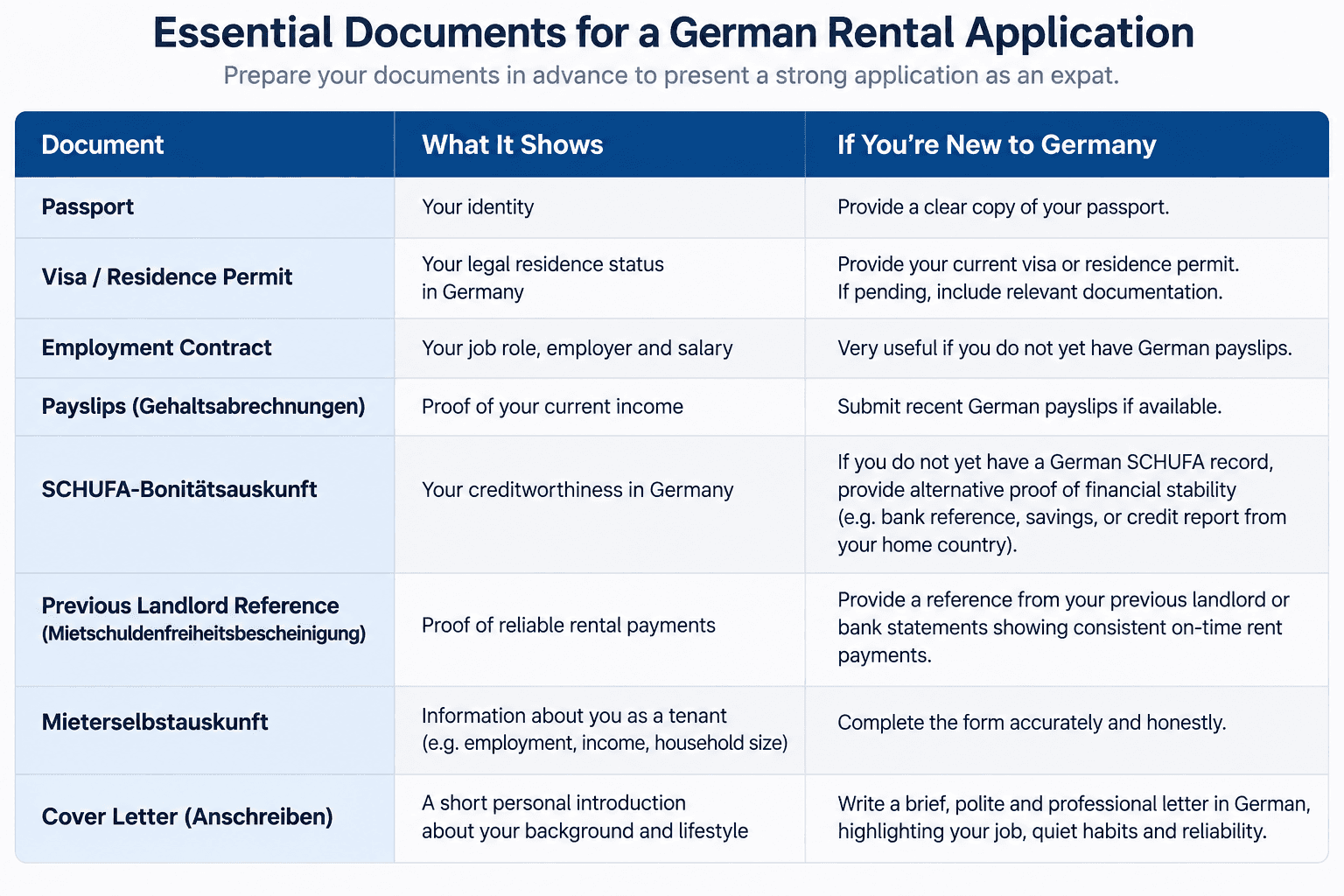
The German government's official guidance confirms that landlords commonly request payslips and proof of identity/residence status, and that an employment contract can be useful when payslips are not yet available.
How to Search for an Apartment in Germany
Don't rely on one website.
Use several channels simultaneously.
ImmoScout24
One of the major online property platforms in Germany.
Use filters carefully and check new listings regularly.
When contacting a landlord, don't send a generic:
"Hello, is the apartment available?"
Instead, introduce yourself briefly and mention the information most relevant to the application.
WG-Gesucht
If you're a student, young professional or comfortable sharing accommodation, WG-Gesucht can be particularly useful for finding rooms and shared apartments.
A WG can also be a practical starting point while you search for a long-term apartment.
Immowelt
Another established property platform worth checking alongside other portals.
Kleinanzeigen
Private listings can appear here as well.
But this is where you need to be particularly careful.
Never assume a listing is genuine simply because it contains attractive photos and a detailed description.
Don't Wait for One Perfect Apartment
A common mistake is spending hours preparing one application while ignoring other listings.
Instead, create a repeatable process.
Your daily apartment-search routine
Morning
Check new listings.
Within the same day
Send applications for suitable properties.
Evening
Check responses and prepare for the next day.
Keep your documents ready in one folder so you aren't rebuilding the application every time.
The official German government guidance also recommends making multiple enquiries because finding suitable accommodation can take time, particularly in major cities.
Write a Better German Apartment Application
Your first message doesn't need to be a long autobiography.
Keep it short.
For example:
Guten Tag,
mein Name ist [Name]. Ich arbeite als [Beruf] bei [Unternehmen] und interessiere mich sehr für die angebotene Wohnung.
Ich bin berufstätig und verfüge über ein regelmäßiges Einkommen. Die erforderlichen Unterlagen kann ich gerne kurzfristig zur Verfügung stellen.
Über einen Besichtigungstermin würde ich mich sehr freuen.
Mit freundlichen Grüßen
[Name]
If you don't speak German confidently, you can use clear professional German rather than trying to sound overly sophisticated.
The objective is simple:
Make it easy for the landlord to understand who you are and whether you can provide the required documents.
Kaltmiete vs. Warmmiete: Don't Compare the Wrong Number
German rental listings commonly distinguish between Kaltmiete and Warmmiete.
Kaltmiete
The basic rent for the apartment, excluding certain operating costs.
Warmmiete
The rent plus applicable advance payments for operating and heating costs.
However, not every household expense is necessarily included.
Depending on the property, you may still need to arrange and pay separately for things such as:
Electricity
Internet
Certain utility costs
Always ask the landlord exactly what is included.
Don't build your monthly budget around the Kaltmiete alone.
How Much Is the Rental Deposit in Germany?
Germany has specific legal rules for residential rental deposits.
Under Section 551 of the German Civil Code (BGB), a cash security deposit generally cannot exceed three times the monthly rent excluding operating-cost advances or lump sums. The tenant is also entitled to pay the deposit in three equal monthly instalments, with the first instalment due when the tenancy begins.
For example, if:
Kaltmiete = €1,000
the maximum cash deposit under the general rule would be:
€3,000
And the law permits payment in three instalments.
This is one reason you should calculate the total move-in cost, not just the advertised monthly rent.
Rental Scams: The Biggest Warning Signs
This deserves special attention if you're searching from outside Germany.
The German consumer protection organisation Verbraucherzentrale published updated guidance in August 2026 warning about fake property listings and specifically advises prospective tenants not to pay in advance for an apartment they have not seen.
Watch for these warning signs.
1. The landlord is supposedly abroad
You receive a story about the owner working overseas and being unable to meet you.
That alone doesn't prove fraud.
But combined with a demand for advance payment, it is a serious warning sign.
2. You're asked to pay before viewing
Be extremely cautious about requests for:
Deposit before viewing
Money for a key
Payment to reserve a viewing
Transfer before signing the contract
Consumer protection guidance specifically identifies advance-payment schemes as a common fake-property tactic.
3. The rent looks unrealistically cheap
A beautiful apartment in an excellent location for far below comparable local rents deserves additional verification.
Check comparable listings and the local rent situation.
4. You're asked to use a strange payment method
Be especially cautious with requests involving:
Western Union
Cryptocurrency
Unusual foreign accounts
Unverified payment platforms
The Verbraucherzentrale specifically warns about advance transfers and unexpected foreign accounts in fake-property scams.
5. Airbnb or another platform is supposedly holding your money
Don't assume that a message mentioning Airbnb, Booking.com or another recognizable platform is legitimate.
Consumer protection authorities have documented scams involving fake payment requests connected to legitimate booking platforms.
Never Send Sensitive Documents Carelessly
A rental application requires personal information.
But that doesn't mean you should send every document to every stranger who contacts you.
Be careful with:
Passport copies
Bank statements
Residence documents
Tax documents
Personal identification numbers
Verify who you're dealing with before sending sensitive information.
The Verbraucherzentrale also warns about fake property advertisements designed to obtain both money and personal data.
A Practical Apartment-Hunting Plan for Expats
If you're arriving in Germany without an established rental history, use this sequence.
Before arriving
Prepare:
Passport
Visa/residence documents
Employment contract
Proof of income
Previous rental reference
Bank reference if useful
Digital application folder
German-language introduction
First weeks
Look for suitable temporary accommodation if necessary.
But confirm whether the accommodation supports registration if you need an address for Anmeldung.
Once you move into a registrable residence
Get your Wohnungsgeberbestätigung and complete your Anmeldung within the applicable deadline.
During your long-term search
Apply across multiple platforms.
Respond promptly.
Keep your documents ready.
Never let urgency push you into paying an unverified landlord.
Final Checklist Before You Pay Anything
Before transferring money for a German rental, ask:
Have I seen the property?
Have I verified who the landlord or agent is?
Have I read the rental contract?
Do I understand Kaltmiete and additional costs?
Do I know what the deposit is for?
Is the payment request consistent with the contract?
Have I verified the bank details?
Do I know whether Anmeldung is possible?
If several answers are unclear, stop and verify the situation before paying.
Final Thoughts
Finding an apartment in Germany as an expat can be frustrating, especially when you're trying to understand SCHUFA, Anmeldung, rental applications and German housing terminology at the same time.
But you don't need to have everything perfect before you start.
The practical approach is to prepare your documents, understand the registration requirements, search across multiple channels and be transparent about what you don't yet have.
If you don't have a German SCHUFA history, explain your situation and provide appropriate alternatives.
If you don't have German payslips yet, your employment contract may help demonstrate your income.
And if a landlord pressures you to transfer money before you've properly verified the property and transaction, slow down.
The German rental market rewards preparation—but it also requires caution.
Prepare your documents. Search consistently. Verify before you pay.
FAQ
Can I rent an apartment in Germany without SCHUFA?
Yes, it can be possible, particularly for newcomers who do not yet have an established German credit history. Landlords may consider alternatives such as an employment contract, proof of income, references or a guarantor. The decision depends on the individual landlord.
How do I get Anmeldung in Germany?
After moving into a residence, you generally register with the responsible local registration authority within two weeks. A Wohnungsgeberbestätigung is normally required for a rental property.
Can I get Anmeldung from a hotel?
Generally, ordinary hotel or holiday accommodation cannot be used as your normal residential registration address. Confirm the registration situation before booking temporary accommodation.
How much is the rental deposit in Germany?
For residential rentals, the cash security deposit is generally limited to three times the monthly rent excluding operating-cost advances or lump sums. The tenant can generally pay the deposit in three equal monthly instalments.
How can I avoid apartment scams in Germany?
Do not pay advance money for a property you have not properly verified. Be particularly cautious about unusually cheap listings, landlords who cannot meet or show the property, requests for advance deposits and unusual payment methods.