

Working in Germany: Net vs. Gross Salary, Tax Classes & Social Deductions
A €75,000 salary in Germany sounds straightforward until you receive your first payslip.
Your employment contract shows your Bruttogehalt — gross salary. But the amount that reaches your bank account is your Nettogehalt — net salary.
Between those two numbers sit income tax, pension contributions, health insurance, unemployment insurance and long-term care insurance.
For international professionals moving to Germany, understanding this difference before accepting a job offer can prevent some unpleasant surprises.
So, how does the German salary system actually work?
Gross vs. Net Salary in Germany
Your gross salary (Brutto) is the amount agreed with your employer before statutory deductions.
Your net salary (Netto) is what remains after applicable taxes and employee contributions have been deducted.
The exact amount depends on several factors, including:
Annual gross income
Tax class
Marital status
Children
Church tax, where applicable
Health insurance arrangement
Pension and other social insurance contributions
Certain tax allowances and deductions
This means two employees earning the same gross salary can have different net salaries.
For example, someone earning €60,000 gross cannot simply divide that amount by 12 and assume €5,000 will arrive in their bank account every month.
Your payslip will show the deductions that turn your Brutto into Netto.
What Gets Deducted From Your German Salary?
For employees covered by Germany's statutory social insurance system, several contributions are normally deducted from payroll.
The major categories are:
1. Pension Insurance — Rentenversicherung
The statutory pension contribution rate is 18.6% in 2026, generally split equally between employer and employee.
That means the standard employee share is 9.3%, subject to the applicable contribution ceiling.
2. Health Insurance — Krankenversicherung
The general statutory health insurance contribution is 14.6%, plus a supplementary contribution set by the health insurer.
For employees, the basic contribution and supplementary contribution are generally shared between employer and employee.
The 2026 average supplementary contribution rate is 2.9%, although the actual rate can vary by insurer.
3. Unemployment Insurance — Arbeitslosenversicherung
The unemployment insurance contribution is 2.6% in 2026, with the standard employee share being 1.3%.
4. Long-Term Care Insurance — Pflegeversicherung
Long-term care insurance helps fund care services when someone becomes dependent on long-term assistance.
The contribution structure is more complicated than a simple 50/50 split because additional rules apply to people without children and reductions can apply for parents with multiple children.
This is why using a generic “Germany deducts exactly X% from every salary” formula can be misleading.
German Tax Classes Explained: Steuerklasse I to VI
One of the first German tax terms international employees encounter is Steuerklasse, or tax class.
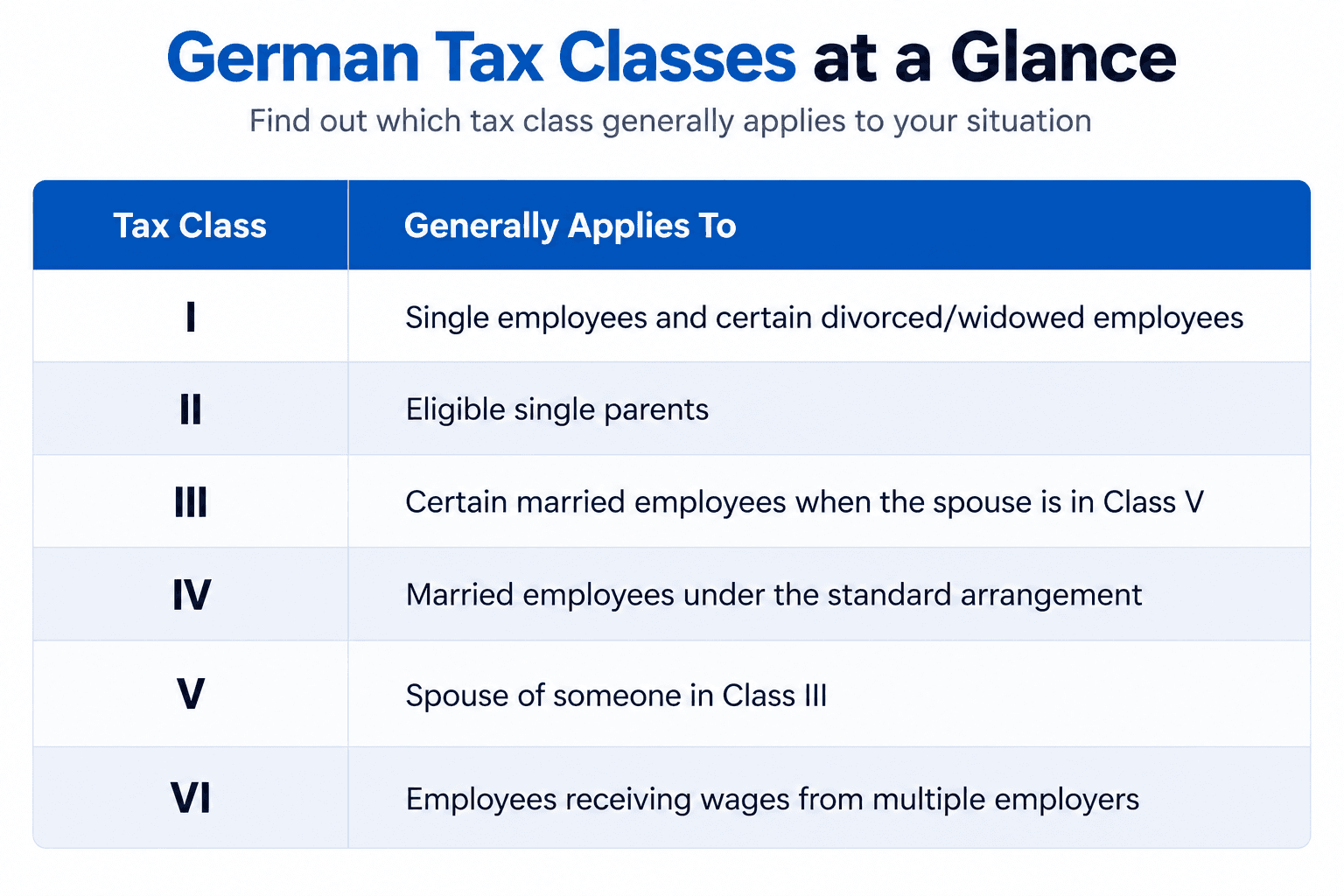
The German Federal Ministry of Finance confirms these classifications under the 2026 income-tax rules.
Does Your Tax Class Change Your Final Annual Tax?
This is an important point that many newcomers misunderstand.
Tax class primarily affects how much income tax is withheld from your regular payslip.
It does not simply mean that choosing a particular class permanently changes the amount of tax a married couple owes as a household.
For married couples, combinations such as IV/IV, III/V and IV/IV with the factor method can be available depending on their circumstances.
For that reason, choosing a tax class should be considered in the context of the couple's overall tax situation rather than simply asking, “Which class gives me the highest monthly salary?”
Public vs. Private Health Insurance in Germany
Health insurance is another major consideration when comparing German job offers.
Employees whose income is below the statutory annual income threshold of €77,400 in 2026 are generally subject to compulsory membership in the statutory health insurance system, subject to the applicable rules.
Employees whose income exceeds the threshold may have the option to remain voluntarily insured in the statutory system or choose private health insurance, provided the relevant conditions are met.
This decision deserves more attention than simply comparing monthly premiums.
When considering public versus private insurance, look at factors such as:
Your age
Family situation
Expected future income
Coverage requirements
Long-term affordability
Whether dependants need coverage
For an international professional planning to stay in Germany for several years, the cheapest option today is not necessarily the most suitable option long term.
Why Your €75,000 Salary Doesn't Mean €6,250 in Your Bank Account
Suppose a company offers you:
€75,000 gross per year
Your monthly gross salary is:
€6,250
But €6,250 is not your take-home pay.
Income tax and employee social-security contributions are deducted before your salary reaches your bank account.
And the exact net figure cannot be accurately calculated from gross salary alone.
Your tax class, health insurance, personal circumstances and other payroll factors all matter.
That's why a German Brutto-Netto salary calculator can be useful when evaluating an offer — but treat the result as an estimate rather than a guaranteed payslip amount.
Don't Ignore Your German Tax Return
Your monthly payslip is not necessarily the end of the story.
Many employees can claim eligible work-related expenses and other deductions through their annual Steuererklärung, or German tax return.
Depending on your circumstances, potentially relevant expenses can include certain:
Work-related costs
Commuting expenses
Professional training
Job-related relocation expenses
Work equipment
Other deductible professional expenses
The rules are specific, so keep receipts and documentation rather than assuming every expense automatically qualifies.
For someone moving to Germany for employment, keeping records from the beginning can make the tax-return process much easier.
What International Workers Should Check Before Accepting a German Job
Don't compare German job offers using gross salary alone.
Before signing, check:
1. Gross annual salary
What exactly is included in the quoted package?
2. Expected monthly net salary
Use your personal circumstances when estimating this.
3. Health insurance
Understand whether you will be in statutory or private insurance and what your employee costs are.
4. Bonus and benefits
Find out whether bonuses, relocation support, transportation benefits or other payments are included separately.
5. Working location
Berlin, Munich, Frankfurt and other cities can have very different living costs.
6. Tax situation
Your tax class and personal circumstances can affect monthly withholding.
7. Annual tax return
Understand which work-related expenses you may potentially claim.
If you're also considering Germany for education before entering the workforce, you can read our Study in Germany Guide for International Students and Germany University Admission Requirements for Students.
And once you're preparing for employment, our guide on AI Interview Process: How It Works and How to Prepare can help you prepare for modern recruitment processes.
Final Takeaway
Understanding Germany salary net vs gross is essential before accepting a job offer.
Your gross salary is only the starting point. Your actual take-home pay depends on income tax, tax class, health insurance and several social-security contributions.
The good news is that the system becomes much easier to understand once you separate the pieces:
Brutto → Tax + Social Contributions → Netto
If you're relocating to Germany, don't judge an offer by the headline salary alone. Calculate your expected take-home pay, understand your insurance position, consider your tax circumstances and compare the salary against the actual cost of living in your destination city.
That gives you a much more realistic picture of what your German job offer is really worth.