
18-Month Post-Study Work Visa in Germany: Complete Job Search Guide
Finishing your degree in Germany does not mean you have to pack your bags and leave.
If you are an international student from outside the EU, Germany gives you a valuable opportunity to stay after graduation and search for a qualified job. Under Section 20 of the German Residence Act (AufenthG), eligible graduates can receive a residence permit for up to 18 months to find suitable employment.
This period can be an important bridge between university and a long-term career in Germany. You can also work during the job-search period, giving you a way to support yourself while applying for positions related to your qualification.
Here is what you need to know before making the transition.
Key Takeaways
International graduates can generally obtain a residence permit for up to 18 months to look for qualified employment in Germany.
During this period, you can take up any type of employment, not just a job related to your degree.
You need to show that you have successfully completed your studies, health insurance and secured livelihood.
The 18-month residence permit is not renewable beyond the statutory period.
Once you receive a suitable job offer, you may be able to switch to a Skilled Worker residence permit or EU Blue Card.
Graduates of German universities can have a particularly strong pathway toward permanent residence once they move into qualified employment.
What Is the 18-Month Job Search Visa in Germany?
The so-called 18-month job search visa Germany is actually a residence permit for graduates who have successfully completed higher education in Germany.
The legal basis is Section 20(1) No. 1 AufenthG. It allows eligible graduates to remain in Germany for up to 18 months while searching for qualified employment.
This is different from Germany's Opportunity Card (Chancenkarte). The graduate route is specifically designed for people who have already completed their studies in Germany.
The biggest advantage is simple: you get time to find the right career opportunity instead of having to accept the first job immediately.
Related Article
Who Can Get the 18-Month Post-Study Work Permit?
You generally need to meet three core conditions:
You successfully completed your studies in Germany.
You have health insurance coverage.
You can demonstrate that your livelihood is secured.
The residence permit is issued by the competent local Ausländerbehörde (Foreigners Authority), and the exact documents required can vary by local authority.
So, do not wait until the last few days of your current student residence permit. Start checking your local authority's requirements before your student permit expires.
If you are still planning your studies, you can also read our [Study in Germany Guide for International Students] and [Germany University Admission Requirements for Students] for the earlier stages of the journey.
Can You Work During the 18-Month Job Search Period?
Yes — and this is one of the most useful parts of the graduate residence permit.
While looking for qualified employment, you are allowed to take up any form of employment. That means your temporary job does not necessarily have to match your degree.
For example, a graduate searching for an IT position could temporarily work in retail, hospitality, logistics or another legitimate job while continuing to apply for software or technology roles.
This is significantly different from the restrictions that apply during your studies.
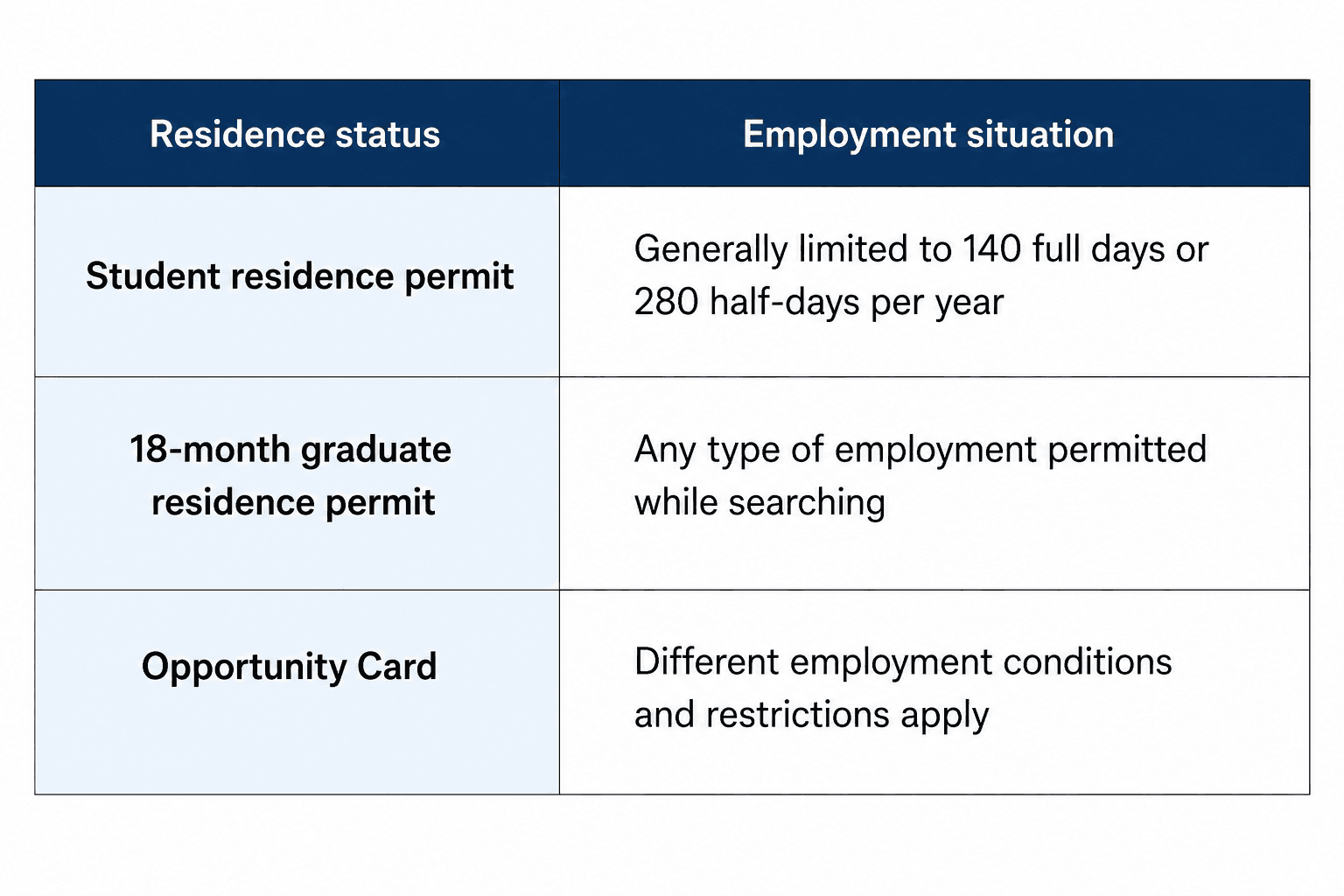
International students can currently work up to 140 full days or 280 half-days per year during their studies, subject to the applicable rules.
When Should You Apply?
The safest approach is to start the transition before your current student residence permit expires.
After completing your degree, contact your local Ausländerbehörde and ask for the application process for a residence permit under Section 20.
Your university's examination office can also be useful. Once your academic requirements have been completed, ask what official proof of successful completion they can provide. Depending on your university and authority, this may help you document your graduation while the final diploma is still being processed.
Do not assume that your graduation ceremony or the date printed on your physical diploma is the only relevant date. What matters for the immigration process is official evidence that your studies have been successfully completed.
What Documents Will You Need?
The exact checklist depends on your Ausländerbehörde, but you should be prepared to provide documents such as:
Valid passport
Current residence permit
Proof of successful completion of your German degree
Proof of health insurance
Proof that your livelihood is secured
Biometric photograph, where required
Completed application forms
Registration/address documents, where required
Important: Do not automatically assume that you need a new blocked account. The law requires you to demonstrate that your livelihood is secured, while the acceptable form of proof can depend on your circumstances and local authority.
How to Use the 18 Months Effectively
Eighteen months sounds like a long time. It is not.
The biggest mistake graduates make is treating the first few months like an extended holiday and starting their job search later.
A better strategy is to divide the period into three stages.
Months 1–3: Build Your Job Search Foundation
Update your Lebenslauf (CV), LinkedIn profile and application documents.
Identify the job titles that match your qualification and research employers in your field. If you are applying for German companies, learn how German-style applications work and check whether German language skills are commonly requested.
If you are changing careers, build evidence of your new skills through projects, certifications or practical experience.
Months 4–9: Increase Application Quality
Do not simply send hundreds of generic applications.
Target positions where your education, technical skills, internships and experience genuinely fit the requirements.
Track:
Companies you applied to
Application dates
Interview stages
Rejection reasons
Follow-up dates
Skills employers repeatedly request
If you are moving from a non-technical background into technology, our guide on [How to Switch From Non-Tech to Tech Roles] can help you structure that transition.
You should also prepare for online assessments and AI-supported hiring processes. See our guide on [AI Interview Process: How It Works and How to Prepare].
Months 10–18: Prioritize Conversion
By this point, your goal should not simply be "find any job."
Your goal is to secure qualified employment that can support your next residence permit.
If your job offer meets the requirements for a Skilled Worker permit or EU Blue Card, begin the conversion process with the Ausländerbehörde rather than waiting until your 18 months are nearly finished.
Can You Convert the 18-Month Permit Into an EU Blue Card?
Potentially, yes.
Once you have a qualifying job offer, you may be able to switch from the graduate job-search residence permit to another employment residence title, including an EU Blue Card or residence permit for skilled workers.
For 2026, the general EU Blue Card salary threshold is €50,700 gross per year. A lower threshold of €45,934.20 applies to eligible shortage occupations and certain other qualifying categories, subject to the applicable requirements.
The job also needs to meet the Blue Card's qualification and employment requirements.
If your salary or position does not qualify for a Blue Card, a Skilled Worker residence permit may still be an option.
What About Permanent Residence?
This is where planning your first job becomes important.
Germany has special rules for graduates of German universities. According to the official Make it in Germany guidance, graduates who move into qualified employment can potentially qualify for a settlement permit after two years of employment under the relevant skilled-worker residence provisions, assuming the other requirements are satisfied.
The EU Blue Card has a separate settlement pathway: generally 27 months of qualifying employment with A1 German, reduced to 21 months with B1 German, subject to the applicable conditions.
So the 18-month period should not be viewed as the end of your German journey. It can be the transition point from student → job seeker → skilled professional → permanent resident.
Can the 18 Months Be Extended?
Generally, no.
Section 20 provides the job-search residence permit for up to 18 months, and the law expressly excludes an extension beyond that period.
That makes planning important. If you have not secured a qualifying job by the end of the period, you need to determine whether you qualify for another residence purpose, such as another study programme or another employment-based residence title.
Do not wait until the final weeks to investigate your options.
Final Thoughts
Germany's 18-month post-study work opportunity is one of the strongest advantages available to international graduates who want to build a career in the country.
You have time to search, you can work while searching, and a successful job offer can open the door to a Skilled Worker permit, EU Blue Card and eventually permanent residence.
But the 18 months should be treated as a career runway, not a waiting period.
Start preparing before graduation, understand your residence options, apply consistently and focus on jobs that can move you toward long-term employment in Germany.
Most importantly, immigration rules and salary thresholds can change. Before submitting an application, always confirm the current requirements with your local Ausländerbehörde and official German government sources.