

How to Run Effective 1-on-1 Meetings With Your Manager
A weekly or biweekly 1-on-1 with your manager can be one of the most useful meetings on your calendar—or one of the biggest wastes of time.
If every meeting follows the same pattern—“What are you working on?”, a quick project update, a few questions, and “See you next week”—you may be missing its biggest value.
A good 1-on-1 is not simply a status meeting.
It is a space to remove roadblocks, align priorities, get useful feedback, discuss career growth, and build trust with your manager.
The biggest change is simple: stop treating the meeting as something your manager has to run for you.
Instead, take ownership of the conversation.
Why Your 1-on-1 Should Be More Than a Status Update
Routine project updates can often be handled through email, Slack, project-management tools, or shared dashboards.
Your 1-on-1 gives you something those tools cannot easily provide: context and conversation.
This is where you can discuss why a project is stuck, ask for judgment on a difficult decision, understand changing priorities, or talk about the skills you need to develop for your next career step.
Google's guidance for helpful content emphasizes creating information that genuinely helps people accomplish their goals rather than producing content primarily to attract search traffic. Google for Developers
The same principle applies here: make the meeting useful enough that both you and your manager want to keep it.
The 4-Part 1-on-1 Meeting Agenda
A simple 1-on-1 meeting agenda template for employees can keep the conversation focused without making it feel scripted.
For a 30-minute meeting, use these four sections.
1. Roadblocks and Decisions — 10 Minutes
Do not spend ten minutes listing everything you completed.
Bring the problems where you actually need your manager's help.
Instead of:
“The project is delayed because Security hasn't approved the infrastructure.”
Try:
“Security approval is blocking the Friday deadline. I see two options: we can move the launch by two days or use an isolated staging environment. I recommend the second option. Can you help me get approval?”
This approach shows ownership.
You are not simply reporting a problem. You are bringing context, options, and a recommendation.
More Blogs
2. Priorities and Alignment — 8 Minutes
Your manager may have information you do not have about changing company priorities, leadership expectations, customers, or upcoming deadlines.
Use the 1-on-1 to understand what matters most.
Useful questions to ask your manager in a 1-on-1 include:
“What is the most important outcome for our team this month?”
“Have any priorities changed since our last meeting?”
“Is there anything I should stop doing or deprioritize?”
“Where would you like me to take more ownership?”
One particularly useful question is:
“What is creating the most pressure for you right now, and is there anything I can take ownership of?”
That turns the conversation from task reporting into business contribution.
3. Feedback and Cross-Team Insights — 5 Minutes
A strong employee does not only talk about their own tasks.
Bring observations from customers, other departments, or cross-functional projects.
For example:
“Marketing is bringing the enterprise campaign forward by two weeks. I've spoken with their team, and I think we should prepare the infrastructure earlier to avoid a last-minute capacity issue.”
This demonstrates that you are thinking beyond your individual task list.
It also creates opportunities for your manager to give you feedback on how you communicate, prioritize, and make decisions.
Instead of asking:
“How am I doing?”
Ask:
“What is one behavior I could change to operate more effectively at the next level?”
That question produces much more actionable feedback.
4. Career Growth and Next Steps — 7 Minutes
Do not wait until an annual performance review to talk about your career.
If you want to understand how to talk about career growth in a 1-on-1, start with expectations rather than immediately asking for a promotion.
For example:
“I'm interested in moving toward a senior role. What skills or behaviors would you need to see consistently from me before you would consider me ready?”
Then turn the answer into measurable goals.
You can ask:
“What is my biggest development gap right now?”
“Which projects would give me the right experience?”
“What would strong performance at the next level look like?”
“Can we review my progress against these goals next month?”
This creates a career-development conversation instead of a vague promotion request.
Passive 1-on-1 vs. Strategic 1-on-1
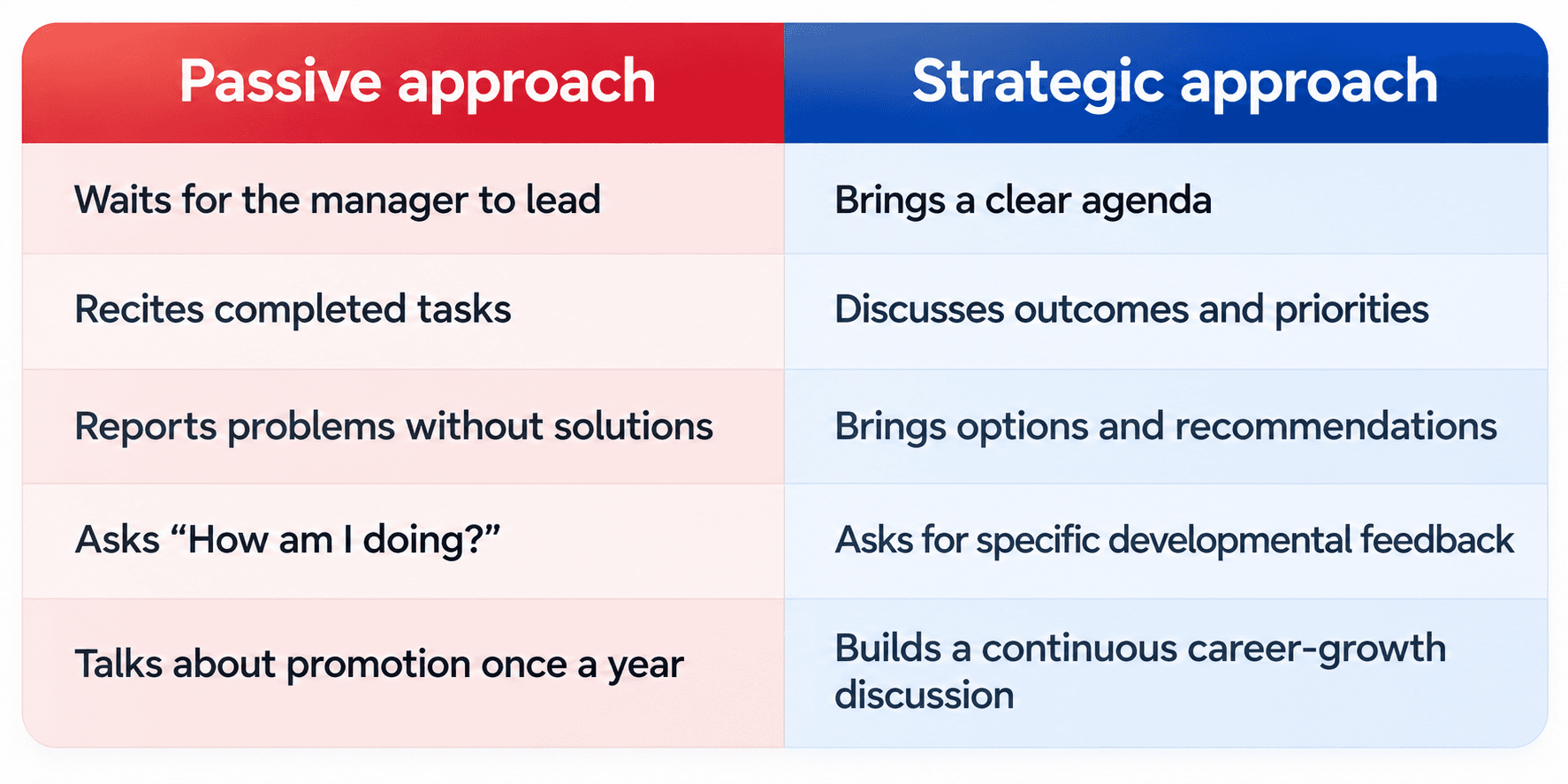
The goal isn't to make every meeting formal.
The goal is to make the conversation useful.
Use a Shared 1-on-1 Document
One of the easiest ways to improve recurring meetings is to maintain a shared document in Notion, Google Docs, or another workspace.
Keep four simple sections:
Current priorities
What matters most right now?
Roadblocks
Where do you need help, decisions, or resources?
Discussion points
What questions or issues need conversation?
Action items
Who will do what, and by when?
Add topics before the meeting instead of trying to remember everything five minutes before it starts.
After the meeting, update the action items.
This creates continuity from one meeting to the next and prevents important topics from disappearing.
The Monthly Career Zoom-Out
Not every 1-on-1 needs to be about career progression.
But once every few meetings, deliberately create space for it.
You could tell your manager:
“For our next 1-on-1, I'd like to spend some time reviewing my development goals, recent impact, and what I should focus on for the next quarter.”
Then review:
What have you accomplished?
What business impact did it create?
What new responsibility have you taken?
Which skill are you developing?
What evidence shows your progress?
What should you focus on next?
Keep a simple career impact log throughout the quarter. Record meaningful outcomes, positive feedback, successful projects, problems you solved, and additional responsibilities you took on.
That gives you concrete evidence when performance reviews or career discussions arrive.
How to Manage Up in a 1-on-1
Managing up does not mean telling your manager how to do their job.
It means understanding how they work and making collaboration easier.
If your manager frequently asks for status updates, improve visibility before the meeting.
Send a short summary such as:
Top priorities: 3 items
Current blocker: 1 item
Decision needed: 1 item
Next milestone: Friday
If your manager tends to micromanage, proactive communication can reduce uncertainty.
If they prefer concise conversations, bring the decision first and supporting details second.
If they prefer detailed context, prepare the background before the meeting.
This is the practical side of a managing up 1-on-1 framework: understand what your manager needs to make good decisions, then provide that information clearly.
What If Your Manager Keeps Cancelling 1-on-1s?
Do not immediately assume they do not value you.
First, make the meeting more useful.
Bring a short agenda, focus on decisions and roadblocks, and connect discussions to team priorities.
If cancellations continue, ask directly:
“I want to make sure our 1-on-1s are useful for both of us. Is there a format or frequency that would work better for you?”
That turns a scheduling problem into a constructive conversation.
Frequently Asked Questions
What should I discuss in a 1-on-1 with my manager?
Focus on priorities, roadblocks, decisions, feedback, team issues, and career development. Avoid spending the entire meeting reciting routine task updates.
How do I ask my manager about career growth?
Ask what skills, behaviors, and results are expected at the next level. Then agree on specific development goals and review your progress regularly.
How often should I discuss career growth?
Career growth should be an ongoing conversation rather than something reserved for an annual review. You can discuss progress regularly while using longer quarterly conversations for deeper planning.
What should I do if I have nothing to discuss?
Review your priorities, recent challenges, feedback, upcoming decisions, and development goals. A shared agenda also prevents the meeting from becoming dependent on last-minute ideas.
Who should own the 1-on-1 agenda?
Both people contribute, but employees should take meaningful ownership of the topics they want to discuss. A shared agenda works best because it gives both sides visibility before the meeting.
Final Takeaway
The best 1-on-1 meetings are not about talking more.
They are about talking about the right things.
Use your time with your manager to remove roadblocks, understand priorities, request specific feedback, share useful observations, and build a clear path toward your next career goal.
If you consistently arrive with context, thoughtful questions, and possible solutions, your 1-on-1 can become much more than a recurring calendar event.
It can become one of the most valuable conversations in your career.