
How to Get Recruiters to Message You on LinkedIn: The Inbound Profile SEO Playbook
Sending dozens of applications every week can feel like a second full-time job. You tailor your resume, write cover letters, click Apply—and then hear nothing.
There’s another approach: make your LinkedIn profile easier for the right recruiters to find.
That doesn’t mean stuffing your profile with keywords or trying to “hack” LinkedIn. It means clearly showing what you do, what you’re good at, where you fit, and what kind of opportunity you want.
LinkedIn Recruiter lets recruiters search and filter candidates by factors including job titles, locations, skills, seniority, companies and other profile information. Skills can come from both your explicitly listed skills and relevant text in sections such as your headline, title, summary/About and experience.
Here’s how to turn your profile into a stronger inbound job search strategy.
Why Your LinkedIn Profile Matters More Than You Think
Imagine a recruiter searching for:
“Performance Marketing Manager with B2B SaaS and paid acquisition experience.”
If your profile simply says “Digital Marketer | Growth Enthusiast”, you may be harder to discover for that specific search.
Now compare it with:
Performance Marketing Manager | B2B SaaS Growth | Paid Acquisition & SEO | $5M+ Pipeline
The second version immediately communicates your target role, specialization and business impact.
That is the basic idea behind LinkedIn profile SEO for job seekers: use the language recruiters actually search for while keeping your profile natural and credible.
And remember, there is no guaranteed “Page 1” position or magic keyword formula. Recruiter search uses multiple filters and signals, so your goal should be relevance and clarity, not gaming an algorithm.
If job searching is already affecting your energy, it may also help to recognize the difference between exhaustion and laziness. 7 Signs You're Burned Out – Not Lazy
The 4 Elements of LinkedIn Profile SEO
Think of your profile as a search-friendly professional landing page.
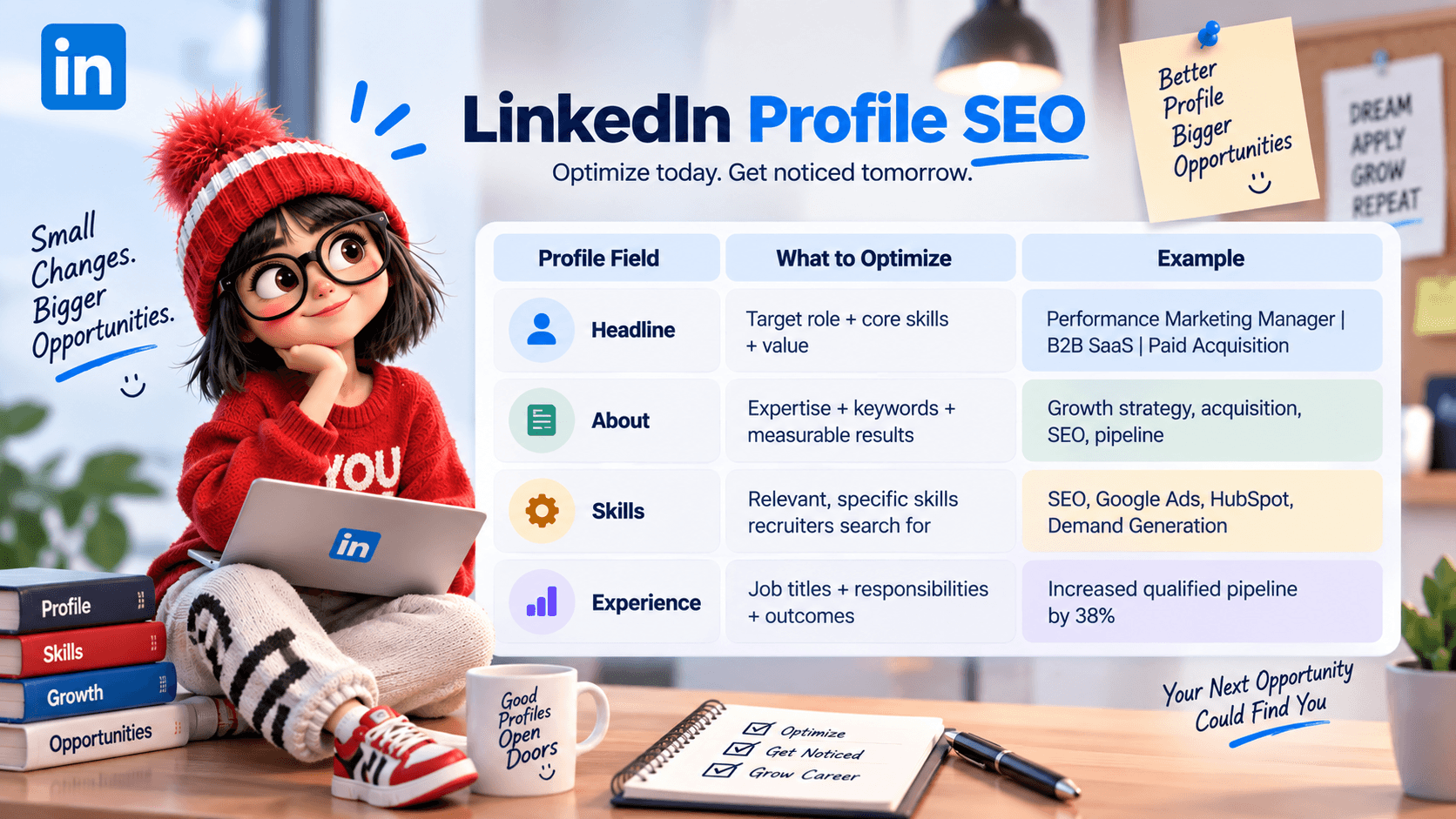
LinkedIn Recruiter specifically supports searches around job titles, locations, skills and other candidate attributes. Its skills search can also identify evidence of skills from profile text—not only from the Skills section.
1. Write a Searchable Headline
Your headline has two jobs: help people understand you and help relevant searches find you.
A useful formula is:
[Target Job Title] | [Core Specialization] | [Business Value]
For example:
Weak:
“Experienced marketer passionate about brand growth.”
Stronger:
“Performance Marketing Manager | B2B SaaS Growth | Paid Acquisition & SEO | $5M+ Pipeline”
The second version gives recruiters much more context without sounding like a keyword list.
2. Make the First Lines of Your About Section Count
Your About section shouldn't begin with:
“I am a passionate professional who loves challenges…”
Recruiters don't need a biography. They need to understand your professional value quickly.
Start with a concise positioning statement:
Example:
“Performance marketing professional with 7+ years of experience helping B2B SaaS companies turn paid acquisition and SEO into measurable pipeline growth.”
Then add:
Your core areas of expertise
Tools or platforms you genuinely use
Industries you understand
Two or three measurable achievements
The type of opportunity you're targeting
Think proof, not adjectives.
Instead of saying “results-driven,” explain what result you produced.
More from this category
LinkedIn About Section: How to Write Yours + Examples
How to Message Recruiters on LinkedIn and Get Responses
3. Choose Skills Based on Recruiter Searches
Your Skills section should reflect the work you actually want to be hired for.
For example, a B2B SaaS marketer might prioritize:
Performance Marketing
Paid Search
SEO
Demand Generation
Google Ads
HubSpot
Lead Generation
Marketing Analytics
Don't add 50 unrelated skills simply because they sound impressive.
Recruiter searches can use explicit skills from your profile as well as skill evidence found in relevant profile text. That makes consistency important: your headline, About section, experience and Skills section should tell the same professional story.
4. Rewrite Experience Around Results
Your Experience section is where keywords become credible.
Compare:
Weak:
“Responsible for managing digital marketing campaigns.”
Better:
“Managed paid acquisition campaigns across Google and LinkedIn, increasing qualified B2B leads by 32%.”
The second bullet contains:
Skill + context + action + measurable outcome.
Use the terminology that accurately describes your work, but don't copy a job description word-for-word.
Don't Ignore Location and Job Preferences
Location can matter significantly in recruiter searches. LinkedIn Recruiter allows recruiters to search by country, metro area and city, and can also account for candidates who are open to relocating.
So make sure your profile reflects your actual situation.
If you're targeting remote roles, don't rely only on a headline saying “Open to Remote.” Use LinkedIn's job preferences appropriately as well.
Should You Turn On “Open to Work”?
If you're actively looking, yes—it can be useful.
LinkedIn lets you choose between sharing your status with all LinkedIn members or Recruiters only. The Recruiters-only option is designed to privately signal your career interests to people using LinkedIn Recruiter, although LinkedIn says it cannot guarantee complete privacy from recruiters connected to your current company.
You can specify things such as:
Target job titles
Preferred locations
Workplace type
Employment type
Start date
LinkedIn Recruiter can then surface candidates who have privately indicated that they're open to work.
The Inbound Profile Checklist
Before expecting more recruiter messages, ask yourself:
Can a recruiter understand these five things in 10 seconds?
What role do I do?
What am I particularly good at?
Which industry or domain do I know?
What results have I produced?
What opportunity am I looking for?
If the answer is unclear, your profile needs work.
And don't forget that your profile should match your communication skills. Action Plan to Improve Communication Skills
The Bottom Line
Learning how to get recruiters to message you on LinkedIn isn't about discovering one secret algorithm trick.
It's about becoming easier to find, understand and trust.
Use the job titles recruiters search for. Mention your genuine core skills. Make your experience measurable. Keep your location and job preferences accurate. And if you're actively searching, consider using Open to Work → Recruiters only when privacy matters.
You may still need to apply directly—but a well-optimized LinkedIn profile can create another path: instead of always chasing opportunities, you give relevant opportunities a better chance of finding you.