

How to Change Careers Without Taking a Pay Cut: The Transferable Skills Matrix
Changing careers doesn't necessarily mean starting over.
If you've spent 8–15 years building expertise, managing people, handling clients, solving business problems, or improving processes, you already have something valuable: professional leverage.
The challenge is knowing how to transfer that value into a new role or industry without accepting an entry-level salary.
The key is to stop presenting yourself as someone who is new to the field and start showing employers what you already know how to deliver.
Why Career Changers Take Pay Cuts
One of the biggest mistakes professionals make during a career change is positioning themselves as beginners.
You might be new to the industry, but you're probably not new to work.
Employers don't only pay for technical knowledge. They also pay for judgment, communication, leadership, problem-solving, stakeholder management, and the ability to deliver results.
For example, an operations manager moving into product management may not know every product-management framework. But they may already know how to:
Manage cross-functional teams
Identify operational problems
Analyze data
Prioritize competing demands
Communicate with senior stakeholders
Deliver projects under pressure
Those capabilities have economic value.
The goal of a successful career change is to carry that value with you.
The Transferable Skills Matrix
Instead of listing everything you've done on your resume, map your experience to the value your target role needs.
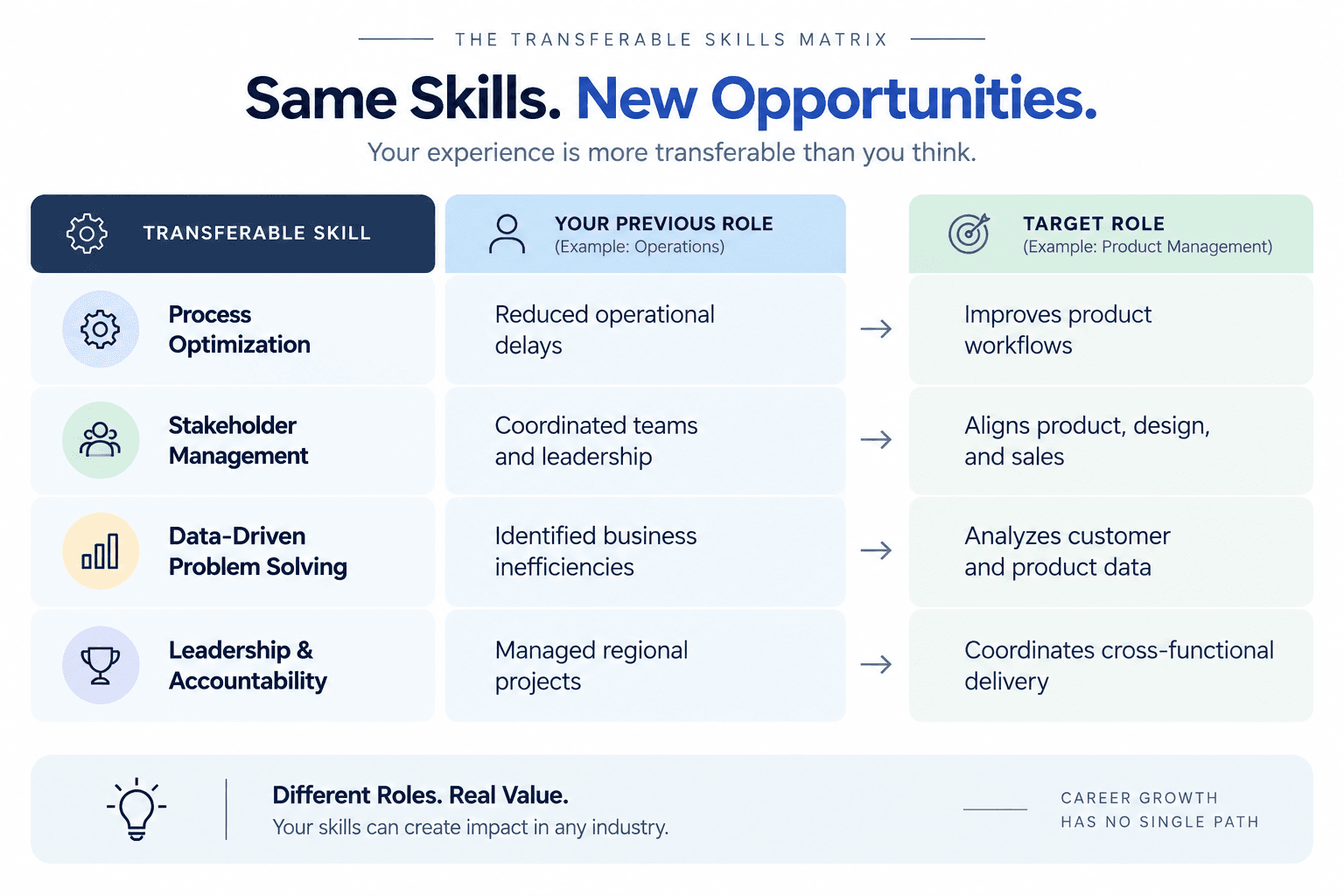
This is the transferable skills matrix in practice.
You're not claiming that your previous job was identical to your target job.
You're showing that the business problems you solved are transferable.
Use an Adjacent Career Pivot
A direct career jump can be difficult.
For example, moving from teacher → software engineer requires rebuilding a significant amount of technical expertise.
An adjacent pivot is usually easier.
Consider this path:
Teacher → Curriculum Specialist → Product Manager
The first move changes the industry environment while keeping much of the existing expertise.
The second move changes the function after you've gained relevant industry experience.
This two-step approach can make a career transition more credible — and potentially help you protect your compensation.
How to Position Yourself at Senior Level
Your resume and interviews should answer one question:
"Why should we pay this person at their current level despite their career change?"
Don't lead with what you lack.
Instead of:
"I'm transitioning into product management and don't have direct experience."
Try:
"I've spent the last eight years leading cross-functional initiatives, solving customer problems, and improving operational performance. I'm now applying that experience to product development."
Same career history. Completely different positioning.
Your outsider perspective can actually become an advantage when it gives you a deeper understanding of customers, operations, or an industry problem.
Can You Really Change Careers Without a Pay Cut?
Yes — but it's not guaranteed.
Your chances are strongest when your new role is adjacent to your existing experience, your transferable skills are easy to demonstrate, and you target positions where your previous seniority still has value.
Don't chase a new job title.
Chase a new application of your existing value.
That's the difference between starting over and strategically changing careers.
If you're moving from a non-technical background into digital roles, our guide on How to Switch From Non-Tech to Tech Roles can help you identify realistic transition paths.
For stronger interview positioning, see our Action Plan to Improve Communication Skills and What to Say When You Don't Know an Interview Answer.
Quick Takeaway
Don't reset your career. Repackage your experience.
Your industry can change. Your job title can change. Your responsibilities can change.
But the value you've built over years of professional experience doesn't have to disappear with them.