

How to Change Careers in Your 30s or 40s Without Taking a Pay Cut
Changing careers at 25 is one thing. Changing careers at 35, 40, or 45 is completely different.
By that point, you may have a mortgage, family responsibilities, financial commitments, and a lifestyle built around your current income. The idea of starting again at the bottom can make an exciting career opportunity feel financially impossible.
But here's the important part:
A career change does not necessarily mean starting over.
If you've spent 10 or 15 years building valuable professional skills, you don't need to throw that experience away. The smarter approach is to identify what you already do well and find a new environment where those skills have value.
This is where the idea of Domain & Skills Arbitrage becomes useful.
Why Changing Careers in Your 30s or 40s Feels So Difficult
Early-career professionals can experiment more easily. They typically have fewer financial obligations and more time to recover from a wrong decision.
Mid-career professionals have more at stake.
You may be thinking:
"Will employers consider me too experienced?"
"Do I need to start at an entry-level salary?"
"Will my previous experience become irrelevant?"
"What if I leave my current job and the new career doesn't work?"
"Am I too old to enter a completely different industry?"
These concerns are understandable.
The mistake is assuming that a career change automatically means becoming a junior employee again.
Your previous experience still has value.
You've probably learned how to manage projects, communicate with stakeholders, solve problems, negotiate, lead teams, manage budgets, handle pressure, and make decisions.
Those skills don't disappear simply because you change industries.
The Domain & Skills Arbitrage Strategy
One of the smartest ways to make a mid-career change without a pay cut is to avoid changing everything at once.
Think about your career using two dimensions:
Function: What you know how to do
Domain: Where you apply that expertise
For example, someone might be an experienced project manager in healthcare.
They could move into:
Same domain + different function
Healthcare Operations → Healthcare Product Management
Or:
Same function + different domain
Automotive Project Management → Renewable Energy Project Management
In both cases, the professional isn't starting from zero.
They're transferring existing capabilities into a new context.
Career Transition Matrix
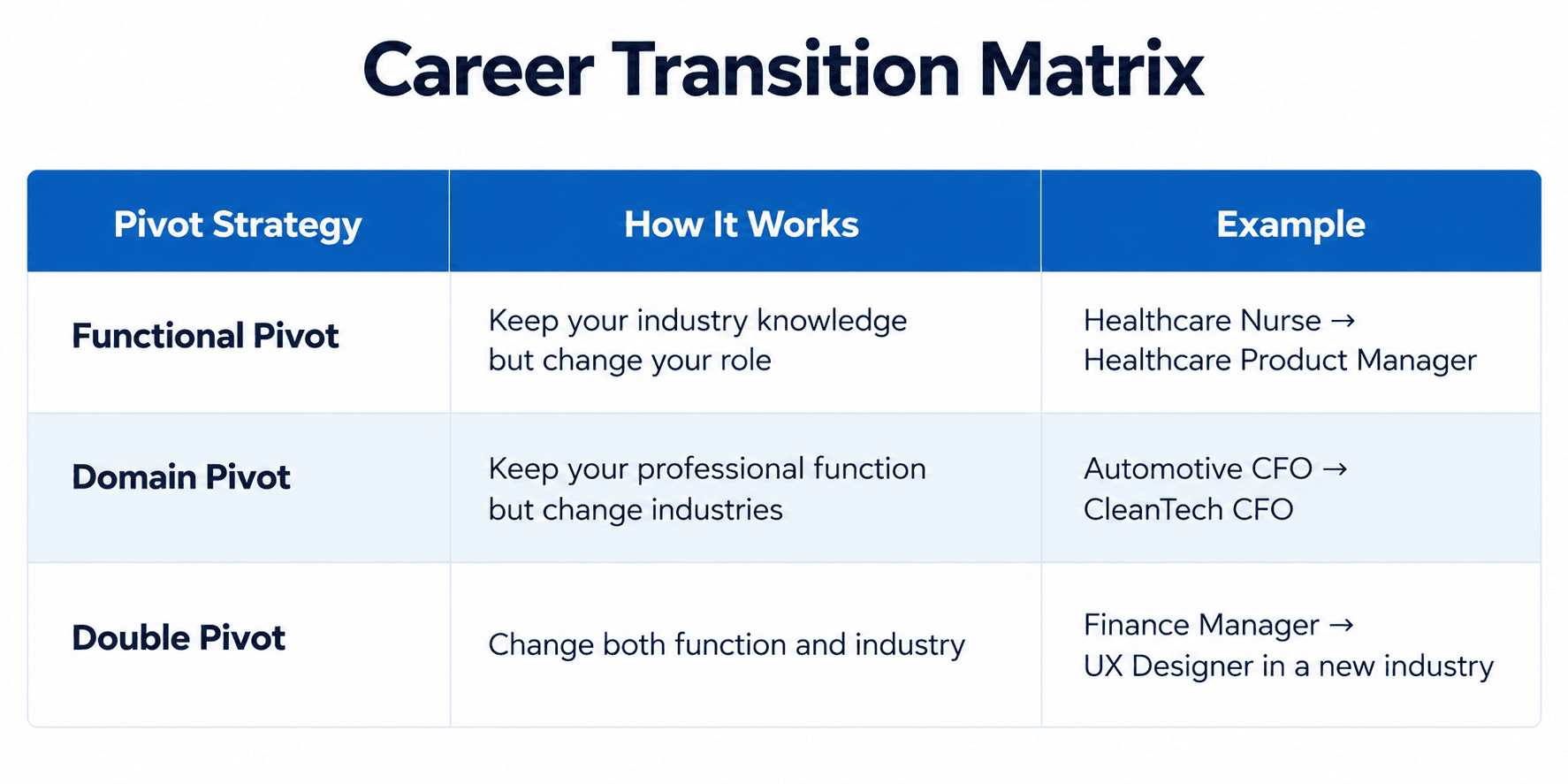
The third option isn't impossible, but it usually requires more significant retraining and may make it harder to immediately command the same compensation.
That's why one-axis transitions are often easier to position than changing everything simultaneously.
Your Transferable Skills Are Your Career Currency
Before applying for a completely different role, make a list of what you've actually become good at.
Don't focus only on your job title.
For example, a senior sales professional may have developed:
Enterprise negotiation
Client relationship management
Pipeline management
Presentation skills
Revenue forecasting
Stakeholder management
Team leadership
Those capabilities could be valuable in technology, consulting, professional services, healthcare, SaaS, or other industries.
Similarly, an operations manager may have experience in:
Process improvement
Vendor management
Budget control
Team leadership
Performance measurement
Cross-functional coordination
The question isn't:
"What new career should I start?"
A better question is:
"Where else can my existing capabilities create significant value?"
Build a Bridge Narrative for Your Career Change
One of the biggest mistakes career changers make is apologizing for their previous career.
Your interview shouldn't sound like this:
"I spent 12 years in commercial real estate, but I didn't enjoy it anymore. I completed a three-month digital marketing course and now I'm looking for an entry-level marketing job."
That positioning makes your previous experience sound irrelevant.
Instead, build a bridge narrative.
For example:
"For the past 12 years, I've managed complex commercial negotiations involving developers, investors, and multiple stakeholders. That experience taught me how enterprise buyers evaluate risk, value, and long-term partnerships. I'm now applying that understanding to B2B technology marketing, where understanding complex buying decisions is equally important."
Notice the difference?
You're not saying:
"I'm starting over."
You're saying:
"I'm applying what I've already learned to a new problem."
That is a much stronger career-change story.
Test the New Career Before You Quit
A career transition becomes much less risky when you test your assumptions first.
You don't necessarily need to resign tomorrow and enroll in a two-year program.
Instead, consider building evidence while keeping your current income.
You could:
Take on a small consulting project
Work with a startup, nonprofit, or small business to gain experience in your target function.
Build a portfolio project
If you're moving into marketing, design, analytics, technology, or another portfolio-driven field, create work that demonstrates your ability.
Earn a targeted credential
A relevant certification can help close a specific skills gap—but don't collect certificates without building practical evidence.
Talk to people already doing the job
Conduct informational interviews with professionals in your target field. Ask what skills actually matter and which qualifications employers value.
Try a small internal transition
If your company has opportunities in another department, an internal move can sometimes be a lower-risk way to change functions.
The goal is simple:
Get evidence before making an expensive decision.
Don't Let Your Current Job Title Define You
Your job title describes what your employer calls you.
It doesn't necessarily describe everything you're capable of doing.
A person with the title "Operations Manager" may already have experience in strategy, analytics, project management, vendor negotiations, and people leadership.
A "Sales Director" may have strong expertise in business development, customer research, commercial strategy, and leadership.
Your career change becomes easier when you translate your experience into skills, outcomes, and business value rather than relying only on your old title.
What If You Actually Need to Start at a Lower Level?
Sometimes a pay cut is unavoidable.
If you're moving into a highly specialized profession where you have little transferable experience, employers may expect you to prove yourself before offering senior-level compensation.
That's not necessarily failure.
The objective should be to minimize the gap and create a clear path back to your previous earning level.
Before accepting a lower-paying position, ask:
What skills will I gain?
How quickly can I progress?
Does this role give me credible experience in the new field?
Can my existing experience help me negotiate better compensation?
Is there a realistic path to a higher-level role?
A temporary step backward can sometimes create a much stronger long-term career—but it should be a calculated move, not an emotional escape.
The Best Mid-Career Career Change Is Usually a Strategic One
You don't need to erase your previous career to build a new one.
Your experience can become your advantage if you know how to transfer it.
Instead of asking:
"How do I start over?"
Ask:
"How can I combine what I already know with what the new industry needs?"
That's the foundation of a smarter mid-career transition.
Your goal isn't to become a beginner again.
Your goal is to become a valuable professional in a new context.
FAQs
Can I change careers at 35 without taking a pay cut?
Yes, it is possible, particularly when you move into a related function or industry where your existing experience remains valuable. Your ability to maintain compensation will depend on your skills, target role, industry, location, and how well you position your previous experience.
What is the best career change at 40?
There isn't one universally best career. Look for roles where your existing professional skills overlap with growing demand. Functional or domain pivots can often be easier than completely unrelated career changes.
Should I go back to college for a career change?
Not always. If your target career requires a formal qualification, education may be necessary. Otherwise, targeted certifications, practical projects, consulting work, and relevant experience may be more efficient.
How do I explain a career change in an interview?
Don't apologize for your previous career. Explain what you've accomplished, identify the transferable skills you've developed, and show why those skills are relevant to your target role.