
How to Stay Relevant as AI Changes Your Job: 5 Future-Proof Skills for 2026
AI probably isn't going to walk into your office tomorrow and take your job.
But it may change what your job is worth.
The tasks that once took hours—drafting reports, summarizing information, cleaning data, writing routine code, creating first drafts—can increasingly be completed with AI. The bigger career risk isn't simply “Will AI replace me?” It's:
“If AI can do part of my job faster, what valuable work will I be known for?”
That is the question professionals should be asking in 2026.
The World Economic Forum estimates that 39% of workers' core skills could change by 2030, while AI, big data and technological literacy are among the fastest-growing skill areas. At the same time, creative thinking, analytical thinking, resilience, leadership and collaboration remain important.
So future-proofing your career doesn't mean competing against AI.
It means learning how to work with AI while becoming better at the things that require context, judgment, trust and responsibility.
The Real AI Career Shift: From Operator to Decision-Maker
For years, being good at execution was enough.
A marketer who could build campaigns, a developer who could write code, an analyst who could create reports, or a project manager who could organize workflows could build a strong career around those abilities.
AI is changing that equation.
Today, AI can help generate code, analyze information, summarize documents and produce first drafts. But someone still has to decide what problem is worth solving, whether the answer makes sense, what risks exist and what should happen next. The World Economic Forum describes this emerging division of work as a shift toward human problem framing, oversight, contextual evaluation and decision-making.
That's where your opportunity lies.
5 Skills That Can Help Future-Proof Your Career
1. Problem Framing and Critical Thinking
AI is excellent at answering questions.
But asking the right question is still a human advantage.
Imagine your company's sales have dropped by 15%.
A basic approach is:
“Ask AI why sales are down.”
A stronger professional asks:
Did traffic decline?
Did conversion rates change?
Did pricing change?
Did a major customer leave?
Did competitors launch something new?
Is the problem acquisition, retention or product-market fit?
The difference isn't the tool.
It's how you frame the problem.
How to build this skill
Before asking AI for an answer, spend a few minutes defining:
Problem → Context → Constraints → Desired outcome
The better your input and reasoning, the more useful AI becomes.
2. AI Literacy and Tool Orchestration
You don't need to become an AI engineer to benefit from AI.
But you should understand where AI fits into your workflow.
Think of AI as a capable junior assistant—not the person responsible for the final decision.
You might use it to:
Summarize research
Analyze large amounts of information
Create first drafts
Generate test cases
Brainstorm alternatives
Automate repetitive workflows
Identify patterns worth investigating
Then you bring your domain knowledge and judgment to the result.
LinkedIn and the World Economic Forum have both highlighted the growing importance of AI literacy, with professionals increasingly adding AI-related capabilities to their skill sets.
The goal isn't to use the most AI tools.
It's to know which tool to use, when to use it and when not to trust its output.
3. Communication, Influence and Stakeholder Management
Here's something interesting about the AI era:
As producing information becomes easier, getting people to act on that information can become more valuable.
A perfect strategy is useless if:
Leadership doesn't understand it.
Teams disagree with it.
Customers don't trust it.
Stakeholders can't align around it.
That's why communication, collaboration and leadership continue to matter even as technology advances. The WEF identifies leadership, social influence, collaboration and creative thinking among skills expected to remain important as work changes.
Learn to:
Explain complex ideas simply.
Handle disagreement without creating unnecessary conflict.
Present evidence persuasively.
Adapt your message to different audiences.
Build trust across teams.
Your ability to move people toward a decision can become more valuable than your ability to produce another document.
If you want to strengthen this area, check out our Action Plan to Improve Communication Skills.
4. Ethical Judgment and Risk Awareness
AI can generate an answer.
That doesn't mean the answer should be used.
Consider a recruiter using AI to screen candidates, a financial team using AI for analysis, or a healthcare organization processing sensitive information.
Someone needs to ask:
Is this accurate? Is it fair? Is it safe? What could go wrong?
As AI becomes embedded in business processes, professionals who understand privacy, bias, security, compliance and responsible decision-making can become important safeguards.
This is especially valuable in regulated or high-stakes industries.
You don't necessarily need to become an AI ethics specialist.
You do need to develop the habit of asking:
“What happens if this AI-generated recommendation is wrong?”
5. Empathy and Navigating Ambiguity
Some workplace problems don't have a clean answer.
A customer may be frustrated for reasons they haven't explained.
Two departments may technically agree but still distrust each other.
A manager may know something is wrong without knowing exactly what to fix.
AI can help analyze the information around these situations.
But humans still have to read the room, understand motivations and make decisions in messy environments.
Empathy, active listening and nuanced human interaction are among the areas where current generative AI has limited ability to substitute for people. The WEF's 2025 skills analysis, drawing on research with Indeed, found particularly low substitution potential for skills involving empathy, active listening and physical or deeply human interaction.
This makes emotional intelligence more than a “soft skill.”
It can become a career advantage.
What AI Can Automate vs. What You Should Strengthen
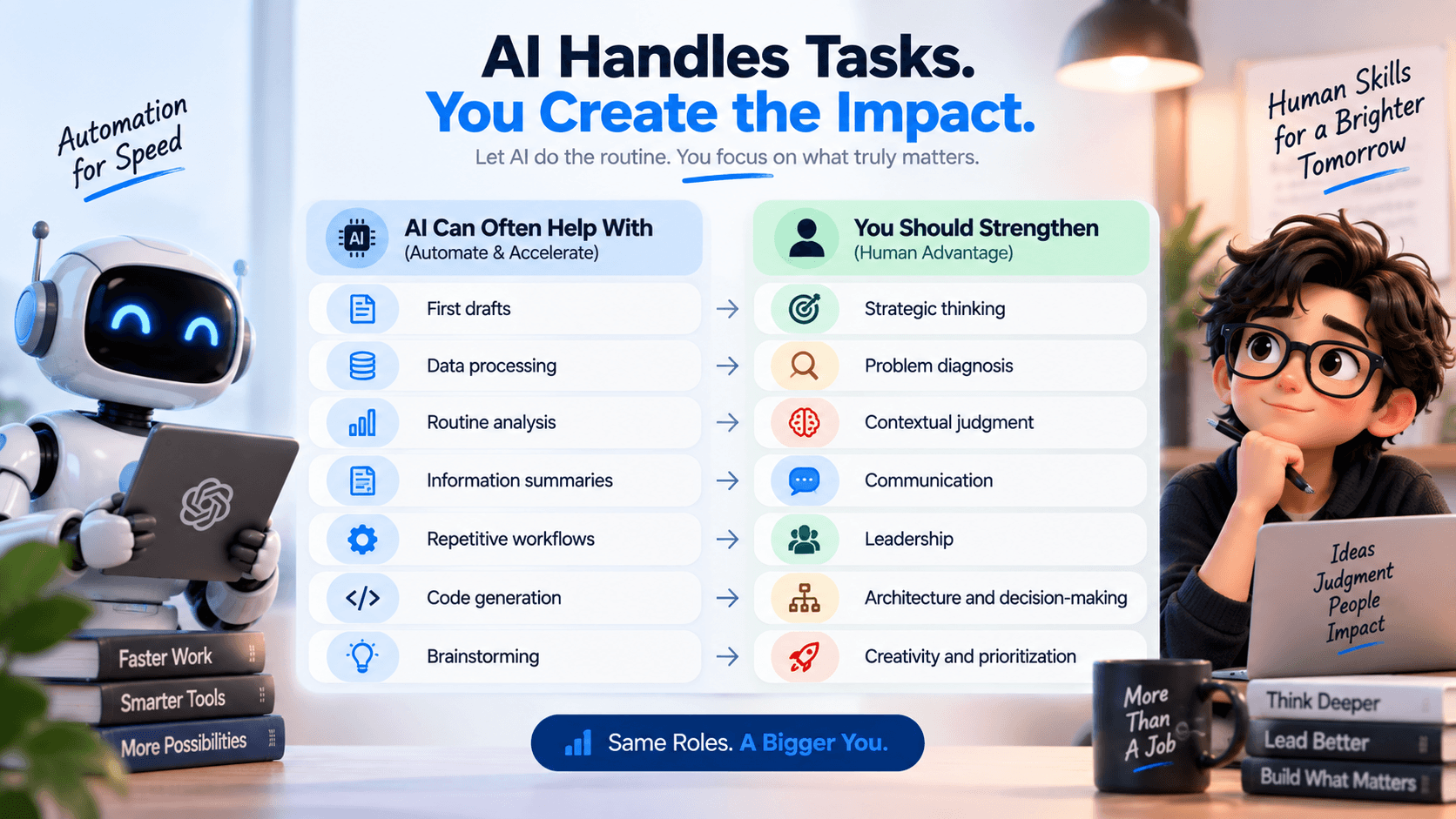
The winning combination isn't AI vs. humans.
It's AI + human expertise.
How to Future-Proof Your Career in 2026
Don't try to learn everything.
Instead, build a T-shaped skill set:
Deep expertise + AI literacy + strong human skills
For example:
Marketing professional
→ Deep expertise: Performance Marketing
→ AI capability: AI-assisted research and campaign analysis
→ Human advantage: Strategy, storytelling and stakeholder influence
Software developer
→ Deep expertise: Backend Engineering
→ AI capability: AI-assisted coding and testing
→ Human advantage: Architecture, security and business judgment
HR professional
→ Deep expertise: Talent Acquisition
→ AI capability: AI-assisted sourcing and analysis
→ Human advantage: Interviews, empathy and organizational judgment
This is far more practical than trying to become an expert in every new AI tool.
The Bottom Line: Don't Try to Become AI-Proof
There is no career that can honestly be guaranteed “AI-proof.”
Technology will continue to change. Job descriptions will change with it. Some tasks will disappear, others will emerge, and many existing roles will be redesigned.
The better goal is to become AI-adaptable.
Learn the tools.
Understand your industry deeply.
Get better at solving ambiguous problems.
Communicate clearly.
Build trust.
Question AI outputs instead of blindly accepting them.
And most importantly, move from being the person who only executes tasks to the person who understands why the work matters and what should happen next.
That's the kind of professional who doesn't simply survive technological change.
They become more valuable because of it.
If you're considering a move toward technical or digital work, explore our guide on How to Switch From Non-Tech to Tech Roles.