
How to Stay Relevant at Work as AI Changes Your Job
Artificial intelligence is changing the way people work. Tasks that once took hours can now be completed in minutes with the help of AI tools. From writing emails and analyzing data to creating designs, writing code, and preparing reports, AI is becoming part of everyday work across many industries.
That naturally raises an important question: Will AI take my job?
The answer is more complicated than a simple yes or no. Some tasks will become automated, while others will change significantly. At the same time, employees who know how to work effectively with AI can become more productive and valuable to their organizations.
The goal, therefore, isn't to compete with AI. It's to learn how to work alongside it while developing the skills that technology cannot easily replace.
If you want to stay relevant as AI changes your job, here are five practical strategies you can start using.
Understand How AI Is Changing Your Role
Before trying to future-proof your career, understand exactly where AI is affecting your work.
Look at your typical week and separate your responsibilities into three categories:
Tasks AI can already automate
Tasks AI can assist you with
Tasks that still require significant human judgment
For example, a marketing professional may previously have spent hours creating first drafts of social media posts. AI can now help generate those drafts quickly. However, deciding what the brand should communicate, who it should target, and whether the message is appropriate still requires human judgment.
The same principle applies to other professions.
A developer might use AI to generate boilerplate code, but architecture, security decisions, and understanding business requirements still require deeper expertise.
An accountant might use AI to organize financial information, but interpreting unusual situations and advising a client requires professional judgment.
The more clearly you understand this shift, the easier it becomes to decide which skills you need to strengthen.
Related Blog
1. Move From Doing Every Task to Reviewing and Improving
One of the most useful ways to adapt to AI at work is to change your role from executor to reviewer.
Instead of doing everything manually, use AI for the repetitive first stage and spend your time checking, improving, and making decisions.
For example, you could ask AI to:
Create a first draft of a report
Summarize a long document
Organize information
Generate possible ideas
Write basic code
Analyze a large dataset
Create an initial presentation structure
But don't automatically treat the output as finished work.
AI can produce information that is incomplete, inaccurate, outdated, or unsuitable for a particular situation. Your expertise is what turns a fast AI-generated output into useful professional work.
Think of yourself as an editor-in-chief rather than someone who simply produces the first draft.
This shift makes your experience more valuable, not less.
2. Learn AI Tools That Actually Improve Your Work
You don't need to become an AI engineer to build a future-proof career.
However, you should understand the AI tools that are relevant to your profession.
Start with the tools you already use at work. Ask yourself:
"Which part of my job takes the most repetitive time?"
If you spend hours preparing weekly reports, perhaps AI can help summarize the information.
If you repeatedly respond to similar customer questions, automation may be able to handle the initial response.
If you constantly move information between different applications, an automated workflow could reduce that manual work.
The important thing is not to collect dozens of AI tools just because they're popular. Learn how to solve real workplace problems with them.
As you become more comfortable, you can explore AI automation, workflow platforms, APIs, and other tools that connect different systems.
That turns AI from something you occasionally experiment with into a genuine productivity skill.
3. Strengthen the Human Skills AI Can't Easily Replace
Technical skills matter, but they aren't the only way to future-proof your career.
As AI becomes better at producing information and completing routine tasks, skills such as communication, negotiation, leadership, critical thinking, empathy, and decision-making become increasingly valuable.
Consider a difficult workplace situation.
A manager needs to resolve a disagreement between two employees. An AI system can suggest communication strategies, but understanding the personalities involved, organizational politics, emotions, and consequences requires human judgment.
The same applies when dealing with an unhappy customer, negotiating with a client, leading a team, or making a difficult business decision.
Don't abandon your technical expertise. Instead, combine it with strong human skills.
That combination can make you much harder to replace.
4. Become the Person Who Helps Your Team Use AI
You don't have to wait for your company to make you an AI expert.
Start small.
Find one AI tool or workflow that could save your team time. Test it carefully. Measure the difference. Then show your colleagues or manager what you discovered.
For example, instead of saying:
"We should start using AI."
You could say:
"I tested this workflow on our weekly reporting process, and it reduced the preparation time significantly."
That's a much stronger contribution.
You aren't simply following an AI trend. You're identifying a problem, testing a solution, and helping the organization improve.
Over time, this can position you as someone who understands both your profession and how emerging technology can improve it.
5. Get Better at Solving Ambiguous Problems
AI is often excellent when a problem is clearly defined.
But real workplaces are rarely that simple.
A project might have unclear requirements. Different stakeholders might want different outcomes. A customer might not know exactly what they need. A deadline might change halfway through the project.
These situations require people who can ask the right questions, identify the real problem, prioritize competing requirements, and make decisions with incomplete information.
This is where you can create significant value.
Instead of only asking:
"What task should I complete?"
Start asking:
"What problem are we actually trying to solve?"
That small change can move you from task execution toward strategic thinking.
AI-Vulnerable Tasks vs. AI-Resilient Skills
The difference isn't necessarily between one profession and another. In many cases, it's about which parts of the job you specialize in.
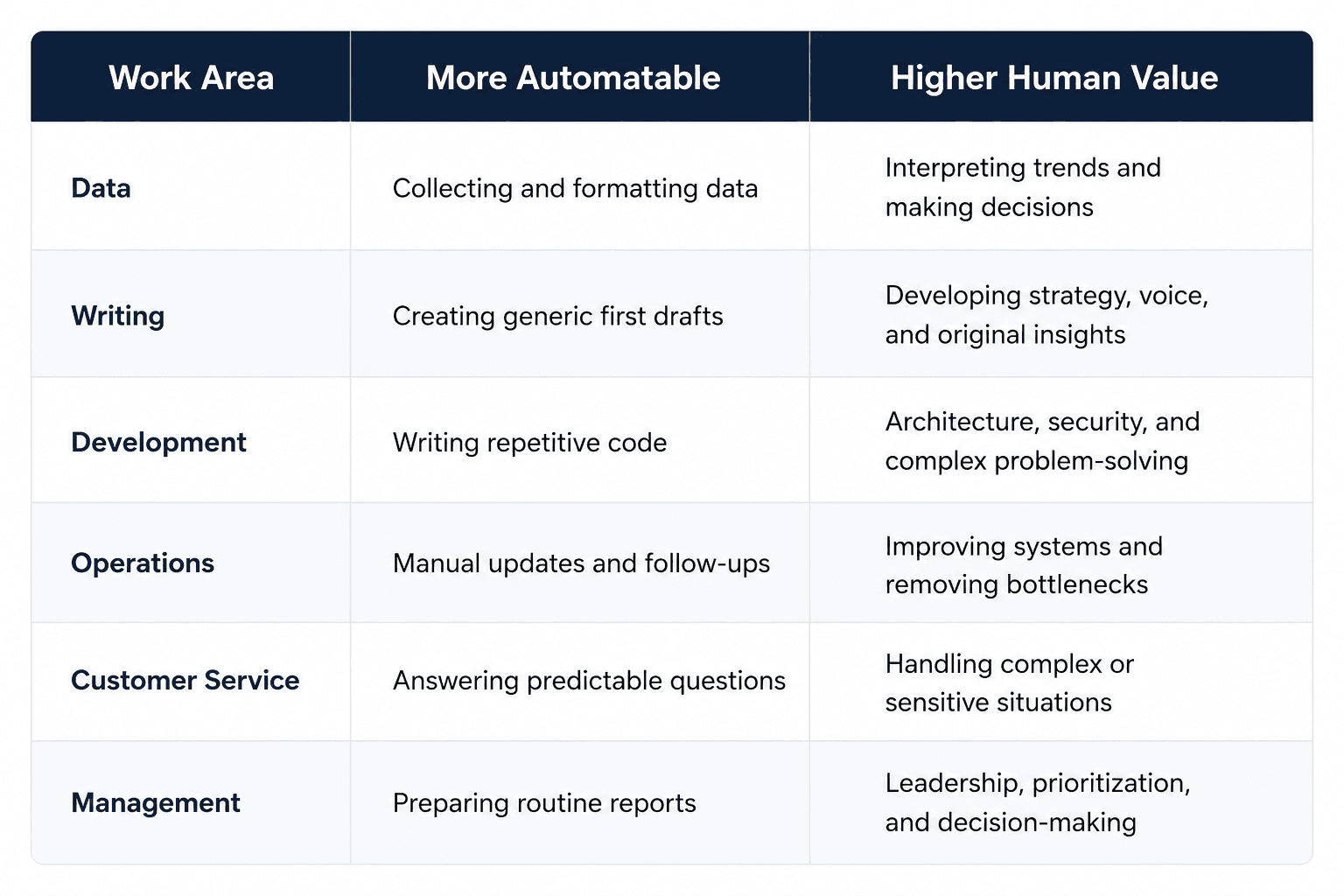
The objective isn't to avoid everything AI can do.
It's to become valuable in the areas where AI still needs human direction.
A Simple 30-Day Plan to Future-Proof Your Career
You don't need to completely reinvent your career overnight. Start with one month of focused experimentation.
Days 1–7: Audit Your Work
Write down your recurring weekly tasks.
Identify which activities are:
Repetitive
Time-consuming
Based on predictable processes
Suitable for AI assistance
Pick one task that consumes more time than it should.
Days 8–20: Experiment With AI
Find an AI tool or workflow that can assist with that task.
Don't immediately automate everything. Test the process, review the results, and make sure the output meets your professional standards.
Your goal should be simple:
Can I reduce the time spent on this task without reducing quality?
Days 21–30: Reinvest Your Time
Once you've saved some time, don't simply fill those hours with more routine work.
Use them to develop skills that increase your long-term value.
You could:
Learn more about your industry
Improve your communication skills
Work on strategic projects
Build relationships across teams
Learn a new technical skill
Take responsibility for a difficult problem
Explore ways AI can improve your department
This is how automation can become a career advantage rather than a career threat.
Final Thoughts
AI is changing jobs, but it doesn't mean your career has to become less valuable.
The professionals who adapt best will not necessarily be the people who know the most about AI. They will be the people who understand how to combine AI with their existing expertise, judgment, creativity, and human skills.
Don't focus entirely on protecting your current job from technology.
Instead, ask yourself:
"How can I become more valuable as AI becomes better at routine work?"
Learn to use AI. Understand your industry deeply. Strengthen your human skills. Take ownership of difficult problems. And look for opportunities to turn repetitive work into better systems.
That's a much more practical way to build a future-proof career in an AI-driven workplace.
Frequently Asked Questions
Will AI replace my job?
AI may automate some tasks within your job, but automation of tasks doesn't necessarily mean complete replacement of a profession. The impact depends on your industry, role, and how much of your work can be standardized.
What skills should I learn to stay relevant as AI changes my job?
Focus on a combination of AI literacy, critical thinking, communication, problem-solving, leadership, domain expertise, and adaptability. The strongest combination is usually technology skills plus human judgment.
Do I need to learn coding to use AI at work?
No. Many AI tools can be used without coding. However, learning basic automation, APIs, or technical concepts can become useful if your role involves building more advanced workflows.
How can I start adapting to AI at work?
Start with one repetitive task. Find an AI tool that can assist with it, test the results carefully, and measure whether it actually saves time or improves quality.
What is the best way to future-proof a career?
Don't rely on one skill or tool. Continuously develop your professional expertise, learn how technology is changing your industry, and become better at solving complex problems that require human judgment.