
SMART Goals for Improving Communication Skills at Work (With Examples)
Good communication is not about using complicated words or speaking for a long time. It is about expressing your thoughts clearly, listening carefully, understanding others, and responding with confidence.
Whether you are a student, working professional, job seeker, entrepreneur, or someone simply looking to become more confident, strong communication skills can make everyday interactions easier.
The good news is that communication is not something you either have or do not have. It is a skill that can be developed through consistent practice.
Instead of trying to improve everything at once, a simple action plan can help you build better communication habits step by step.
In this guide, you will learn how to create an action plan to improve communication skills and turn small daily practices into long-term improvement.
Why Are Communication Skills Important?
Communication affects almost every part of our personal and professional lives.
At work, effective communication can help you:
Explain ideas more clearly
Participate confidently in meetings
Build stronger professional relationships
Handle disagreements
Give and receive feedback
Perform better in interviews
Work effectively with teams
Present your ideas with confidence
For students and job seekers, communication skills can also make a difference during interviews, presentations, group discussions, networking, and professional interactions.
But improving communication does not mean becoming the loudest person in the room.
It means becoming someone who can listen, think, speak, and respond effectively.
Your Action Plan to Improve Communication Skills
A practical communication improvement plan should focus on several areas rather than just speaking.
Here is a simple six-step framework you can follow.
1. Improve Your Listening Skills
Communication starts with listening. Many people listen only to prepare their response. As a result, they miss important information, emotions, or context.
Start practicing active listening.
When someone is speaking:
Avoid interrupting.
Maintain appropriate eye contact.
Pay attention to their main point.
Ask questions when something is unclear.
Think about what they mean before responding.
Avoid checking your phone or multitasking.
Instead of immediately thinking, “What should I say next?”, try asking yourself:
“What is this person actually trying to tell me?”
This small change can significantly improve the quality of your conversations.
2. Practice Speaking Clearly
You do not need an impressive vocabulary to become a better communicator.
You need clarity.
Try to:
Speak at a comfortable pace.
Use simple and familiar words.
Avoid unnecessary filler words.
Organize your thoughts before speaking.
Pause instead of rushing.
Keep your sentences reasonably short.
For example, instead of saying:
“Basically, what I was kind of trying to explain was that there might possibly be a problem…”
You could simply say:
“There may be a problem with the plan.”
Clear communication is often more powerful than complicated communication.
3. Build Your Vocabulary Naturally
Vocabulary can help you express yourself more accurately, but memorizing hundreds of difficult words is not the answer.
Instead, learn words in context.
You can:
Read articles, books, and professional content.
Write down unfamiliar words.
Look at how those words are used.
Create your own sentences.
Use new words in conversations.
Review them regularly.
Try learning 3–5 useful words each day rather than attempting to memorize dozens at once.
The goal isn't to sound intelligent.
The goal is to have the right words available when you need them.
4. Practice Speaking Every Day
One of the biggest mistakes people make is waiting until they feel confident before they start speaking.
Confidence usually comes after practice, not before it.
Set aside 10–15 minutes every day for speaking practice.
You can:
Talk to Yourself
Choose a simple topic and explain it aloud.
For example:
What did I learn today?
What happened at work?
What are my goals?
What is my opinion about a recent topic?
How would I explain my job to someone unfamiliar with it?
Try speaking continuously for two minutes.
Then gradually increase the time.
Record Your Voice
Use your phone to record yourself speaking.
Listen to the recording afterward and notice:
Do you speak too quickly?
Do you repeat certain words?
Are your sentences clear?
Do you pause too often?
Is your explanation easy to understand?
This may feel uncomfortable initially, but it is one of the easiest ways to identify communication habits you normally don't notice.
5. Improve Your Written Communication
Communication is not limited to conversations.
Emails, messages, reports, LinkedIn posts, presentations, and documents all require strong written communication.
Before sending an important message, ask:
Is it clear?
Is it concise?
Does the reader know what I want them to do?
A useful structure for professional writing is:
Purpose → Context → Key Information → Action
For example:
Instead of writing a long paragraph explaining everything first, start with the purpose:
“I'm writing to confirm the deadline for the project.”
Then provide the relevant details.
Good professional writing respects the reader's time.
6. Work on Your Body Language
Your words are only one part of communication.
Your facial expressions, posture, gestures, eye contact, and tone also influence how your message is received.
When communicating with others:
Maintain natural eye contact.
Sit or stand with good posture.
Avoid constantly looking at your phone.
Use natural hand gestures.
Keep your facial expressions appropriate to the conversation.
Avoid appearing closed off with crossed arms when possible.
You don't need to imitate someone else's body language. The goal is to appear comfortable, attentive, and approachable.
A 30-Day Communication Skills Action Plan
If you want to turn these ideas into actual improvement, use a simple 30-day routine.
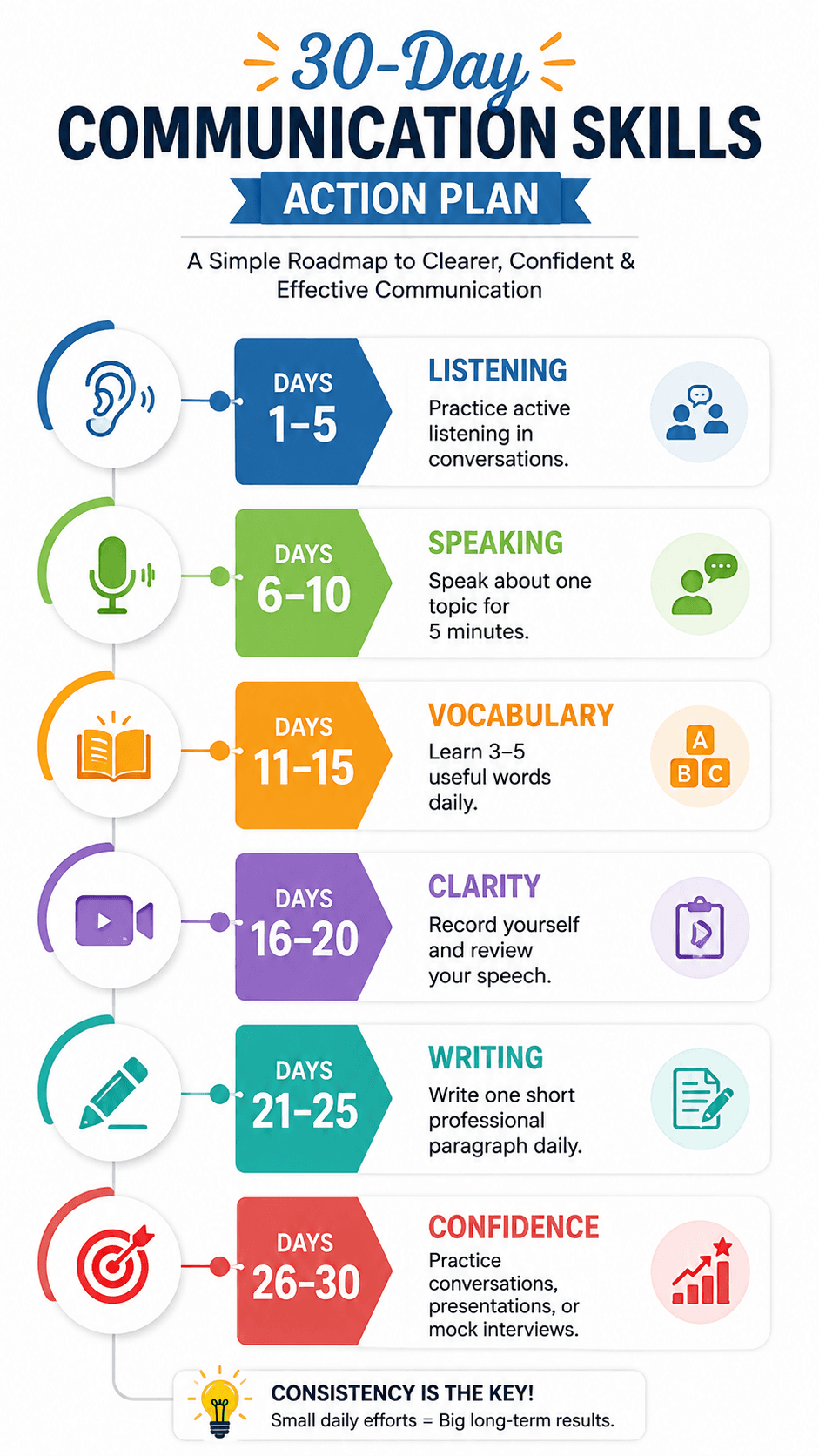
The objective isn't perfection.
The objective is consistent practice.
Simple Daily Communication Routine
You don't need to spend hours every day improving your communication skills.
Try this 30-minute routine:
10 minutes — Reading
Read an article, book, or professional content.
5 minutes — Vocabulary
Learn a few useful words or phrases.
10 minutes — Speaking
Talk about a topic or record yourself.
5 minutes — Reflection
Think about one communication mistake you made that day and how you could handle it differently next time.
Do this consistently for a month and you will have enough practice to identify noticeable changes in your communication habits.
Common Communication Mistakes to Avoid
Improving communication isn't only about learning what to do. It is also about recognizing what to stop doing.
Speaking Without Listening
A conversation isn't a competition to see who talks the most.
Overusing Filler Words
Words such as “um,” “actually,” “basically,” and “like” can become distracting when used excessively.
Trying to Sound Too Professional
Using complicated vocabulary can make your message less clear.
Interrupting People
Even if you already know what someone is going to say, let them finish.
Giving Too Much Information
More information does not always mean better communication. Give people the information they actually need.
Avoiding Difficult Conversations
Avoiding an important conversation often makes the situation worse. Learn to communicate disagreements respectfully instead.
How to Measure Your Communication Improvement
If you don't measure your progress, it can be difficult to know whether your practice is working.
At the end of every week, ask yourself:
Am I speaking more clearly?
Do I listen without interrupting?
Am I more comfortable starting conversations?
Can I explain my ideas more easily?
Have I reduced filler words?
Is my professional writing becoming clearer?
Do I feel more confident during meetings or presentations?
You can even rate yourself from 1 to 10 each week.
For example:
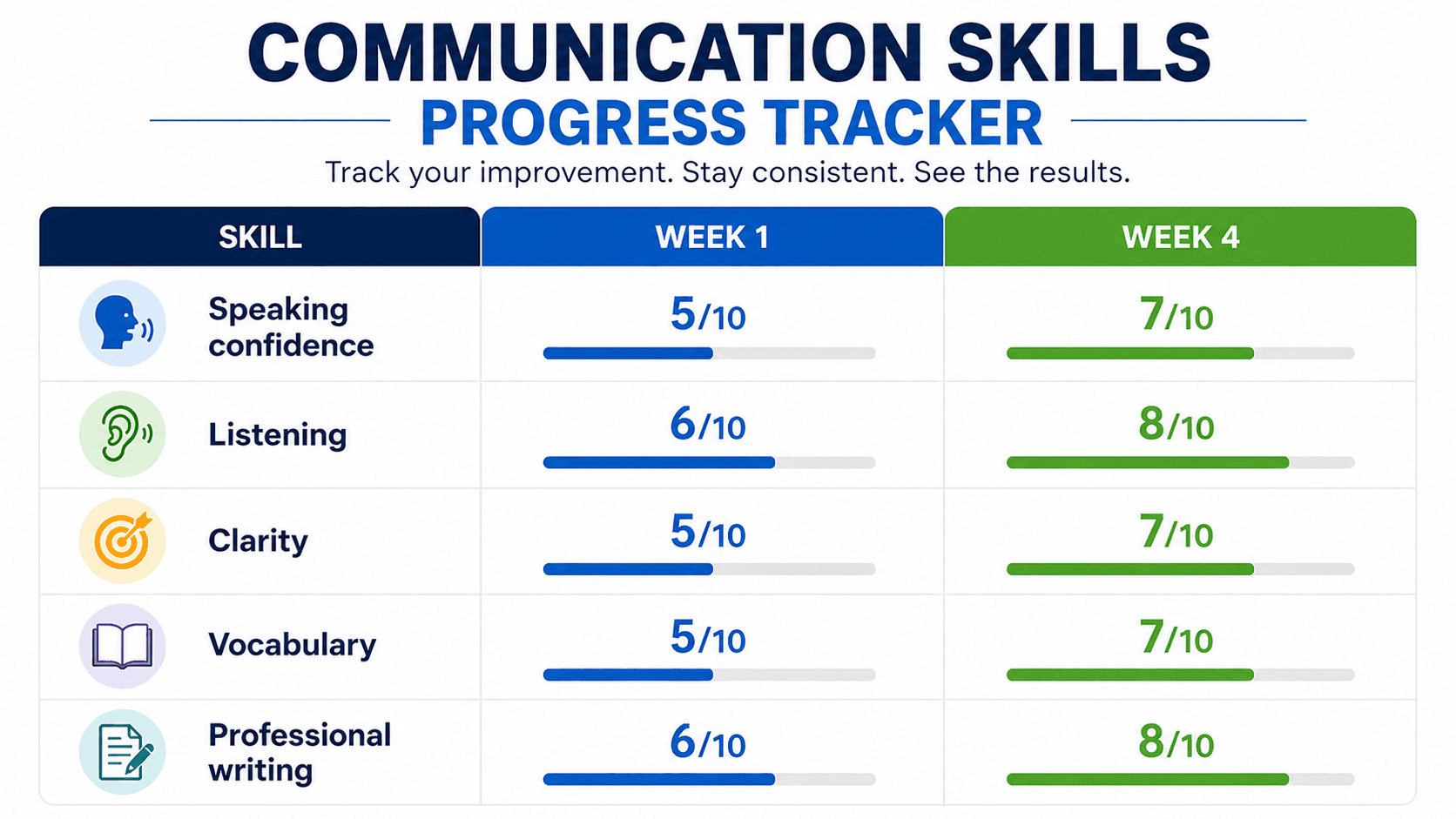
The numbers don't need to be scientifically accurate. They simply give you a way to track your progress.
The 3-Second Rule for Better Communication
Here's a simple habit you can start using immediately.
Pause for three seconds before responding to an important question.
This gives your brain time to:
Understand the question.
Organize your thoughts.
Choose the right words.
Respond instead of reacting.
A short pause doesn't make you look less confident. In many situations, it can make you appear more thoughtful and composed.
Final Thoughts
Improving communication skills doesn't happen overnight. You won't suddenly become an excellent communicator after reading one article or memorizing a list of techniques.
Real improvement comes from small, repeated actions.
Listen more carefully.
Speak more clearly.
Read regularly.
Write with purpose.
Record yourself.
Practice conversations.
Learn from your mistakes.
Most importantly, don't wait until you feel confident to start.
Practice creates confidence. Confidence improves communication. And better communication creates better opportunities.
Start with just 30 minutes a day for the next 30 days. You don't need to become a perfect communicator. You simply need to become a little better than you were yesterday.