

How to Switch from Non-Tech to Tech Roles Without a CS Degree
For years, a Computer Science degree was treated as the standard entry point into technology. Today, the picture is different.
People move into software development, data analytics, product operations, QA, cloud, and other technology roles from backgrounds such as sales, education, finance, customer service, administration, and operations.
But there is an important distinction: not having a CS degree does not mean you can skip the hard part.
A successful non-tech to tech career transition requires more than completing an online course or collecting certificates. Employers need evidence that you can use technical knowledge to solve real problems.
The good news is that you can build that evidence deliberately.
Can You Get a Tech Job Without a CS Degree?
Yes. A degree can help, particularly for certain specialized or highly technical positions, but it is not the only way to demonstrate capability.
For many entry-level and career-change opportunities, employers may look at a combination of:
Technical skills relevant to the role
Practical projects and portfolio work
Problem-solving ability
Communication and collaboration
Understanding of business or user needs
Previous professional experience
GitHub or other evidence of work
Ability to explain what you built and why
This is why the question should not simply be, “How do I get into tech without a degree?”
A better question is:
“How can I prove that I can perform the work?”
That shift in mindset makes the career transition much more practical.
Step 1: Choose One Specific Tech Career Path
One of the biggest mistakes career changers make is trying to learn everything at once.
You do not need to become a full-stack developer, data scientist, cloud engineer, and cybersecurity specialist simultaneously.
Start with one realistic target.
Frontend Development
If you enjoy creating websites and user interfaces, you could start with:
HTML and CSS
JavaScript
TypeScript
React
Next.js
Git and GitHub
Basic API integration
Your goal should eventually be to build responsive, functional web applications rather than simply following tutorials.
Data Analytics
For people who enjoy numbers, business decisions, and finding patterns in information, data analytics can be a practical transition.
Core skills include:
Excel
SQL
Python
Power BI or Tableau
Data cleaning
Data visualization
Basic statistics
For example, instead of creating a generic practice dashboard, analyze sales, customer retention, website traffic, or publicly available business data.
Product or Technical Operations
Not every technology career requires becoming a programmer.
People with strong organizational and business backgrounds can explore areas such as product operations, technical project coordination, implementation, or business systems.
Useful skills may include:
Jira
Agile methodologies
Process mapping
API fundamentals
UX workflows
Documentation
Basic SQL
Product analytics
The best career path is usually the one where your existing professional experience and new technical skills overlap.
Step 2: Learn Skills Through Projects, Not Just Courses
Online courses can teach you the fundamentals, but they cannot demonstrate how you perform when a problem does not have a step-by-step tutorial.
That is why project-based learning matters.
Suppose you previously worked in sales.
Instead of building another basic to-do application, create a small CRM dashboard that tracks:
Leads
Follow-ups
Conversion rates
Sales stages
Customer information
Monthly performance
Now your project demonstrates both technical ability and business understanding.
Similarly, someone from operations could build a workflow management system, while someone from education could create a student progress dashboard.
Your previous career becomes part of the project rather than something you need to hide.
Step 3: Build a Portfolio That Shows Evidence
A portfolio should answer one simple question:
“What can this person actually do?”
Two or three strong projects are generally more useful than ten unfinished tutorial projects.
For every major project, explain:
What problem were you solving?
Who would use the solution?
Which technologies did you use?
How did the system work?
What challenges did you encounter?
What decisions or trade-offs did you make?
What would you improve in a future version?
For development projects, include a clean GitHub repository, meaningful documentation, and—where possible—a live deployment.
For analytics projects, explain the dataset, cleaning process, analysis, dashboard, and business conclusions.
This creates proof of work, which is much stronger than simply saying that you completed a course.
Step 4: Turn Your Previous Career Into an Advantage
Career changers often make another mistake: they treat their previous experience as irrelevant.
It isn't.
Imagine two candidates applying for a technical role.
One understands the technology but has little understanding of customers.
The other understands the technology and has five years of experience dealing with customers, business processes, or stakeholders.
That second candidate may have a valuable advantage.
Examples of Transferable Skills
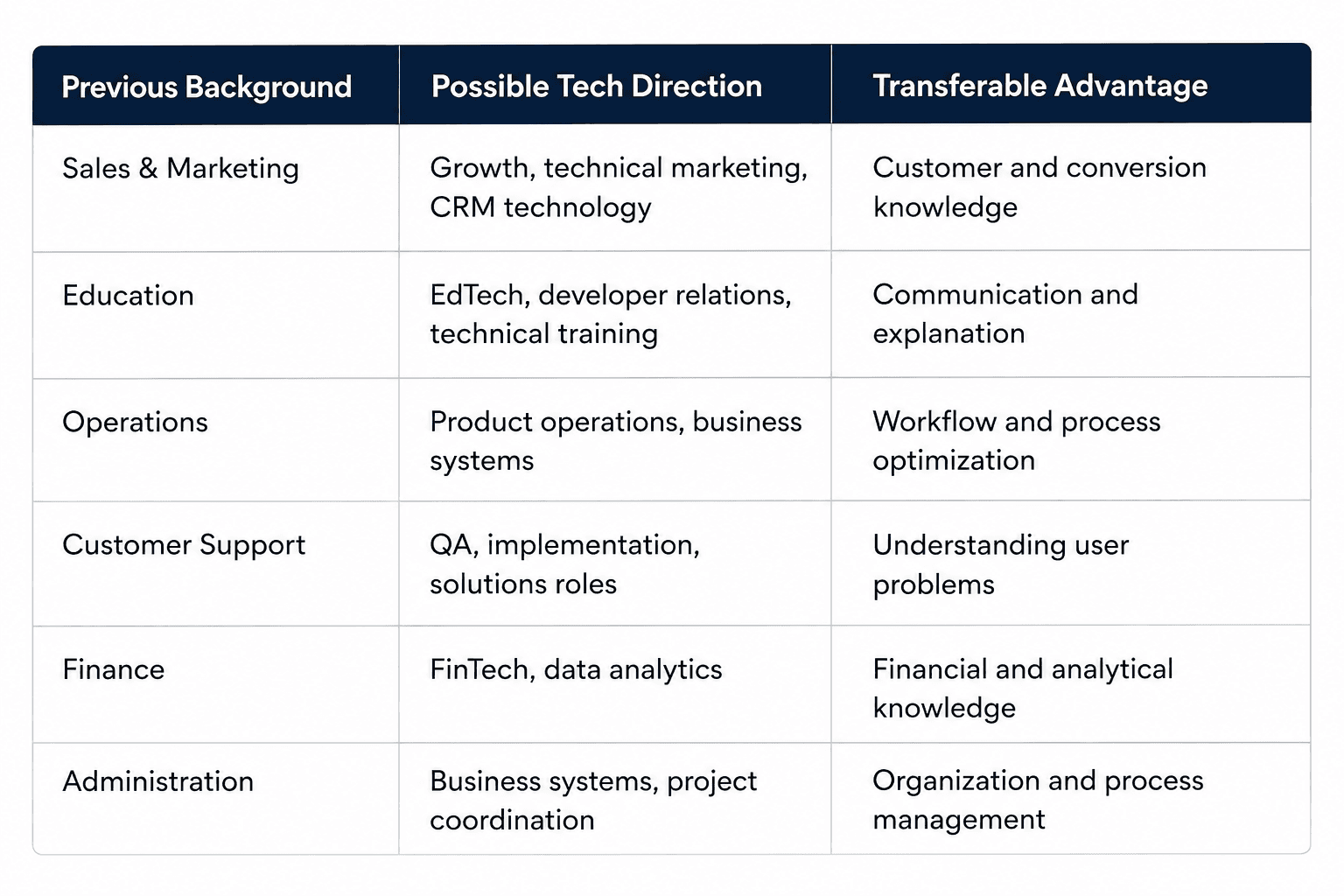
The objective is not to pretend your previous career never happened.
Connect your old experience with your new technical capabilities.
Step 5: Make Your Resume Relevant to Tech
A career-change resume should not look like a completely unrelated professional history.
Lead with the skills relevant to the target role.
For example, instead of writing:
“Responsible for managing customer accounts.”
You could demonstrate the technical connection through a project:
“Built a CRM analytics dashboard using SQL and Power BI to analyze customer activity and conversion trends.”
The second statement gives the recruiter something concrete to evaluate.
Where appropriate, include:
Technical skills
Relevant projects
Certifications
GitHub
Portfolio website
Quantifiable achievements
Transferable professional experience
Do not claim professional experience you do not have. Show what you actually built and what you learned from it.
Step 6: Start Applying Before You Feel 100% Ready
Many career changers wait too long.
They finish another course, learn another programming language, or collect another certificate because they believe they are not ready yet.
There is no point at which you suddenly become “fully ready.”
Once you have foundational skills and a few credible projects, start applying while continuing to learn.
Search for roles where your existing experience provides an advantage.
For example:
Sales + technology → technical sales or growth technology
Operations + technology → product operations or business systems
Education + technology → EdTech or developer relations
Customer support + technology → QA, implementation, or technical support
This can sometimes provide a more realistic entry point than competing immediately for highly specialized software engineering positions.
Step 7: Use LinkedIn and Networking Strategically
Networking does not have to mean sending hundreds of generic messages to strangers.
Instead, make your learning visible.
Share things such as:
A project you completed
A technical problem you solved
Something you learned while debugging
A useful data insight
A short project demonstration
A lesson from transitioning into technology
For example:
“I recently built a sales dashboard using SQL and Power BI. The interesting part wasn't creating the charts—it was cleaning inconsistent customer data and deciding which metrics actually mattered.”
That tells people considerably more than:
“Completed another Power BI course.”
Public proof can gradually help you build credibility with recruiters, hiring managers, and professionals in your target field.
A Practical 6-Month Non-Tech to Tech Roadmap
Month 1: Pick Your Direction
Choose one target role and identify the technical skills commonly required for it.
Do not build a learning plan around random technologies.
Months 2–3: Build Your Foundation
Learn the core concepts while immediately applying them through small exercises and practical work.
Focus on understanding rather than memorizing syntax.
Months 3–4: Build 2–3 Serious Projects
Create projects connected to real-world problems.
Where possible, deploy them and make them accessible online.
Month 5: Build Your Professional Profile
Update your:
Resume
LinkedIn profile
GitHub
Portfolio
Project case studies
Make sure all of them communicate the same career direction.
Month 6: Apply and Network
Start targeted applications and professional conversations.
Track your applications, analyze interview feedback, improve weak areas, and continue building relevant skills.
The timeline is not a guarantee of employment. Some people transition faster, while others need significantly longer depending on their starting skills, target role, location, and available time.
What Should Your Tech Portfolio Include?
A strong career-change portfolio should be easy to evaluate.
Ideally, someone should understand what you built and why within a few minutes.
Follow these three principles:
1. Make Projects Usable
Give recruiters a live demo whenever practical. If authentication is required, provide a test account or clear instructions.
2. Explain Your Decisions
Do not only show screenshots.
Explain the architecture, technologies, database decisions, challenges, limitations, and improvements.
3. Keep Your Code Professional
Use meaningful names, organize files logically, write useful documentation, and maintain clean repositories.
Your portfolio does not need to look like a large company's production system. It needs to show that you understand what you are doing.
Common Mistakes When Switching to Tech
Avoid these common career-change traps:
Collecting certificates without building projects: Certifications can support your profile, but they rarely replace practical evidence.
Learning too many technologies: Depth in one relevant stack is usually more useful than shallow knowledge of five.
Copying tutorial projects: A tutorial clone does not tell an employer much about your independent problem-solving ability.
Hiding your previous career: Your domain experience can be a differentiator.
Applying randomly: Target roles where your combination of old and new skills makes sense.
Waiting until you know everything: Technology constantly changes. Employers need people who can learn, adapt, and solve problems.
The Real Goal Is Not to “Start Over”
Switching from a non-tech career to technology does not necessarily mean starting from zero.
You already have experience solving problems, communicating with people, meeting deadlines, handling responsibility, or understanding a particular industry.
Your job is to add technical capability to that foundation.
A successful transition happens when those two sides come together:
Existing professional experience + relevant technical skills + proof of work = a stronger tech career profile.
You do not need to convince an employer that your background does not matter.
You need to show them why your background makes you different—and why you can now do valuable technical work.
Frequently Asked Questions
Can I get into tech without a Computer Science degree?
Yes. Many technology roles can be entered through skills, projects, professional experience, networking, and demonstrated ability. However, some specialized positions may still have degree or advanced education requirements.
What is the easiest tech career to transition into?
There is no universally easiest tech career. Data analytics, QA, technical support, product operations, and frontend development can be accessible pathways depending on your existing skills and interests.
How long does it take to switch from non-tech to tech?
There is no fixed timeline. A focused learner may build foundational skills within several months, but becoming job-ready and finding the right opportunity can take longer.
Are coding bootcamps or online courses enough?
Usually, no. They can provide structure and foundational knowledge, but you should combine formal learning with independent projects, portfolio development, and job applications.
Should I learn coding before applying for tech jobs?
Not necessarily. It depends on the role. Software development requires substantial coding knowledge, while roles such as product operations, technical support, QA, and some implementation positions may require different technical skill sets.
Final Takeaway
A non-tech background does not automatically prevent you from building a career in technology.
But changing careers successfully requires a deliberate strategy.
Choose a specific role. Learn the skills that role actually requires. Build projects that solve realistic problems. Document your work. Connect your previous experience to your new capabilities. Then put that evidence in front of employers.
The goal is not to become someone with a Computer Science degree.
The goal is to become someone who can demonstrate that they are capable of doing the work.