
From EU Blue Card to German Permanent Residency: The 21-Month vs. 27-Month Guide for 2026
If you hold an EU Blue Card in Germany, permanent residency may be closer than you think. Under Germany's current immigration rules, eligible EU Blue Card holders can qualify for a Niederlassungserlaubnis (settlement permit) after 27 months, or after just 21 months if they can demonstrate German at B1 level.
For many international professionals, this makes the EU Blue Card one of the clearest routes toward long-term residence in Germany.
But reaching the 21- or 27-month point does not automatically mean permanent residency is granted. You still need to meet the other legal requirements, including qualifying employment, pension contributions, sufficient income, language knowledge and integration-related requirements.
This 2026 guide to EU Blue Card to permanent residency in Germany explains the rules, documents, pension requirements and application process in practical terms.
EU Blue Card to Permanent Residency in Germany: 21 vs. 27 Months
The special settlement route for EU Blue Card holders is governed by Section 18c(2) of the German Residence Act (AufenthG).
The basic timeline is:
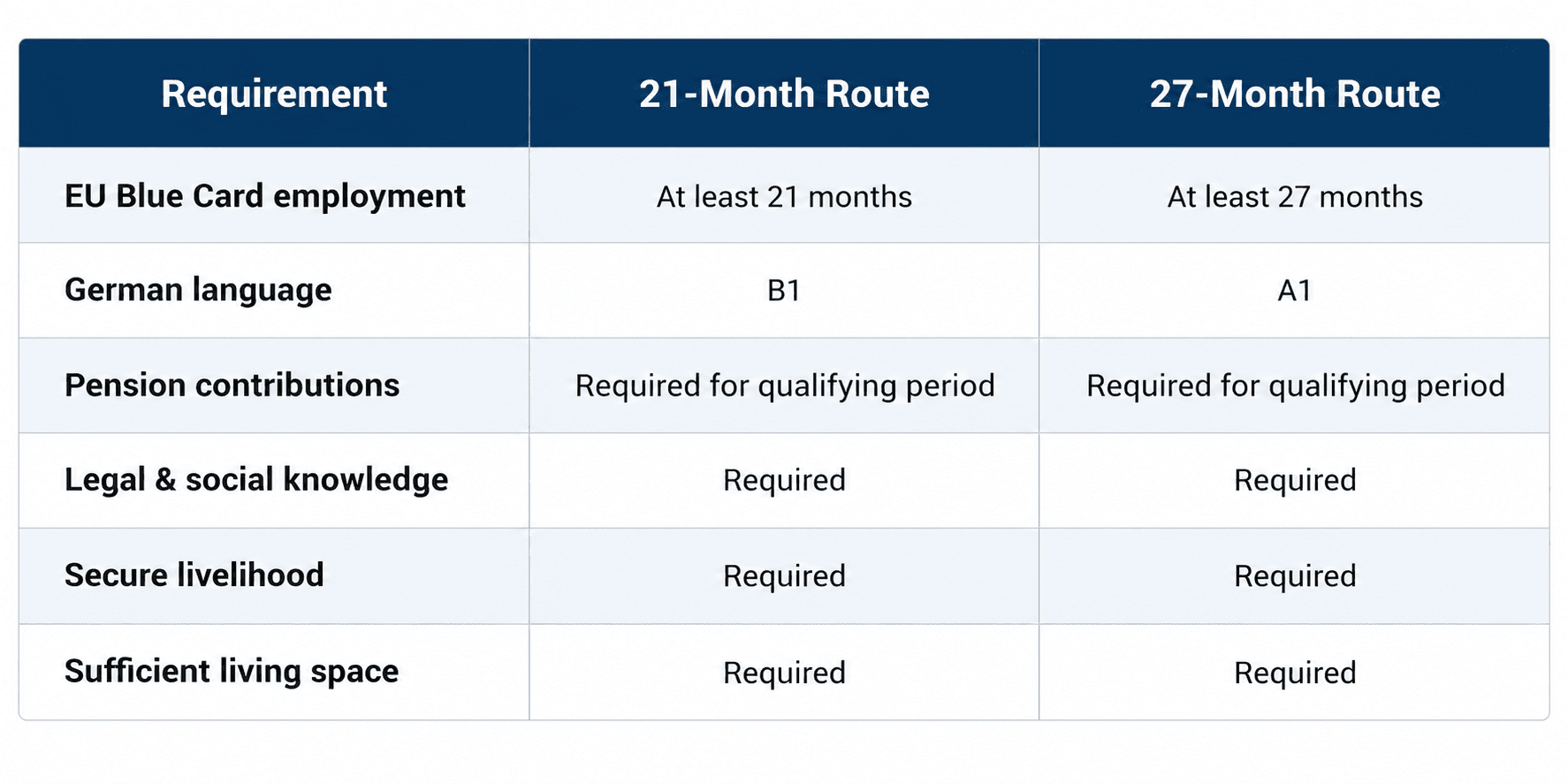
The important point is that B1 German does not simply make the application easier—it reduces the qualifying employment period from 27 months to 21 months. This is specifically provided for EU Blue Card holders under §18c(2) AufenthG.
So, if your goal is the earliest possible settlement permit, improving your German from A1 to B1 can potentially save six months.
More Germany Blogs
What Are the Niederlassungserlaubnis Blue Card Requirements?
Meeting the month requirement is only one part of the application.
For the Niederlassungserlaubnis Blue Card requirements, applicants generally need to demonstrate:
Qualifying employment with an EU Blue Card
Required statutory pension contributions or qualifying equivalent provision
A1 German for the 27-month route or B1 German for the 21-month route
Basic knowledge of Germany's legal and social system and living conditions
Sufficient financial means to support themselves
Adequate living space
Fulfilment of the applicable general settlement-permit conditions
Germany's official Make it in Germany guidance confirms these core requirements for EU Blue Card holders.
This means reaching month 21 or 27 should be treated as your eligibility milestone, not as a guarantee that the permit will automatically be approved.
The Pension Contribution Requirement: Why Your Versicherungsverlauf Matters
One of the most important parts of the application is proving your pension contribution history.
For the Blue Card settlement route, the law requires qualifying pension contributions for the relevant 21- or 27-month period. The German pension authority, Deutsche Rentenversicherung, maintains the insurance record known as the Versicherungsverlauf.
Your Versicherungsverlauf shows the insurance periods recorded in your pension account. You can request a current version and check whether your recorded periods contain gaps.
This is why applicants should not wait until the last minute.
Before applying for permanent residency, review your pension record and make sure the relevant employment periods have been correctly recorded. If something appears to be missing, contact Deutsche Rentenversicherung and clarify the record before submitting your settlement-permit application.
You can also use its online services to request an updated Versicherungsverlauf.
What if Your Pension Record Has a Gap?
Do not automatically assume that a gap means your entire application will fail.
The correct response is to determine why the period is missing and whether it can be corrected or otherwise documented. Keep relevant employment contracts, salary records and social-security documents available if clarification is needed.
The key lesson is simple: check your pension record before your PR application, not after the immigration office asks about it.
German Language: Why B1 Can Make a Big Difference
The language requirement is one of the biggest differences between the two Blue Card settlement routes.
With A1 German, the standard Blue Card route requires 27 months of qualifying employment.
With B1 German, the period can be reduced to 21 months.
Therefore, applicants planning their long-term settlement in Germany should consider B1 German as more than an integration goal. It can directly affect the timeline for their permanent residence application.
Make sure your language evidence is accepted by the competent authority and that your certificate meets the applicable requirements.
Permanent Residency Germany 2026: Application Document Checklist
The exact document list can vary between authorities, so always check the requirements of your responsible Ausländerbehörde.
A practical preparation checklist may include:
Valid passport
Current EU Blue Card/electronic residence permit
Biometric passport photograph, where required
Employment contract and current employment evidence
Recent salary or income documents
Pension insurance record (Versicherungsverlauf)
Recognized German language certificate
Proof of sufficient livelihood
Proof of health insurance
Proof of adequate living space
Evidence of required legal and social knowledge, such as the Leben in Deutschland test where applicable
Any additional forms or documents requested by your local Ausländerbehörde
Do not assume that every German city uses exactly the same checklist or application procedure. Local immigration authorities can provide additional instructions.
How to Prepare for Your Ausländerbehörde PR Application
A good strategy is to start preparing several months before your eligibility date.
For example, if you expect to qualify for the 21-month route in October, begin checking your documents well in advance.
Step 1: Confirm Your Eligibility Date
Calculate the date on which you complete the required 21 or 27 months of qualifying Blue Card employment.
Step 2: Check Your Pension Record
Request your Versicherungsverlauf from Deutsche Rentenversicherung and identify any missing periods.
Step 3: Confirm Your German Level
If you are targeting the 21-month route, make sure you have evidence of B1 German.
Step 4: Prepare Your Financial Evidence
Collect recent salary statements and employment documentation showing that your livelihood remains secured.
Step 5: Check Your Local Authority
Your application is handled by the competent immigration authority for your place of residence. Check its current application procedure, forms and document requirements before submitting anything.
This preparation can reduce unnecessary back-and-forth with the authority.
Does Changing Employers Affect Your Blue Card PR Timeline?
Changing jobs does not automatically mean that your permanent residency plan is cancelled.
However, your new employment must continue to meet the applicable requirements for your residence status. Blue Card holders should also pay attention to the specific rules concerning employment changes, particularly during the early period of Blue Card employment.
Germany's official guidance confirms that Blue Card holders can change employers, although notification and additional examination may apply during the first year.
Because your settlement application depends on qualifying employment and pension contributions, keep documentation from both your old and new employers.
Does Student-Visa Time Count Toward the 21-Month Blue Card Route?
The special 21-month/27-month Blue Card route is based on the qualifying employment period under §18g and the conditions of §18c(2).
Therefore, you should not simply add previous residence periods to the Blue Card employment clock and assume they qualify for this specific accelerated route.
If you previously lived in Germany as a student or held another residence title, your situation may need to be assessed under a different settlement-permit provision.
Can You Apply for German Citizenship After Permanent Residency?
Permanent residency and citizenship are separate legal processes.
A Niederlassungserlaubnis gives you permanent settlement rights in Germany, while naturalization has its own eligibility requirements.
According to current German government guidance, naturalization can generally be possible after five years of legal residence if the other statutory conditions are satisfied.
Therefore, obtaining permanent residency can be an important milestone in a longer-term plan to remain in Germany, but it does not itself grant citizenship.
Final Takeaway: Plan Your Blue Card PR Before Month 21
For EU Blue Card holders, the difference between 21 months and 27 months can be significant.
If you have B1 German and meet the other statutory requirements, you may qualify for a German settlement permit after 21 months of qualifying employment. With A1 German, the standard Blue Card route is 27 months. Both routes also involve pension contributions and other settlement requirements.
The smartest approach is to prepare before you reach the qualifying date:
Check your eligibility → verify your pension record → prepare your language proof → collect employment and income documents → check your local Ausländerbehörde requirements → submit a complete application.
If you are planning a move, career change or long-term settlement in Germany, explore the other guides in our Germany immigration and relocation hub for practical information on visas, employment and life in Germany.
Immigration rules and local administrative procedures can change. This article is for general informational purposes and should not be treated as individual legal advice.