
Best Universities in Germany for International Students
Choosing a university is one of the biggest decisions you will make when planning to study abroad. Germany is especially attractive to international students because it offers a wide range of universities, degree programmes, research opportunities, and study options across different fields.
But finding the best university in Germany is not as simple as looking at a single ranking.
A university that is excellent for engineering may not be the best choice for business, medicine, computer science, or social sciences. Germany's official CHE University Ranking also follows a subject-specific approach instead of naming one institution as the overall best university.
So, instead of choosing a university only because it has a famous name, students should consider the course, teaching language, admission requirements, location, costs, career opportunities, and their own academic goals.
In this guide, we look at some of the best-known universities in Germany for international students and explain what makes each one worth considering.
Why Study at a German University?
Germany has a large and diverse higher education system. Students can choose between traditional universities, universities of applied sciences, and specialised institutions such as art and music colleges.
This variety gives international students more options depending on their preferred learning style and career plans.
German universities are particularly well known for areas such as:
Engineering
Computer Science
Artificial Intelligence
Natural Sciences
Medicine
Business and Economics
Technology
Research
Environmental Sciences
Social Sciences
Another reason Germany attracts international students is the availability of many study programmes and relatively affordable options at public institutions, although tuition and other costs can vary depending on the university, state, programme, and student's circumstances.
10 Best Universities in Germany for International Students
The universities below are not presented as a strict overall ranking. Instead, they are well-known German institutions that international students may want to consider based on academic reputation, subject strengths, research, international opportunities, and location.
1. Technical University of Munich (TUM)
The Technical University of Munich, commonly known as TUM, is one of Germany's best-known technical universities.
It is particularly attractive to students interested in technology, engineering, computer science, natural sciences, management, and innovation.
TUM can be a strong option for students who want to study in a research-oriented environment while being close to one of Germany's major technology and business centres.
Popular areas include:
Computer Science
Engineering
Artificial Intelligence
Data-related fields
Natural Sciences
Management
Technology
TUM also has a strong international profile. In 2025, it had the highest number of DAAD-funded scholarship holders among German universities, with 453 students and doctoral candidates receiving DAAD funding.
Best for: Technology, Engineering, Computer Science, Research and Innovation
2. Ludwig Maximilian University of Munich (LMU Munich)
Ludwig Maximilian University of Munich, often called LMU Munich, is one of Germany's major comprehensive universities.
Unlike a university focused mainly on technology, LMU offers a broad range of academic disciplines.
Students can explore areas such as:
Medicine
Natural Sciences
Business and Economics
Social Sciences
Humanities
Law
Computer Science
Its location in Munich also puts students in one of Germany's major economic and business centres.
LMU was among the German universities with the highest number of DAAD scholarship holders in 2025, with 395 students and doctoral candidates receiving support.
Best for: Broad subject choices, Research, Medicine, Sciences and Humanities
3. Heidelberg University
Heidelberg University is one of Germany's most recognised research universities and is an attractive option for students interested in academic and research-oriented study.
It offers programmes across several disciplines, including:
Medicine
Life Sciences
Natural Sciences
Social Sciences
Humanities
Law
Heidelberg also has strong connections with research institutions and international academic networks.
In 2025, Heidelberg University had 380 DAAD scholarship holders among its students and doctoral candidates, placing it among the German universities receiving the largest number of DAAD-funded students.
Best for: Medicine, Life Sciences, Research and Academic Studies
4. RWTH Aachen University
If engineering is your main priority, RWTH Aachen University should be on your shortlist.
RWTH is particularly associated with technical and engineering education and has strong connections with industry.
Students interested in areas such as:
Mechanical Engineering
Electrical Engineering
Civil Engineering
Computer Science
Automotive Engineering
Materials Science
Industrial Engineering
may find RWTH particularly relevant.
The university is located in Aachen, close to Germany's borders with Belgium and the Netherlands, giving students an international environment.
Best for: Engineering, Technology, Computer Science and Industry-oriented education
5. Freie Universität Berlin
Freie Universität Berlin (FU Berlin) is another important choice for international students, particularly those interested in humanities, social sciences, natural sciences and international studies.
The university is part of Berlin's large academic ecosystem and participates in international university networks. DAAD lists FU Berlin among the German institutions involved in the European Universities initiative.
Popular areas can include:
Social Sciences
Political Science
International Relations
Humanities
Natural Sciences
Life Sciences
Best for: Social Sciences, Humanities, International Studies and Research
6. Humboldt University of Berlin
Humboldt University of Berlin (HU Berlin) is another major university in the German capital.
It offers a wide selection of academic disciplines and is particularly relevant for students interested in humanities, social sciences, natural sciences and research.
HU Berlin is also part of the Circle U. European university network, reflecting its international academic connections.
Its location in Berlin can also give students access to a large cultural, political, research and professional environment.
Best for: Humanities, Social Sciences, Natural Sciences and Research
7. Karlsruhe Institute of Technology (KIT)
Karlsruhe Institute of Technology (KIT) is a strong choice for students interested in science, engineering and technology.
KIT combines university-level education with a strong research focus, making it particularly interesting for students who want to continue into research or technical careers.
Potential study areas include:
Computer Science
Engineering
Physics
Chemistry
Mathematics
Energy-related fields
Information Technology
KIT is also involved in international European university networks and research collaborations.
Best for: Engineering, Computer Science, Natural Sciences and Research
8. Technical University of Berlin (TU Berlin)
Located in Germany's capital, Technical University of Berlin (TU Berlin) is another option worth considering for students interested in technical and scientific disciplines.
The university offers opportunities across areas connected to:
Engineering
Computer Science
Architecture
Technology
Natural Sciences
Planning
TU Berlin is part of the ENHANCE European Universities of Technology Alliance, highlighting its international academic connections.
Best for: Engineering, Technology, Computer Science and Architecture
9. University of Freiburg
The University of Freiburg is a comprehensive university with a strong research orientation.
Students can explore subjects across:
Medicine
Biology
Environmental Sciences
Engineering
Economics
Humanities
Social Sciences
Freiburg can also appeal to students who prefer a university city with a different atmosphere from larger metropolitan centres such as Berlin or Munich.
The university is part of the European University Networks initiative supported by DAAD and the German government.
Best for: Medicine, Life Sciences, Environmental Studies and Research
10. University of Bonn
The University of Bonn is another established German university with a broad academic portfolio.
Students can consider fields such as:
Mathematics
Computer Science
Natural Sciences
Economics
Social Sciences
Humanities
Medicine
Its international collaborations and research environment can make it an interesting option for students planning academic or research-oriented careers.
Best for: Mathematics, Sciences, Research, Economics and Academic Studies
Which University Is Best for You?
There is no universal answer to this question.
The best university depends on what you want to study and what you want to do after graduation.
For example:
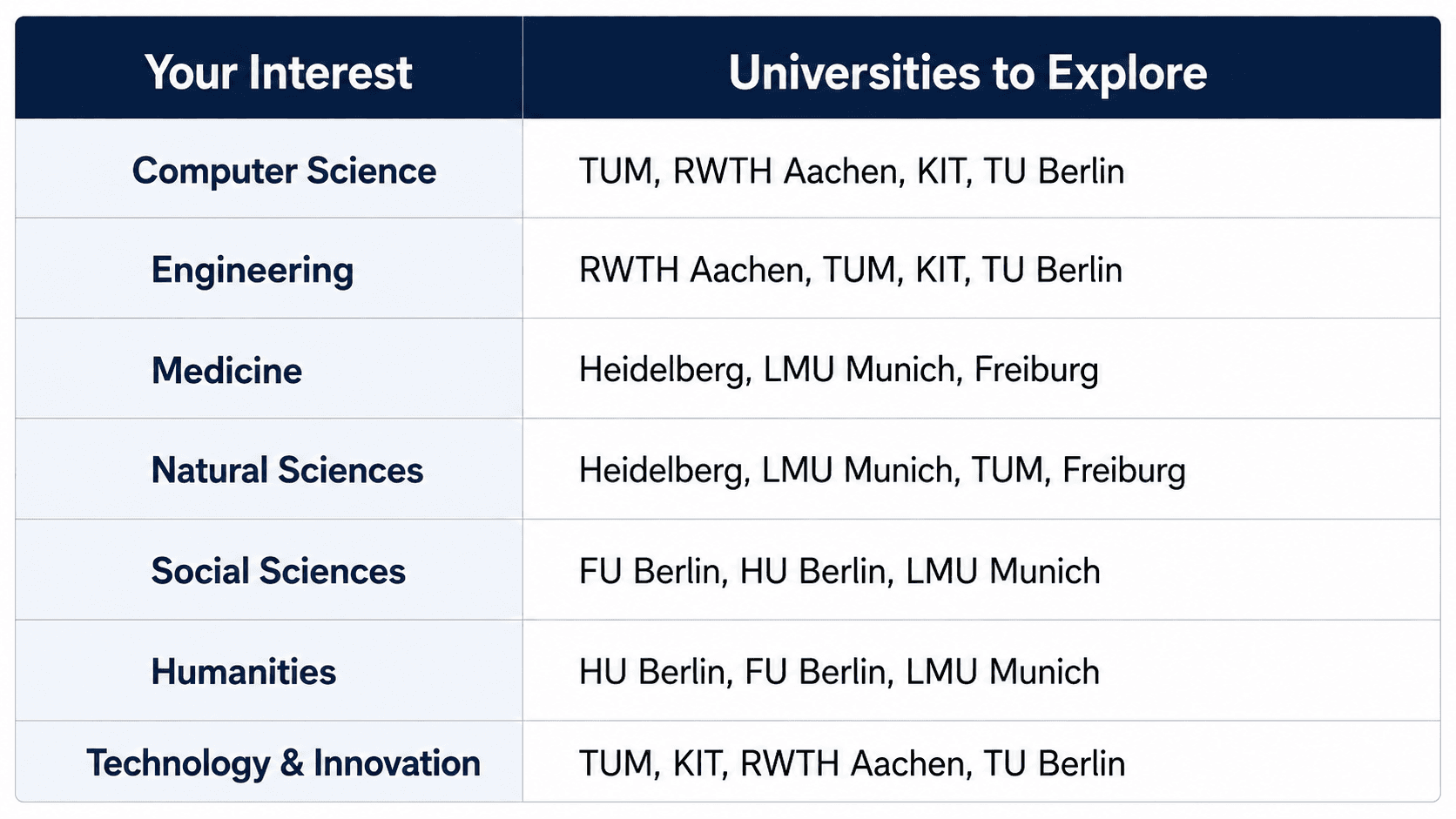
This is a starting point rather than a definitive ranking. The exact quality and suitability of a programme should be checked at the department and course level.
Public vs Private Universities in Germany
International students often ask whether they should choose a public or private university.
Public Universities
Public universities are usually the first option students investigate because many programmes have relatively low tuition costs compared with private institutions.
However, students may still have to pay a semester contribution and cover their living expenses.
Private Universities
Private universities can offer different teaching models, specialised programmes, smaller classes, or industry-focused courses.
However, tuition fees can be significantly higher.
Before choosing a private university, compare:
Total tuition fees
Accreditation
Programme quality
Career opportunities
University reputation
Admission requirements
Scholarships or financial support
Don't assume that private automatically means better.
What Should International Students Check Before Applying?
Before applying to any German university, check these points carefully:
1. Course Content
Read the actual curriculum instead of relying only on the university name.
2. Language
Check whether the programme is taught in English, German, or both.
3. Admission Requirements
Your academic qualification may not provide direct admission to every German programme.
4. Tuition and Semester Costs
Check the exact fees for your programme and state.
5. Living Costs
Rent can vary considerably between cities.
6. Career Opportunities
Look at internships, industry connections and employment opportunities related to your course.
7. Location
Consider whether you prefer a large city such as Berlin or Munich or a smaller university town.
8. International Support
Check whether the university offers support services for international students.
DAAD's CHE University Ranking allows prospective students to compare universities and departments based on subject-specific criteria, including teaching, student support, international orientation, equipment and career-related factors.
Are German Universities Good for International Students?
Many German universities have a strong international orientation, but the experience can differ significantly between institutions and programmes.
For example, some programmes have a large proportion of international students and English-taught courses, while others may be primarily German-speaking.
DAAD's university resources allow students to explore different types of higher education institutions, programmes and subject groups across Germany.
Therefore, don't judge a university only by its overall reputation. Look at the specific course you want to study.
How to Choose the Right German University
A simple way to make your decision is to create a shortlist of around five to eight universities.
For each university, compare:
Course curriculum
Admission requirements
Language requirements
Tuition and semester fees
Living costs
City
Student accommodation
Internship opportunities
Career prospects
International student support
Then remove the universities that don't match your academic qualifications or budget.
Finally, compare the remaining options based on your long-term career goals.
The goal isn't to find the university with the biggest name.
The goal is to find the university where the course, cost, location and career opportunities make sense for you.
Frequently Asked Questions
Which is the best university in Germany?
There is no single university that is officially the best for every subject. Germany's CHE University Ranking is deliberately subject-specific because universities can perform differently across different disciplines.
Which university is best for engineering in Germany?
RWTH Aachen, TUM, KIT and TU Berlin are strong universities to research if you are interested in engineering and technology. However, you should compare the specific programme rather than choosing based only on the university name.
Which university is best for computer science in Germany?
TUM, RWTH Aachen, KIT and TU Berlin are among the universities international students may want to investigate for computer science and related technical fields.
Are German public universities free for international students?
Many public universities do not charge tuition fees for many Bachelor's and Master's programmes, but this is not universal. Semester contributions and other living expenses still apply, and certain states or programmes may charge tuition.
Can international students study in Germany in English?
Yes. Germany has English-taught programmes, particularly at Master's level, although many programmes are taught in German. Always check the language of instruction for the specific course.
How many universities should I apply to in Germany?
There is no universal number that works for everyone. A better strategy is to apply to programmes where you meet the academic and language requirements rather than applying randomly to a large number of universities.
Final Thoughts
Germany offers international students a wide range of universities and study options, from technology-focused institutions such as TUM, RWTH Aachen and KIT to comprehensive universities such as LMU Munich, Heidelberg and the universities in Berlin.
But the best university in Germany is ultimately the one that fits your goals.
Before applying, compare the exact programme, admission requirements, teaching language, costs, location and career opportunities.
Don't choose a university simply because it appears high on a ranking.
Choose the course first, understand where it can take your career, and then find the German university that gives you the strongest overall fit.
That approach can help you make a more informed decision and avoid choosing a university based only on popularity.