

Germany University Admission Requirements: Complete Guide for International Students
Planning to study in Germany can feel exciting until you reach the application requirements. Suddenly, the questions start piling up.
Is my school qualification accepted? Do I need IELTS? Can I apply directly? Do I need German? What documents are required? Do I need Studienkolleg? How much money do I need for the visa?
These questions are important because getting admission to a German university is not simply about having good grades.
Your eligibility can depend on your previous qualification, chosen degree, subject, language of instruction, university requirements and country of education.
Germany's official guidance recommends checking whether your qualification gives you access to higher education before applying. DAAD provides an admission database and My GUIDE specifically for this purpose, while the final admission decision is made by the university itself.
So, before you start sending applications, here's what you actually need to know.
What Are the Basic Requirements to Study in Germany?
For most international students, the application process revolves around several key requirements:
Recognised academic qualification
Required language proficiency
Programme-specific academic requirements
Required application documents
Application through the correct platform
Proof of financial resources when required
Student visa or residence requirements, depending on nationality
The exact requirements can differ between universities and programmes. That's why there is no single checklist that applies identically to every international student.
1. You Need a Recognised University Entrance Qualification
The first and most important question is:
Does your existing qualification allow you to enter higher education in Germany? Germany calls this a university entrance qualification, or Hochschulzugangsberechtigung.
For international applicants, the answer depends on the qualification you obtained in your home country.
DAAD explains that students with non-German school-leaving certificates may sometimes be eligible for direct admission, while others may need additional study or a preparatory programme before starting university.
This means that simply completing high school does not automatically guarantee direct entry to a German Bachelor's programme.
2. Your Qualification May Need to Be Checked
If you completed your education outside Germany, you should check how your qualification is evaluated for German university admission.
DAAD provides an official Admission Requirements Database, while My GUIDE can help students check whether their educational background is suitable for their intended programme.
The evaluation can depend on:
Country where you studied
Type of qualification
Subjects studied
Grades
Previous university study
Degree level
Intended subject in Germany
And this is where many students make a mistake.
They see that another student from their country was accepted and assume they automatically have the same eligibility.
That isn't necessarily true.
Your qualification and your chosen programme have to be evaluated for your individual situation.
3. Do You Need Studienkolleg?
Some international students cannot enter a German university directly after completing their secondary education.
In certain cases, they may need to complete a Studienkolleg, a preparatory programme designed to prepare international students for university study in Germany.
DAAD states that students whose school-leaving certificate is not recognised as a higher education entrance qualification may need to complete a Studienkolleg or, depending on their qualification, undertake other qualifying study before university admission.
A Studienkolleg generally includes:
German language preparation
Subject-specific preparation
Preparation for university study
An assessment examination
After successfully completing the required assessment, students can gain the relevant university entrance qualification for corresponding fields of study.
So if you're applying for a Bachelor's degree after high school, don't assume direct admission until you've checked your qualification.
4. Bachelor's and Master's Requirements Are Different
Another common mistake is treating all German university applications the same.
They aren't.
Bachelor's Applicants
Bachelor's applicants generally need a recognised school-leaving qualification that provides access to higher education in Germany.
Depending on the country and qualification, additional academic requirements may apply.
Master's Applicants
For a Master's programme, you normally need a relevant university degree that meets the programme's academic requirements.
The university may also specify:
Required Bachelor's subject
Minimum credits
Specific modules
Minimum grade
Relevant academic background
Language proficiency
Work experience for certain programmes
So someone applying for a Master's in Computer Science, for example, may need a Bachelor's background with specific computer science or related coursework.
The Master's degree title alone doesn't guarantee eligibility.
5. Do You Need German to Study in Germany?
This depends heavily on your programme.
For German-taught programmes, you normally need to prove German-language proficiency. DAAD states that most programmes in Germany are taught in German and many institutions require German proficiency of at least B2, although the exact level and accepted certificates depend on the programme.
Common German-language qualifications can include certificates such as:
TestDaF
DSH
telc Deutsch C1 Hochschule
Goethe certificates
The exact certificate accepted depends on the university and programme.
What About English-Taught Courses?
For English-taught programmes, German proficiency generally isn't required for admission simply because the programme is taught in English.
Instead, you may need to provide proof of English proficiency.
This could include IELTS, TOEFL or another form of proof accepted by the university.
This connects directly with your previous article:
Study in Germany Without IELTS
Because some programmes may accept alternative proof, but you must check the individual programme requirements.
6. English Language Requirements
If you're applying for an English-taught programme, don't assume that every German university has the same English requirement.
One programme may accept IELTS.
Another may accept TOEFL.
Another may accept a different recognised certificate or evidence of previous English-medium education.
The required score also varies.
Therefore, before taking an English test, first check:
What does my chosen university actually accept?
This can save you time and money.
And if you're trying to study in Germany without IELTS, check the programme's official language requirements rather than relying on third-party lists.
7. Academic Requirements Can Be More Important Than Your Overall Grade
Getting a good overall grade is helpful, but some programmes look beyond your final percentage or GPA.
For example, a programme may require particular subjects or academic credits.
This is especially relevant for Master's programmes.
A university may ask whether you studied:
Mathematics
Programming
Statistics
Economics
Physics
Engineering
Research methods
depending on the programme.
That's why you should always read the programme-specific admission requirements, not just the university's general admission page.
8. What Documents Do You Need?
Your exact document list depends on the university and programme, but international applications commonly involve academic and personal documents.
These may include:
Passport
School-leaving certificate
Bachelor's degree certificate
Academic transcripts
Language certificate
CV
Motivation letter
Recommendation letters
Course descriptions
Proof of previous study
Portfolio for certain programmes
Not every programme requires every document.
DAAD states that the International Office of the chosen higher education institution provides the detailed information about which documents must be submitted.
This is important because submitting unnecessary documents isn't the main problem.
Submitting a required document incorrectly or leaving it out can be.
9. Do You Need a Motivation Letter?
Not every German university or programme requires a motivation letter.
But some programmes do.
When required, don't treat it as a formality.
A strong motivation letter should explain:
Why you chose the programme
Why your previous education is relevant
What you want to learn
Why the university fits your goals
What you plan to do after the degree
Avoid writing:
“Germany is a beautiful country and I have always dreamed of studying there.”
That's not a strong academic reason.
Instead, connect your education → programme → skills → future goals.
10. Do You Need a CV?
Some universities or programmes require a CV, particularly for Master's applications. If requested, keep it focused on your academic and professional background.
Include relevant:
Education
Internships
Work experience
Projects
Research
Technical skills
Certifications
Academic achievements
Don't turn your CV into a long personal biography. For university admission, relevance matters more than filling pages.
11. Where Do You Apply to German Universities?
This depends on the university and programme.
International applicants may need to apply:
Directly through the university
Through uni-assist
Through another application system, depending on the programme
DAAD explains that the application route varies according to the programme, admission restrictions and university. For applicants from outside the EU/EEA, applications may be submitted through uni-assist or directly to the chosen higher education institution, depending on the institution's process.
So before applying, look for the university's official:
“How to Apply”
page.
Don't automatically assume every German university uses uni-assist.
12. What Is uni-assist?
uni-assist is an application service used by many German universities to evaluate applications from international students. However, it isn't used by every university for every programme.
If your university tells you to apply through uni-assist, you'll need to follow its application process and document requirements.
If the university accepts direct applications, you'll use the university's own system.
The correct application route should always come from the university itself.
13. What About Admission Restrictions?
Some degree programmes have admission restrictions.
DAAD explains that there are different types of admission restrictions, including restrictions that apply nationally and restrictions determined by individual universities.
Medicine, dentistry, veterinary medicine and pharmacy are examples of highly regulated fields where admission can be particularly competitive.
Other programmes may have university-specific requirements or no admission restrictions at all.
This means:
Meeting the minimum eligibility requirements doesn't always mean you'll automatically receive an offer.
For competitive programmes, there may be more qualified applicants than available places.
14. Do You Need Proof of Money for a German Student Visa?
If you require a German student visa, you generally need to demonstrate that you can support yourself financially.
Germany's official Make it in Germany portal currently states that students can prove their financial resources through options such as a blocked account, scholarship or declaration of commitment.
For 2026, the required amount for a blocked account is at least €11,904 for the year.
That works out to:
€992 per month.
This is a visa-related financial requirement and should not be confused with the exact cost of living in every German city.
Your actual expenses may be higher or lower depending on accommodation, city and lifestyle.
15. Do You Need a Student Visa?
Your visa requirement depends on your nationality.
EU/EEA citizens generally do not need a visa to study in Germany.
Students from many other countries need a visa before travelling to Germany for study.
Germany's official guidance also notes that certain nationalities can enter without a visa but may still need to obtain a residence permit for longer stays.
If you need a visa, you should begin the process early.
Don't wait until the university semester is about to begin.
16. Can You Work While Studying?
Yes, international students can work under specific conditions.
Germany's current official guidance states that students can work up to 140 full days or 280 half-days per year, or up to 20 hours per week under the applicable rules.
But don't build your entire study budget around a part-time job.
You should first make sure you can financially support yourself.
Part-time work can provide useful experience and additional income, but it shouldn't be your only financial plan.
Germany University Admission Checklist
Before submitting your application, use this simple checklist:
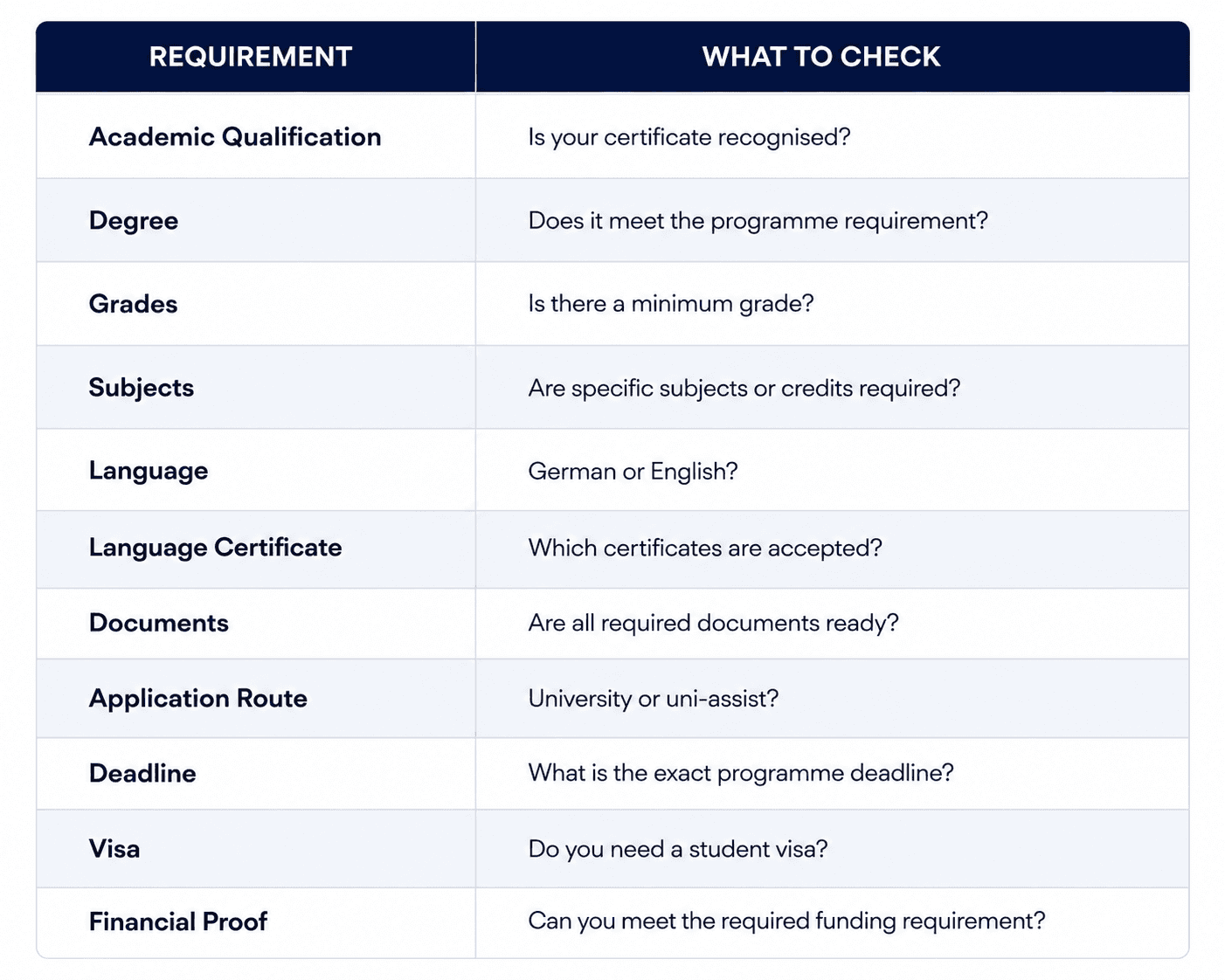
How to Check Your Eligibility Before Applying
Here's the process I recommend.
Step 1: Choose Your Programme
Don't start with the visa.
Start with the degree you actually want to study.
Step 2: Check the Language
Find out whether the programme is taught in German or English.
Step 3: Check Your Academic Qualification
Use DAAD's admission database or My GUIDE to get an initial indication of whether your qualification provides access to German higher education.
Step 4: Read the University's Requirements
Check the exact programme page.
Step 5: Prepare Your Documents
Make sure names, dates, grades and translations are consistent.
Step 6: Check the Application Platform
Find out whether you need uni-assist or direct application.
Step 7: Check the Deadline
Never assume every German university follows the same deadline.
Step 8: Plan Your Visa
If you need a visa, prepare financial and other documentation early.
What If Your Qualification Is Not Accepted Directly?
Don't immediately assume that studying in Germany is impossible.
Depending on your educational background, you may have another route.
This could involve:
Additional university study in your home country
Studienkolleg
A preparatory course
Another qualifying pathway
The correct route depends on your qualification and intended programme. DAAD specifically recommends checking its admission database and My GUIDE because international qualifications are evaluated differently depending on the country and educational background.
Common Mistakes International Students Should Avoid
Applying Before Checking Eligibility
Don't spend money on an application before confirming that your qualification meets the basic requirements.
Assuming All Universities Have the Same Rules
They don't.
Assuming IELTS Is Always Required
It depends on the programme.
Assuming IELTS Is Never Required
That is equally wrong.
Ignoring Programme-Specific Requirements
Your university may have additional academic requirements.
Applying at the Last Minute
Documents, translations, application processing and visa procedures can all take time.
Trusting Old University Lists
Requirements change.
Always check the current official programme information.
Frequently Asked Questions
What qualifications do I need to study in Germany?
You need a recognised university entrance qualification for the degree you want to study. The exact qualification depends on your country and educational background. DAAD provides an admission database to help applicants check this.
Can I study in Germany after 12th?
Yes, potentially, but whether you can enter a Bachelor's programme directly depends on whether your school-leaving qualification is recognised as a German higher education entrance qualification. Some students may need additional study or Studienkolleg.
Is IELTS mandatory for Germany?
No, not for every programme. English-taught programmes may accept different forms of English-language proof, while German-taught programmes have German-language requirements. Always check your specific programme.
Can I apply to Germany without German?
Yes, if you choose an English-taught programme that does not require German proficiency. German-taught programmes generally require proof of German language skills.
How much money do I need for a German student visa?
For 2026, the official Make it in Germany portal states that students using a blocked account need at least €11,904 for one year, although other accepted methods of financial proof may also apply.
Can international students work in Germany?
Yes. Under current rules, international students can generally work up to 140 full days or 280 half-days per year, subject to the applicable conditions.
Final Thoughts
Germany's university admission process isn't impossible.
But it isn't one-size-fits-all either.
Your eligibility depends on your previous education, your intended degree, your language, your academic background and the requirements of the university you choose.
The smartest approach is therefore not to start by asking:
“Which German university will accept me?”
Start with:
“Does my qualification make me eligible for the programme I actually want?”
Then check the language requirements, documents, application route, deadline and visa requirements.
DAAD's admission database and My GUIDE can help you understand your initial eligibility, but remember that the final admission decision belongs to the university.
If you get these steps right before applying, you can avoid one of the most common study-abroad mistakes: spending time and money on an application that was never eligible in the first place.