

Why Study in Germany? 10 Benefits for Students
Meta Description: Why study in Germany? Explore 10 real benefits for international students, from affordable education and top universities to part-time work and career opportunities.
Choosing a country for higher education is a major decision.
For many international students, the shortlist usually includes countries such as the USA, UK, Canada, Australia and Germany. Each destination has its advantages, but Germany has built a particularly strong position for students who want a combination of quality education, internationally recognised degrees, reasonable study costs and career opportunities.
But is Germany actually worth considering in 2026?
For a growing number of international students, the answer is yes. In the 2024/25 winter semester, Germany had around 492,600 foreign students enrolled at its higher education institutions. The number of foreign students increased by 5% compared with the previous year.
That growth is not surprising. Germany offers thousands of degree programmes, a wide range of universities and a study environment that can be attractive to students from different academic and financial backgrounds. DAAD's current database lists 22,698 study programmes in Germany.
Here are the biggest reasons international students choose Germany for higher education.
1. Many Public Universities Have Low or No Tuition Fees
One of the biggest reasons students consider Germany is the cost of higher education.
At many state-funded higher education institutions, there are generally no tuition fees for Bachelor's programmes and most Master's programmes. However, this does not mean that every programme is completely free.
Students usually have to pay a semester contribution, and tuition fees can apply in certain situations. For example, Baden-Württemberg charges non-EU students €1,500 per semester for many degree programmes, while some institutions in Bavaria may also charge tuition fees for non-EU students.
This is why students should check the exact fee structure of their chosen university rather than assuming that all German universities are free.
Still, compared with many expensive international study destinations, the public university system can make Germany financially attractive.
2. You Can Choose From Thousands of Study Programmes
Another major advantage is choice.
Germany's higher education system covers a huge range of academic fields, including:
Computer Science
Artificial Intelligence
Data Science
Engineering
Mechanical Engineering
Electrical Engineering
Medicine
Business
Finance
Natural Sciences
Environmental Studies
Social Sciences
Architecture
Research
DAAD's current database lists more than 22,000 study programmes, with filters for degree level, subject, institution, location, language and admission deadline.
That means students don't have to choose Germany simply because they want to study engineering. There are options across many different academic and professional fields.
3. Germany Has Universities for Different Academic Goals
There isn't one type of university in Germany.
Students can choose from traditional universities, universities of applied sciences and specialised institutions such as art and music colleges.
This matters because students have different goals.
Someone planning an academic or research career may prefer a research-focused university.
Someone who wants more practical and industry-oriented education may prefer a university of applied sciences.
The important question isn't simply:
“Which university is the most famous?”
A better question is:
“Which university and programme fit my career goal?”
4. Germany Is Strong in Engineering, Technology and Research
Germany has a long-standing reputation for engineering and technical education.
Fields such as mechanical engineering, electrical engineering, automotive technology, computer science, natural sciences and research are particularly relevant for students interested in technology-driven careers.
But students should avoid choosing a course only because Germany is famous for a particular industry.
The right course still depends on your academic background, interests and career plans.
For example, a student interested in artificial intelligence may look at computer science, AI or data-related programmes, while another student interested in sustainable technology may explore environmental engineering or renewable-energy-related programmes.
The key benefit is the breadth of options within Germany's higher education system.
5. You Can Find English-Taught Programmes
One common concern among international students is:
“Do I need to speak German before studying in Germany?”
Not always.
Germany has both German-taught and English-taught programmes. The exact language requirement depends on the university and programme.
For an English-taught degree, the university may require proof of English proficiency. For German-taught programmes, applicants generally need to demonstrate the required German-language proficiency.
This makes Germany accessible to students who want to begin their international education in English, while learning German can still be extremely useful for everyday life and future employment.
DAAD's programme database allows students to filter programmes by course language, making it easier to find suitable options.
6. The Cost of Living Can Be Manageable With Proper Planning
Tuition is only one part of the total cost of studying abroad.
Accommodation, food, transport, health insurance and personal expenses also matter.
DAAD estimates that students generally need around €900–€1,200 per month for living expenses in Germany, depending largely on where they live and their lifestyle. Rent is one of the biggest factors affecting the overall budget.
This is why choosing a city carefully matters.
Living in a major city can be more expensive than living in a smaller university town. Students should compare rent, transport, food and other expenses before accepting an offer.
Germany is not a “zero-cost study destination.” But with realistic budgeting, it can be a financially attractive option for many international students.
7. International Students Can Work While Studying
For students who want to gain work experience or earn additional income during their studies, Germany provides legal opportunities for international students to work.
Students from third countries can generally work up to 140 full days or 280 half-days per year without approval from the Federal Employment Agency. The rules also allow certain student employment arrangements of up to 20 hours per week.
Students may find work in areas such as:
University research
Libraries
Hospitality
Retail
Student assistant positions
Internships
Other part-time roles
However, part-time work should be viewed as an additional source of income and experience—not as a substitute for proper financial planning.
8. Germany Offers Scholarships and Financial Support Options
Studying abroad can still be expensive even when tuition fees are low.
International students can therefore explore scholarships from organisations such as DAAD, universities, research institutions and other foundations.
DAAD specifically provides a scholarship database for international students and researchers looking for funding opportunities.
Scholarships are not guaranteed, and eligibility varies.
Academic performance, degree level, nationality, programme, research area and other factors can affect eligibility.
The smartest approach is to start searching early instead of waiting until the admission process is almost complete.
9. Germany Can Offer a Path From Study to Employment
For many students, the real question isn't just:
“Where can I study?”
It is:
“What happens after I graduate?”
Germany has established pathways that can allow international graduates to stay and look for qualified employment after completing their studies.
The German government's Make it in Germany portal states that graduates can apply for a residence permit for job searching after successfully completing their studies. The job-search residence permit can generally be issued for up to 18 months, during which graduates can look for qualified employment.
This does not mean every graduate will automatically get a job.
Your prospects still depend on your qualification, skills, experience, language ability and the demand for your profession.
But having a recognised pathway from education → job search → employment is an important consideration when comparing study destinations.
10. Germany Is Already a Major International Student Destination
Sometimes the strongest evidence of a country's attractiveness is simply who is choosing to study there.
Germany had approximately 492,600 foreign students in the 2024/25 winter semester, according to Germany's Federal Statistical Office. Foreign student numbers increased by about 5% compared with the previous year.
In 2024, around 145,100 foreign students started higher education in Germany for the first time, representing about 30% of all first-time higher-education entrants that year.
These numbers don't prove that Germany is automatically the best choice for everyone.
They do show that Germany has become an established destination within the global higher-education market.
Germany vs Other Popular Study Destinations
If you are comparing Germany with the USA, UK, Canada or Australia, don't ask which country is “best” in general.
Instead, compare the factors that matter to you.
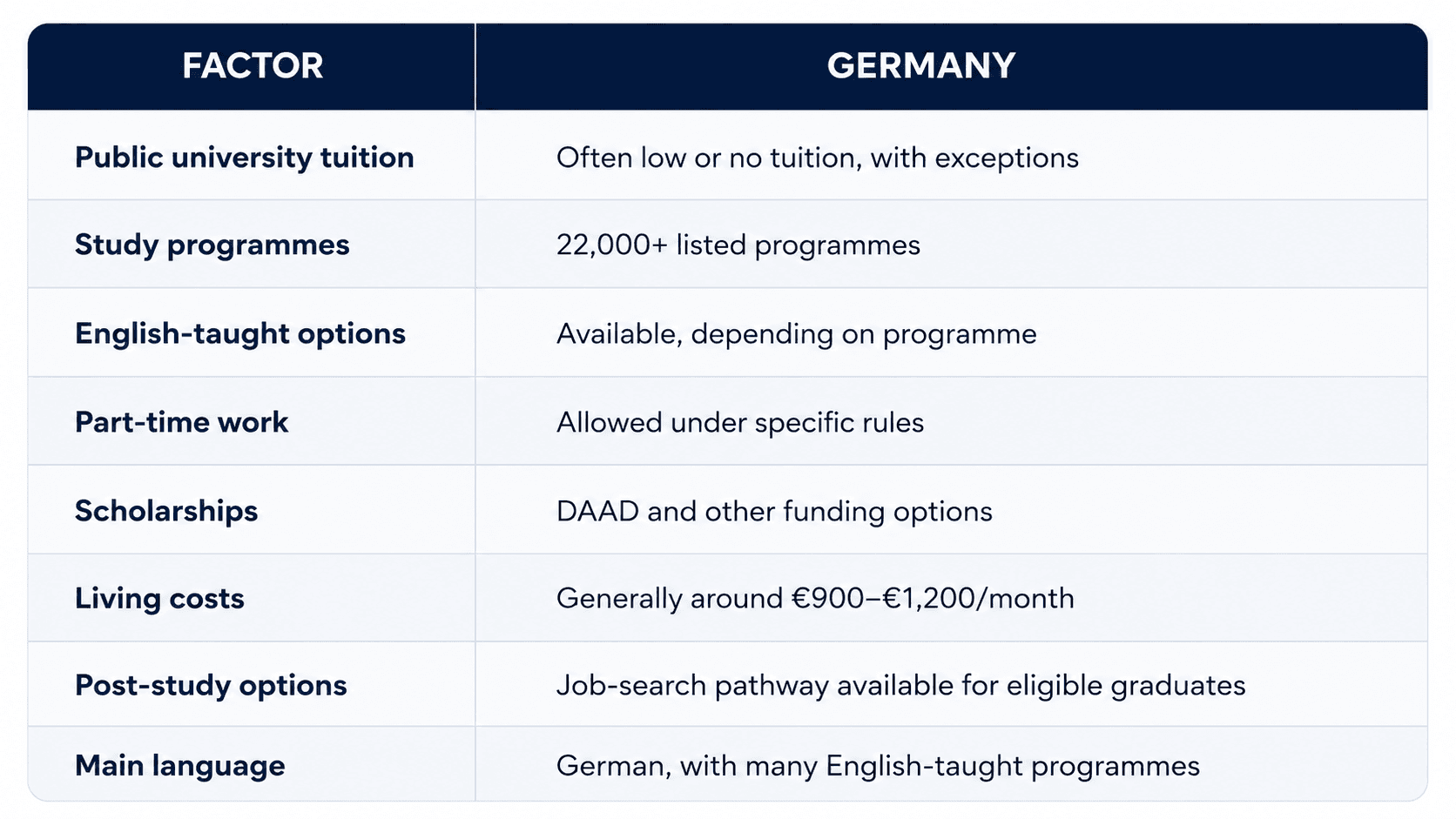
The final decision should depend on your budget, subject, preferred language, university choice and career plans.
Who Should Consider Studying in Germany?
Germany can be particularly worth considering if you:
Want to study at a public university with relatively low tuition costs
Are interested in engineering, technology, science or research
Want a wide choice of degree programmes
Are comfortable studying in English or willing to learn German
Want to gain international work experience
Are planning your career beyond graduation
Prefer a European study destination with a large international student population
But Germany isn't automatically the right choice for everyone.
If your preferred course is not available in a suitable language, your finances are insufficient, or you strongly prefer another country's education or lifestyle, another destination may make more sense.
What Are the Downsides of Studying in Germany?
A trustworthy guide should not only discuss the advantages.
Germany also comes with challenges.
Language
Even if your degree is taught in English, German can be important for daily life, internships and many jobs.
Housing
Affordable student accommodation can be difficult to find in popular cities, so students should start looking early.
Bureaucracy
Registration, residence documents, health insurance and other administrative processes can take time and require careful paperwork.
Admission Requirements
International qualifications are not automatically accepted for direct university admission in every case. Depending on your background, additional requirements or preparatory study may apply.
Financial Planning
“Low tuition” does not mean “low total cost.” Students still need enough money for rent, food, insurance, transport and other expenses. Understanding these challenges before moving to Germany can help you prepare realistically.
Is Germany Worth It for International Students?
For many students, Germany offers an unusually strong combination:
Affordable public higher education + a wide range of programmes + international study opportunities + legal work options + post-study career pathways.
But the real benefit depends on choosing the right programme.
Don't choose Germany simply because someone told you that university is free.
Don't choose a course simply because it is popular.
And don't choose a university simply because it appears in a ranking.
Instead, look at the complete picture:
Course → University → Cost → Admission → Language → Student Life → Work Experience → Career
If those eight factors fit your situation, Germany can be a very strong study-abroad option.
Frequently Asked Questions
Is Germany a good country for international students?
Yes, Germany is an established international study destination with a large foreign-student population, a broad higher-education system and many study programmes. In 2024/25, around 492,600 foreign students were enrolled at German higher education institutions.
Is studying in Germany free?
Not always. Many state-funded institutions generally do not charge tuition for Bachelor's and most Master's programmes, but semester contributions apply and some states, institutions or programmes charge tuition fees.
Can I study in Germany in English?
Yes. Germany offers English-taught programmes, although the availability depends on the subject and degree level. Always check the language requirements of your chosen programme.
Can international students work in Germany while studying?
Yes. Eligible international students can work under specific rules, generally up to 140 full days or 280 half-days per year.
Can I stay in Germany after graduation?
Eligible international graduates can apply for a residence permit to search for qualified employment after completing their studies. The job-search residence permit can generally be issued for up to 18 months.
Is Germany better than the UK, USA or Canada for studying?
There is no universal winner. Germany may be particularly attractive if you prioritise relatively low public-university tuition, technical education, a large range of programmes and European career opportunities. Your course, budget and career goals should determine the final choice.
Final Verdict
Germany's biggest advantage isn't one single feature. It is the combination of several things.
You can find thousands of study programmes, many public universities with relatively low tuition costs, English-taught options, scholarship opportunities, legal part-time work options and a pathway for eligible graduates to search for employment after completing their studies.
That's why Germany deserves a serious place on the shortlist of students planning to study abroad.
But don't make the decision based on a headline like “Germany is free.”
Research the university. Check the course. Calculate the total cost. Understand the language requirements. Look at the career path.
The right question isn't “Why should everyone study in Germany?”
It's:
“Could Germany be the right place for the education and career I want?”
For the right student, the answer can absolutely be yes.