
One-Page vs. Two-Page Resume: The Definitive Guide for 2026
Should your resume be one page or two pages? If you're still following the old rule that every resume must fit on one page, it's time to rethink it.
In 2026, there isn't a universal page-count rule. A strong resume is short enough to scan and long enough to prove you're qualified.
For students and early-career professionals, one page is usually the safest choice. For experienced professionals with substantial, relevant achievements, two pages can be completely appropriate. Indeed and MIT both emphasize relevance, readability, and clarity over blindly forcing every resume into one page.
So, one page or two page resume? Here's the practical answer.
The Quick Rule: How Long Should Your Resume Be?
Use this decision guide:
0–5 years of experience → Start with 1 page
6–10+ years → 1 or 2 pages, depending on relevant content
Senior, Lead, Manager, Executive, or highly technical roles → 2 pages can make sense
Academic/research CV → Different rules may apply
The important part is that years of experience alone shouldn't decide the length.
A professional with 12 years of experience may still have a focused one-page resume. Another person with seven years may genuinely need two pages because they have highly relevant projects, leadership experience, certifications, and measurable achievements.
MIT similarly recommends keeping a resume to one or two pages and focusing heavily on the information most relevant to the target role.
Why the One-Page Resume Rule Still Exists
The "one-page only" rule isn't completely useless.
Recruiters and hiring managers often scan resumes quickly, so a concise first page makes it easier to understand your value. MIT's 2026 career guidance continues to recommend one page in many situations because excessive information can bury the most important qualifications.
The problem is taking that advice too literally.
A cramped one-page resume isn't better than a clean two-page resume.
If you're shrinking your font to 7–8 points, removing white space, or turning every bullet into a dense paragraph just to save space, you've optimized for page count instead of readability.
Your resume has one job:
Make the right experience easy to find.
When a One-Page Resume Is Better
A one-page resume usually works best when your career history is relatively straightforward.
Choose one page if you:
Are a student or recent graduate
Have less than five years of professional experience
Are changing careers and have limited relevant experience
Have only a few highly relevant roles
Can communicate your strongest achievements without leaving out important evidence
For an early-career candidate, adding a second page simply to include every internship, college activity, or minor responsibility usually makes the resume weaker.
Keep the strongest information and remove the rest.
When a Two-Page Resume Makes Sense
A two-page resume becomes useful when one page forces you to remove information that genuinely strengthens your application.
This is particularly common for mid-career and senior professionals.
A second page can be appropriate when you have:
10+ years of relevant experience
Multiple leadership positions
Major projects or measurable achievements
Specialized technical expertise
Relevant certifications
Several closely related roles
Experience that directly matches the job description
Indeed's current guidance specifically identifies mid- to senior-level candidates and professionals with substantial relevant experience as situations where two pages may be appropriate.
But there's an important condition:
Page two needs to earn its place.
Don't add a second page just because you have enough content to fill it.
The 70% Rule: A Useful Editing Test
A practical rule is to avoid a nearly empty second page.
If your second page contains only a few lines, ask yourself:
Can I edit this back to one page without losing important information?
If yes, do it.
Indeed recommends turning a resume back into one page when a two-page version is barely more than a page and a half.
There isn't a universal requirement that page two must be "70% full," so treat that number as an editing guideline, not a recruiter rule.
The real test is simple:
Does page two contain enough relevant evidence to justify its existence?
What Should You Cut First?
Trying to shorten a resume doesn't mean deleting valuable experience. Start with the information that contributes the least.
1. Remove outdated education details
Once you have a degree and meaningful professional experience, high-school information usually doesn't deserve valuable resume space.
2. Delete generic soft-skill lists
"Hardworking," "team player," "excellent communicator" and similar phrases don't prove much on their own.
Show those qualities through achievements.
Instead of:
Excellent leadership and communication skills
Write:
Led a 12-person team through a six-month system migration with zero downtime.
The second version gives the recruiter evidence.
3. Condense older experience
Your most recent and relevant experience usually deserves the most space.
Older positions can often be reduced to one or two bullets—or removed entirely if they don't support your current career direction.
MIT recommends prioritizing relevant experience and tailoring the resume rather than trying to preserve every detail of a long career history.
4. Remove duplicated information
If your summary, skills section, and experience bullets all say the same thing, you're wasting space.
Say it once.
Say it well.
What About ATS and Resume Length?
An ATS (Applicant Tracking System) is software employers may use to collect, parse, search, and organize applications.
But don't fall for the idea that "one page automatically beats two pages with ATS."
Resume parsing focuses on extracting information such as skills, experience, and other resume data.
The better strategy is to make your resume both human-readable and machine-friendly:
Use standard section headings
Include relevant keywords naturally
Avoid unnecessarily complicated layouts
Use readable fonts
Keep dates and job titles clear
Match your experience to the job description
Prioritize achievements over keyword stuffing
MIT also recommends familiar formatting, readable fonts, consistent margins, and clear organization.
The 10-Second Resume Test
Before submitting your resume, open it and look only at the first page.
Ask yourself:
Can someone quickly understand:
What role I'm targeting?
What I specialize in?
How much relevant experience I have?
What results I've delivered?
Why I'm a strong match for this specific job?
If the answers aren't obvious, the problem isn't necessarily the page count.
The problem is the positioning.
One Page or Two Pages? The Final Decision
Here's the simplest way to decide:
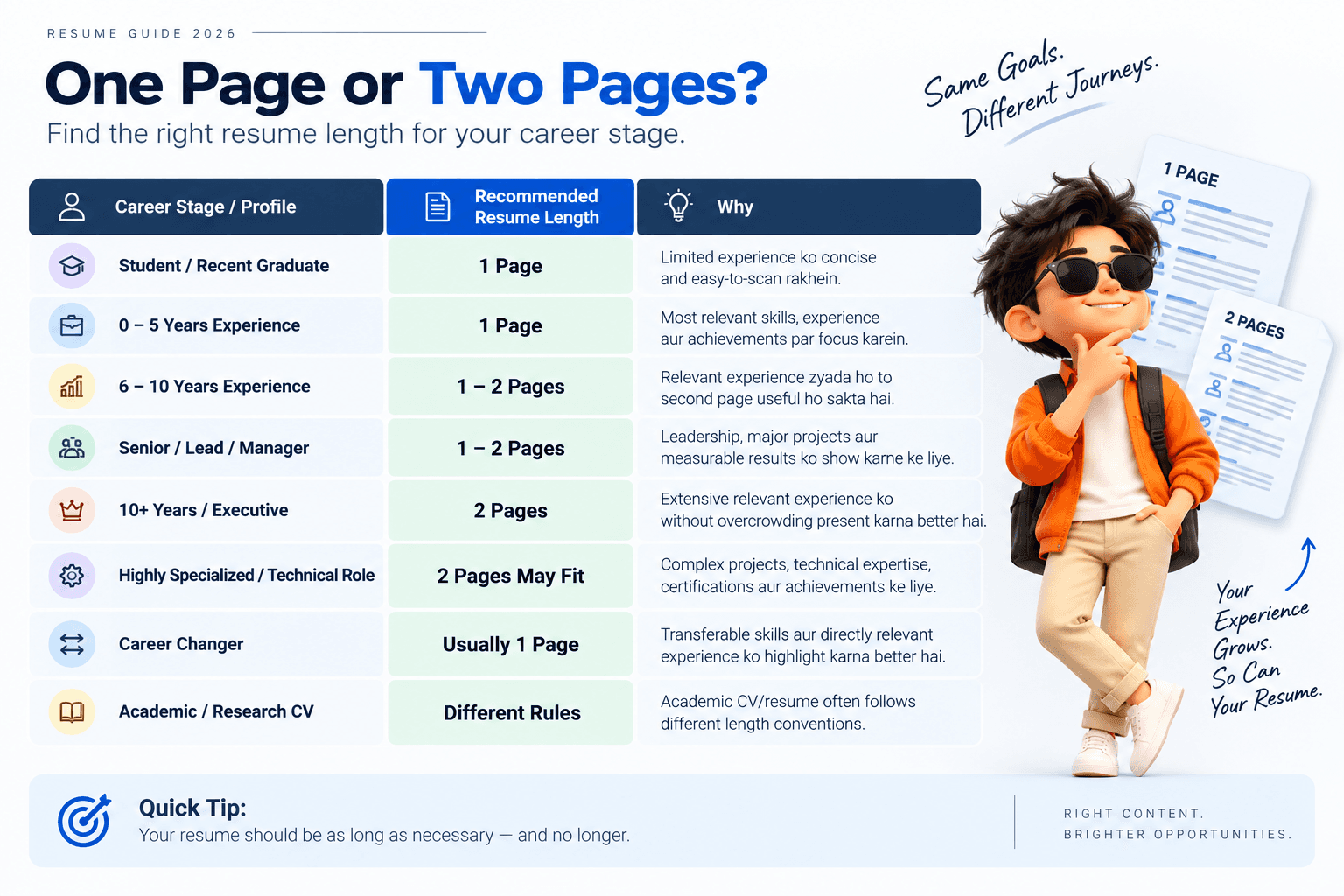
Don't make the mistake of treating these as hard laws.
Your resume should be as long as necessary—and no longer.
If one page communicates your qualifications clearly, use one page.
If cutting it to one page removes important achievements or makes the document difficult to read, use two.
The best resume isn't the shortest one.
It's the one that makes your strongest evidence impossible to miss.
If you're also looking for legitimate opportunities, check our guide on Remote Job Search: How to Find Legit Jobs. And if you're preparing for modern hiring processes, our guide on the AI Interview Process: How It Works and How to Prepare can help you prepare for the next stage.