
One-Page vs. Two-Page Resume: Which One Wins in 2026?
One Page or Two? The Resume Rule Has Changed
For years, job seekers were told one thing:
“Keep your resume to one page.”
That advice is useful—but it was never a universal law.
In 2026, the better question is not “How many pages should my resume be?”
It is:
“How much relevant information does the employer need to see to understand why I am a strong candidate?”
For a student or early-career professional, that answer may easily fit on one page.
For a senior professional with 10, 15 or 20 years of relevant experience, forcing everything onto one page can make the resume harder to read and less useful.
Current career guidance from Indeed also reflects this distinction: one page is generally preferred for concise presentation, but two pages can be appropriate when additional relevant experience or qualifications genuinely need the space.
So, one page doesn't automatically win—and two pages don't automatically impress.
The strongest resume is the one that communicates your value clearly without unnecessary content.
One-Page vs. Two-Page Resume: The Quick Decision
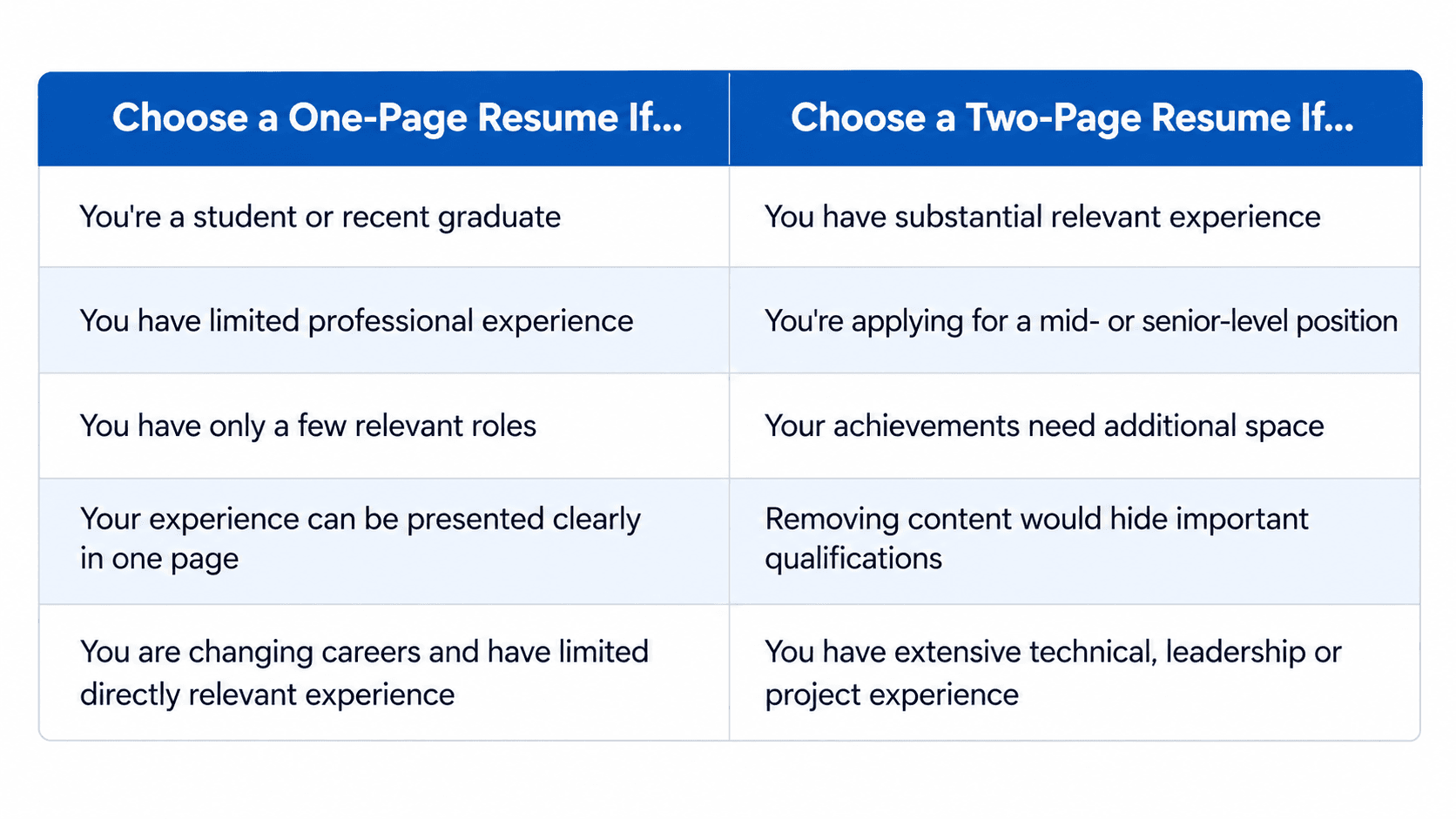
The key principle is simple:
Don't add a second page just because you can. Add it because the content deserves to be there.
The 2026 Resume Length Rule
There is no universal page-count rule that applies to every profession.
A useful guideline is:
0–5 years of experience
Aim for one page.
At this stage, focus on:
Relevant internships
Education
Projects
Skills
Certifications
Measurable achievements
Relevant work experience
You usually don't need to document every responsibility you've ever had.
5–10+ years of experience
One or two pages can work.
If your most relevant achievements comfortably fit on one page, that's perfectly fine.
If cutting the resume to one page means removing important leadership achievements, technical expertise or major projects, two pages may be better.
Senior, specialist and executive professionals
Two pages can be completely reasonable.
Senior candidates often have more relevant evidence to demonstrate:
Leadership
Business impact
Major projects
Technical expertise
Team management
Certifications
Strategic initiatives
Industry specialization
But even experienced professionals should avoid turning their resume into a complete autobiography.
What About ATS? Does It Reject Two-Page Resumes?
This is one of the biggest misconceptions surrounding resume length.
There is no universal ATS rule saying “one page = good” and “two pages = bad.”
Applicant tracking systems extract information such as job titles, companies, dates, skills and education from resumes. Page count itself is not the central issue.
Instead, your bigger ATS concerns are:
1. Can the system extract your text correctly?
2. Are your important skills and qualifications present?
3. Are your job titles and dates clear?
4. Is your resume structured logically?
5. Does your experience match the job description?
A two-page resume with clean structure and relevant keywords can be much stronger than a cramped one-page resume.
The Real ATS Problem: Bad Formatting
Instead of obsessing over page count, pay attention to formatting.
Avoid:
Text hidden inside images
Excessive graphics
Complicated tables
Decorative text boxes
Unusual section names
Tiny fonts
Huge blocks of text
Important information placed only in graphics
For most professional applications, a simple, readable structure is safer.
Think:
Name → Summary → Skills → Experience → Education → Certifications
rather than:
Graphic → icons → text boxes → charts → multiple decorative columns.
The Recruiter Scan Happens Fast
Your resume doesn't usually get a leisurely first read.
A well-known 2018 Ladders eye-tracking study found that recruiters spent an average of 7.4 seconds on an initial resume screen. The study also found that clear information hierarchy and readable formatting helped recruiters navigate resumes more effectively.
That doesn't mean a recruiter literally reads every resume for exactly 7.4 seconds.
It means your resume needs to make its value immediately discoverable.
Your first page should therefore answer three questions quickly:
Who are you?
Your professional identity should be obvious.
What can you do?
Your key skills should be easy to find.
Why should I interview you?
Your strongest achievements should appear early.
What Should Go on Page One?
If you're using two pages, Page One still matters the most.
Prioritize:
1. Professional headline
Instead of:
Resume
Try:
Senior Product Marketing Manager | B2B SaaS | GTM Strategy
This immediately establishes your professional positioning.
2. Short professional summary
Keep it focused on:
Experience
Specialization
Industry
Major strength
Measurable impact
3. Core skills
Include skills relevant to the position you're targeting—not every tool you've ever touched.
4. Most recent experience
Your latest and most relevant roles should receive the strongest attention.
5. High-impact achievements
Instead of writing:
Responsible for managing marketing campaigns.
Write:
Increased qualified leads by 38% through a redesigned B2B content strategy.
The second version gives the recruiter evidence.
How to Make a Two-Page Resume Look Professional
If your resume genuinely needs two pages, don't simply continue writing until you reach Page Two.
Use a deliberate structure.
Page One
Name + Contact
Professional Summary
Core Skills
Most Recent Experience
Major Achievements
Page Two
Earlier Relevant Experience
Projects
Certifications
Education
Additional Technical Skills
Only include sections that strengthen your application.
Indeed recommends maintaining conventional formatting, readable fonts and clear organization when creating a two-page resume.
Don't Make These 5 Resume-Length Mistakes
1. Shrinking the font to 8pt
If you need microscopic text to make everything fit, your resume probably needs editing—not smaller typography.
2. Adding irrelevant experience
More information doesn't automatically create more value.
3. Creating a second page with three bullets
If Page Two contains almost nothing, look for opportunities to tighten the document.
4. Listing every job you've ever had
Older experience matters less when it has little connection to your target role.
5. Treating page count as an ATS strategy
Changing from two pages to one page won't magically make your resume ATS-friendly.
Relevant content + clear formatting + job-specific keywords matter far more.
The Better Rule: Optimize for Relevance, Not Page Count
Here's the simplest way to decide:
Can everything important fit comfortably on one page?
→ Use one page.
Does forcing it onto one page remove important evidence of your qualifications?
→ Use two pages.
Does your second page contain mostly filler?
→ Cut it.
This approach is consistent with current resume guidance: length is secondary to relevance, readability and clarity.
One Page vs. Two Page Resume: Final Verdict
So, which resume wins in 2026?
Neither.
The relevant resume wins.
A fresh graduate with six months of experience probably doesn't need two pages.
A senior engineer with 15 years of specialized experience shouldn't destroy readability just to satisfy an outdated one-page rule.
Your resume should be as short as possible—but as long as necessary.
That's the real rule.
Before submitting your application, ask yourself:
“If I remove this line, will the employer lose useful evidence that I'm qualified?”
If the answer is no, remove it.
If the answer is yes, keep it.
And if your resume needs two pages after you've removed the filler, use two pages confidently.
FAQ
Is a one-page resume better for ATS?
Not necessarily. ATS compatibility depends much more on readable structure, extractable text and relevant information than simply whether the resume has one or two pages.
When should a resume be two pages?
A two-page resume can make sense when you're a mid- or senior-level professional or when important relevant qualifications cannot be presented clearly on one page.
Is a two-page resume bad for freshers?
Usually, yes—unless you have enough genuinely relevant content such as substantial projects, internships, leadership experience or specialized qualifications.
Should a 10-year experienced professional use two pages?
Not automatically. If your strongest qualifications can be communicated effectively on one page, that's fine. If important relevant experience requires additional space, two pages are reasonable.
What font size should a resume use?
Prioritize readability rather than shrinking text to force a page limit. Indeed recommends keeping resume text generally around 10–12 points.