
Remote Job Search: How to Find Legit Jobs
Remote work has changed the way people think about employment.
You no longer have to limit your job search to companies within commuting distance. A company in another city, state, or even country may be able to hire you without requiring you to sit in an office every day.
That sounds like good news—and it is.
But there is another side to the remote job market. More flexibility also means more competition. A single remote position can attract applicants from a much larger talent pool than a local office job.
There is also another problem: not every remote job posting is worth your time. Fake recruiters, misleading job advertisements, requests for upfront payments, and attempts to collect personal information can make online job searching risky.
So how do you find legitimate remote jobs without wasting hours scrolling through hundreds of listings?
The answer is not simply applying to more jobs.
You need a remote job search strategy.
What Makes Remote Job Searching Different?
When you apply for a traditional local position, location can naturally reduce competition.
Remote positions remove much of that limitation.
You may be competing with qualified candidates from different cities, regions, and countries. That means your application needs to communicate your value quickly.
Remote employers also tend to care about something that is harder to demonstrate on a traditional resume:
Can you work effectively without someone constantly supervising you?
For remote roles, employers may pay close attention to communication, reliability, organization, independent problem-solving, and your ability to manage work digitally.
That changes how you should search—and how you should present yourself.
1. Search for Remote Jobs in the Right Places
One of the biggest remote job search mistakes is relying entirely on one large job website.
General job boards can be useful, but don't make them your entire strategy.
Look across several sources:
Remote-Focused Job Boards
Dedicated remote job platforms can make it easier to discover opportunities designed for distributed teams.
Examples include:
We Work Remotely
Remote OK
Working Nomads
Wellfound
FlexJobs
Before applying, always check the actual job description and company details. A listing being labelled “remote” does not automatically mean it can hire candidates from every country.
Company Career Pages
This is one of the most overlooked strategies.
If you already know companies you would genuinely like to work for, visit their official careers pages and search for remote or distributed positions.
This approach can reduce your dependence on third-party listings and helps you verify that the vacancy actually exists.
Create a list of 20–30 companies that regularly hire for your type of role and check their careers pages periodically.
2. Don't Ignore Time-Zone Requirements
“Remote” does not always mean “work whenever you want.”
A company may be remote but still require employees to work within specific hours.
For example, a company may prefer candidates who can overlap with:
US Eastern Time
US Pacific Time
European working hours
UK business hours
APAC time zones
Before applying, check whether the job mentions:
Required working hours
Time-zone restrictions
Core collaboration hours
Country restrictions
Regional hiring requirements
This can save you from applying to positions where your location creates an obvious mismatch.
3. Build a Resume for Remote Work
A normal resume tells an employer what you have done.
A strong remote-work resume should also communicate how you work.
Instead of using vague statements such as:
“Good communication skills and a strong team player.”
Show evidence.
For example:
“Coordinated weekly project updates across three time zones using Slack, Notion, and video meetings.”
Or:
“Managed multiple client deliverables independently while consistently meeting weekly deadlines.”
The difference is simple: the second version demonstrates behaviour rather than making an unsupported claim.
Skills Worth Highlighting
Depending on your profession, consider demonstrating:
Written communication
Project management
Documentation
Independent problem-solving
Digital collaboration
Time management
Task prioritization
Cross-functional communication
Remote collaboration tools
Don't add these skills simply because they sound impressive. Include them when you can support them with actual experience.
4. Develop the Three Skills Remote Employers Notice
Technical skills matter, but remote employees need another layer of professional ability.
Clear Written Communication
Remote teams cannot rely on walking over to someone's desk.
A message needs enough context for another person to understand the situation and take action.
Instead of:
“The task isn't working.”
A better message might be:
“The payment integration is returning a 403 error after the latest update. I tested the previous version and the issue does not occur there. I’m checking the authentication configuration now.”
Clear writing reduces unnecessary meetings and makes collaboration easier.
Independent Problem-Solving
Remote managers don't want to answer every small question throughout the day.
Strong remote employees know how to investigate a problem, check documentation, test possible solutions, and then ask for help when necessary.
You don't have to solve everything alone.
You should, however, demonstrate that you attempted to understand the problem before escalating it.
Reliability and Follow-Through
Remote work gives you freedom, but it also requires accountability.
Meeting deadlines, communicating delays early, maintaining task updates, and documenting important decisions can make you a much stronger remote candidate.
5. Show That You Can Work Remotely
You don't necessarily need previous remote employment to prove that you're remote-ready.
You can demonstrate it through your work.
For example, mention situations where you:
Managed projects independently
Coordinated people across locations
Used digital project-management tools
Created documentation
Worked with distributed clients
Handled deadlines without constant supervision
Communicated progress asynchronously
If you are new to the workforce, personal projects can also help.
A well-documented project on GitHub, a portfolio website, a data-analysis case study, or a marketing campaign can demonstrate how you organize and communicate your work.
6. Stop Applying to Every Remote Job
More applications do not automatically mean more interviews.
One of the most useful remote job search strategies is targeted application.
Before applying, ask:
Do I meet most of the important requirements?
Does my experience match the role?
Can I explain why I am interested in this company?
Does the job actually accept applicants from my location?
Can I demonstrate the skills mentioned in the description?
If the answer is mostly yes, customize your resume and apply.
If the position requires five years of experience in a technology you have never used, sending the same generic resume probably won't help.
7. How to Avoid Remote Job Scams
Remote work scams are one of the biggest reasons you should verify an opportunity before sharing sensitive information.
Be particularly cautious when a recruiter or employer:
Asks You to Pay Money
A request for an upfront payment for a job, training, equipment, or “registration” should be treated as a major warning sign.
Never assume an opportunity is legitimate simply because the recruiter provides a professional-looking offer letter.
Sends You a Check and Asks You to Send Money Back
This is a classic employment scam pattern.
If someone sends you money or a check and asks you to purchase equipment, transfer part of it elsewhere, or return the remaining amount, stop and verify the employer independently.
Uses Pressure or Urgency
Be careful if someone tells you that you must:
Accept immediately
Pay today
Share sensitive information immediately
Buy equipment from a specific seller
Communicate only through an unusual channel
Legitimate hiring processes can have deadlines, but pressure should never replace verification.
Avoids Verifiable Company Information
Research the company independently.
Check whether:
The company has a legitimate website
The job exists on its official careers page
The recruiter has a credible professional profile
The company has a real business presence
Contact details match the company
Don't rely only on information provided by the person who contacted you.
Remote Job Search vs. Traditional Job Search
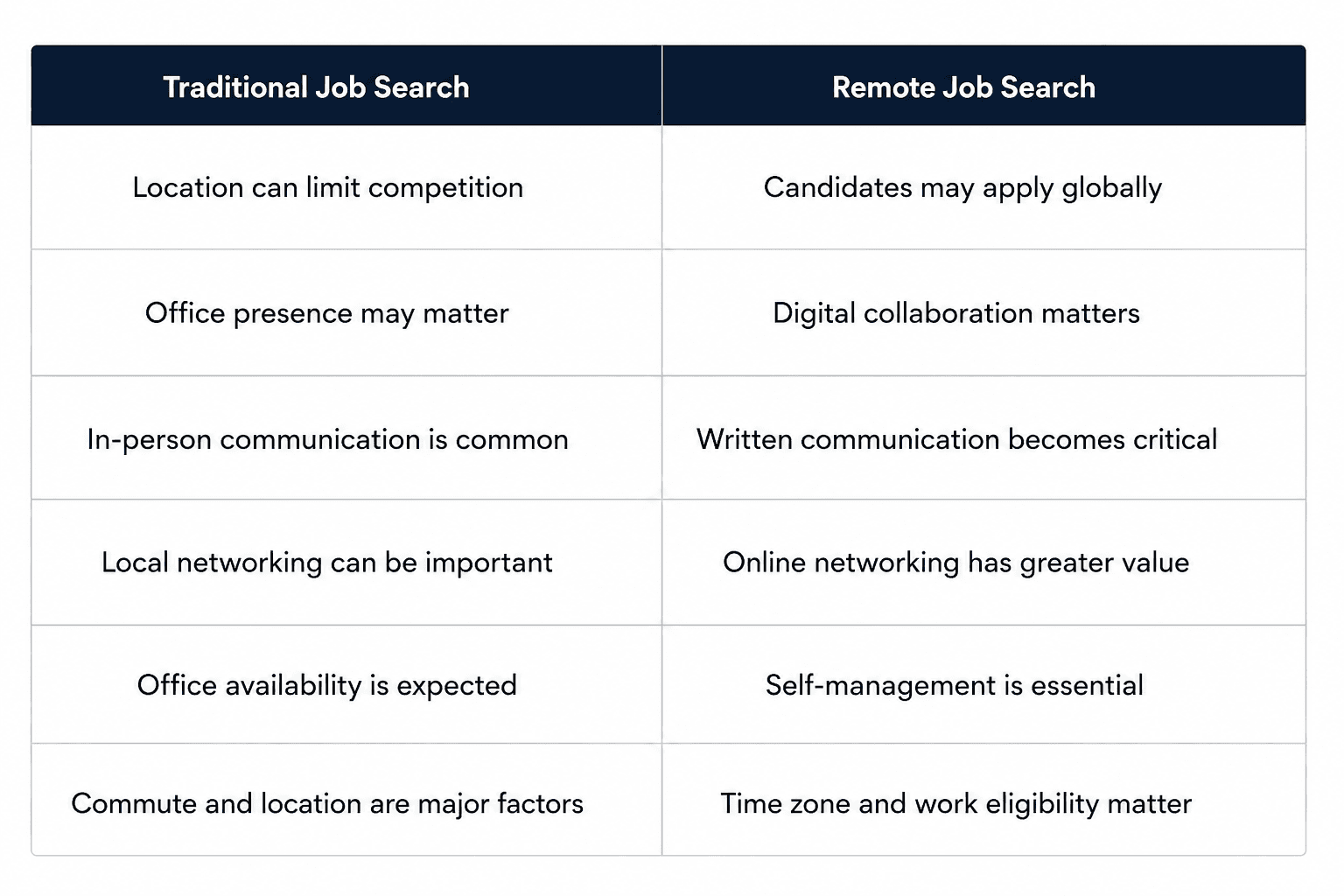
The key difference is that remote employers need confidence that you can deliver results without physical supervision.
What Should You Do If You Have No Remote Experience?
Don't treat “no remote experience” as “no chance.”
Start by making your existing experience relevant.
If you worked in an office, demonstrate projects where you worked independently.
If you are a student, show how you completed projects using digital tools.
If you are changing careers, create practical portfolio projects that demonstrate your ability to work independently.
The objective is to give employers evidence that you already possess the behaviours required for remote work.
A Simple Remote Job Search Routine
Instead of spending three hours randomly browsing job boards, create a repeatable system.
Step 1: Choose one or two target job titles.
Step 2: Identify 5–10 companies you would genuinely consider joining.
Step 3: Search remote-focused job boards and company career pages.
Step 4: Save relevant positions and remove obvious mismatches.
Step 5: Customize your resume for the strongest opportunities.
Step 6: Apply and track every application.
Step 7: Follow up where appropriate and continue networking.
Step 8: Review your results every few weeks.
If you're receiving applications but no interviews, your resume or targeting may need improvement.
If you're getting interviews but no offers, your interview preparation may be the bigger issue.
That distinction matters.
Final Takeaway
Finding a legitimate remote job is not about discovering a secret website or sending hundreds of applications every week.
It's about building a smarter system.
Search across multiple sources. Verify companies before sharing personal information. Pay attention to time zones and location restrictions. Make your resume demonstrate remote-ready behaviour. Build proof of your skills and focus on roles where your experience genuinely matches the requirements.
Most importantly, don't confuse “work from home” with “easy work.”
The best remote opportunities are still competitive because companies are looking for people who can communicate clearly, manage their responsibilities, solve problems independently, and consistently deliver results.
If you can demonstrate those qualities—and back them up with relevant skills and experience—you give yourself a much stronger chance of standing out in the remote job market.
Frequently Asked Questions
What is the best way to find legitimate remote jobs?
Use a combination of established remote job boards, official company career pages, professional networking, and targeted applications. Always verify the company and job before sharing sensitive information.
How can I find a remote job with no experience?
Start with entry-level positions that match your existing skills and build practical projects that demonstrate your ability. Customer support, administration, sales, marketing, operations, and some technical roles can offer different starting points depending on your background.
Are all work-from-home jobs legitimate?
No. Remote job scams exist across many industries. Be cautious about upfront payment requests, fake checks, pressure to act immediately, and recruiters who cannot provide independently verifiable company information.
How can I stand out when applying for remote jobs?
Show evidence of communication, independent work, organization, and results. Customize your resume around the specific position rather than submitting the same generic application everywhere.
Is remote work available internationally?
Some companies hire internationally, while others restrict positions to specific countries, regions, or time zones. Always check the job's location and employment requirements before applying.