

The Hidden Job Market: How to Find Jobs Before Everyone Else Does
Primary Keyword: how to access the hidden job market
Searching for a job usually follows the same routine.
Open LinkedIn. Search for your job title. Apply. Upload your resume. Repeat.
After a few weeks, it can start feeling like you're competing with hundreds of people for the same handful of jobs.
But there is another side of the hiring market that job boards don't show you clearly.
Some opportunities are discovered through employee referrals, professional networks, recruiters, internal conversations, direct outreach, and relationships before they become widely visible to job seekers. That's what career professionals commonly call the hidden job market.
And you don't need a huge network or a famous LinkedIn profile to access it.
You need a smarter job-search strategy.
What Is the Hidden Job Market?
The hidden job market isn't a secret website containing thousands of invisible vacancies.
It is better understood as the part of hiring that happens outside the standard “find a job post → submit an application” process.
For example, a company might:
Hire through an employee referral
Promote someone internally
Ask employees if they know suitable candidates
Contact candidates already in a recruiter's network
Approach a professional directly
Create a role around a specific business need
Begin conversations with candidates before formally advertising a position
This is why relying only on job boards can limit your search.
It doesn't mean you should stop applying to advertised jobs. Instead, run two job-search tracks at the same time: apply to relevant openings while actively creating conversations that can lead to opportunities that aren't obvious yet.
If you're specifically looking for remote opportunities, our guide on Remote Job Search: How to Find Legit Jobs can help you evaluate remote roles more effectively.
Why Companies Don't Always Start With a Public Job Post
There are several reasons a company may not immediately advertise a position.
Sometimes the need is still being defined.
Sometimes an existing employee may be able to move into the role.
Sometimes the hiring manager already knows potential candidates.
And for specialized or senior positions, companies may use recruiters or professional networks to identify people rather than waiting for applications.
This doesn't mean companies are deliberately hiding jobs from candidates.
It simply means hiring doesn't always begin with a job advertisement.
That's an important distinction.
4 Ways to Access the Hidden Job Market
1. Build Relationships Before You Need a Job
The strongest networking doesn't begin with:
“Hi, are you hiring?”
It begins with genuine professional curiosity.
Connect with people working in companies, industries, and roles that interest you.
You could ask:
“I'm exploring product marketing as a career path and noticed your transition from content to product. What skill made the biggest difference when you made that move?”
That's a conversation.
A message asking for a job is a transaction.
Over time, conversations can become relationships—and relationships can expose you to opportunities before they reach a job board.
2. Use LinkedIn to Find People, Not Just Jobs
Most people use LinkedIn's Jobs tab.
That's useful, but it's only one part of the platform.
Try searching for:
Hiring managers
Department heads
Team leads
Recruiters
Alumni from your university
Employees at companies you want to join
Professionals doing the job you want
Then study what their teams are working on.
If a company is expanding its marketing team, launching a product, entering a new market, or building a new technology function, those developments can give you a reason to start a conversation.
This is one of the most useful hidden job market strategies on LinkedIn: use the platform to understand where the business is going, not simply where vacancies are listed.
3. Watch for Business “Trigger Events”
You don't have to guess when a company might need people.
Look for signals.
For example:
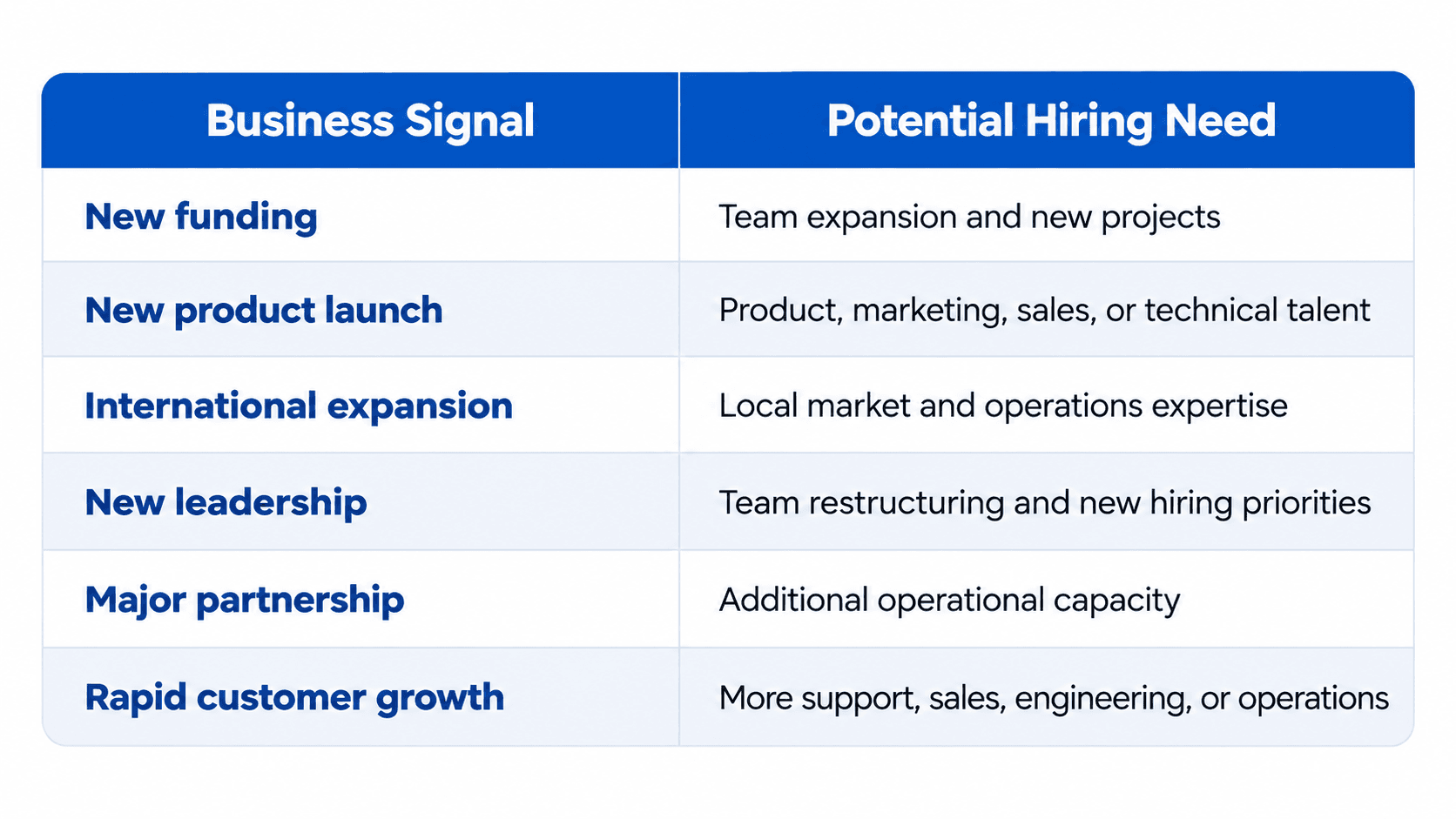
These events don't guarantee that a job is available.
But they give you something much more valuable: a reason to start a relevant conversation.
Instead of saying:
“Are you hiring?”
you can say:
“I noticed your company is expanding into the Southeast Asian market. I've worked on localized digital campaigns for similar markets, and I was curious about how your team is approaching that challenge.”
That's a much stronger opening.
4. Contact the Person Who Understands the Problem
One of the biggest mistakes in hidden-job searching is sending the same message to everyone.
If you're interested in a marketing role, don't automatically send your message to the company's generic HR email.
Find the person leading the relevant function.
That could be:
Head of Marketing
Growth Director
Product Manager
Engineering Manager
Sales Director
Operations Lead
Then learn something about their current priorities.
The goal isn't to manipulate someone into creating a job for you.
The goal is to demonstrate that your skills could potentially solve a problem they already have.
A Better Cold Outreach Example
Subject: Idea regarding [Company]'s [Initiative]
Hi [Name],
I noticed your team recently launched [specific initiative]. I've worked on similar projects involving [relevant skill], and one challenge I've seen at this stage is [specific problem].
In a previous project, I helped [brief result or achievement].
I put together a short overview of how we approached that challenge. If it's useful, I'd be happy to send it over.
No pressure for a call—I simply thought it might be relevant to what your team is working on.
Best,
[Your Name]
[LinkedIn/Portfolio]
Notice what this message doesn't say.
“Please give me a job.”
Instead, it establishes relevance first.
If the person responds positively, the conversation can naturally develop into a discussion about their team, upcoming needs, or potential opportunities.
Don't Make the Hidden Job Market More Complicated Than It Is
You don't need to message 100 executives every week.
You don't need thousands of LinkedIn followers.
And you definitely don't need to pretend you know everything about a company's problems.
Start with a small, consistent system.
Every week:
Find 5 companies you genuinely want to work for.
Identify 1–2 relevant professionals at each company.
Research their current priorities.
Send a personalized message where you have something relevant to contribute.
Follow up once if you don't receive a response.
Then move on.
The objective is to create professional conversations, not spam people's inboxes.
Should You Stop Applying to Job Boards?
Absolutely not.
That's another common misunderstanding about the hidden job market.
Public job postings still matter. Company career pages, LinkedIn, Indeed, and other job platforms remain important sources of opportunities.
The smarter strategy is to stop treating them as your only strategy.
Think of your job search as two lanes:
Visible Market:
Job boards → applications → interviews
Hidden Market:
Networking → referrals → conversations → direct outreach → opportunities
Using both gives you broader coverage.
The Real Advantage of the Hidden Job Market
The biggest advantage isn't that you'll magically discover a secret job.
It's that you stop depending entirely on a resume being selected from a huge pile.
A conversation gives you an opportunity to demonstrate something a resume cannot always communicate:
How you think.
You can show that you understand the industry, ask intelligent questions, explain your experience, and connect your skills to real business problems.
That's why how to find unadvertised jobs is ultimately less about finding invisible vacancies and more about becoming visible to the right people.
The hidden job market isn't a shortcut.
It isn't guaranteed.
And there is no magic percentage of jobs waiting behind LinkedIn.
But if you combine applications with relationships, referrals, targeted outreach, and genuine professional conversations, you give yourself access to opportunities that a job-board-only search can easily miss. Action Plan to Improve Communication Skills.
And sometimes, the best job opportunity isn't the one you find.
It's the one you become aware of before it becomes a job posting.