

The Hidden Job Market: How to Find Unadvertised Jobs Through Strategic Networking
Most job seekers follow the same routine: open LinkedIn, search job boards, upload a resume, and start applying.
There is nothing wrong with that.
But if how to find unadvertised jobs is your goal, applying to public listings is only one part of the strategy. Many opportunities are discovered through professional relationships, referrals, direct outreach, and conversations that happen before a job ever appears on a careers page.
One important clarification: you will often see claims that 70–80% of jobs are never advertised. That figure is widely repeated, but there is no strong evidence supporting it as a universal number. The University of Washington specifically notes that the origin of the 80% claim is difficult to trace and that it should not be treated as a reliable statistic.
The opportunity, however, is real. Employee referrals are a well-established recruiting channel, and research has found that referred candidates can be more likely to be hired and accepted by employers than comparable non-referred applicants.
So instead of waiting for an “unlisted job” to magically appear, you can build a system for finding opportunities before or alongside the public application process.
Here is how.
What Is the Hidden Job Market?
The hidden job market refers to job opportunities that are not easily discoverable through traditional public job boards.
That does not always mean a company is secretly hiring.
Sometimes:
A manager knows they will need someone soon.
A team is growing but the job description isn't ready.
An employee is leaving and the replacement process has not started.
A company wants to test its internal network before advertising externally.
A role exists internally before it becomes public.
A hiring manager meets a strong candidate and creates an opportunity around their skills.
This is why networking can be more than simply “meeting people.”
Done properly, it helps you become aware of opportunities before everyone else is competing for them.
The 4-Step Hidden Job Engine
Instead of randomly messaging hundreds of people, use a simple four-step system:
Spot growth → Find the decision-maker → Start a useful conversation → Build toward a referral
Let's break it down.
1. Track Companies Before They Start Hiring
One of the smartest hidden job market strategies is to look for hiring signals, rather than waiting for job postings.
Companies rarely start hiring without a reason.
They may be:
Launching a new product
Entering a new market
Raising funding
Opening a new office
Acquiring another company
Expanding a department
Hiring a new executive
Announcing major partnerships
Growing their customer base
These events can create hiring needs.
For example, imagine a SaaS company announces that it has raised a new funding round.
Instead of waiting for a “Marketing Manager” position to appear on a job board, you could investigate:
What is the company likely to build next?
If the company is expanding into the U.S., it may eventually need:
Sales professionals
Customer success managers
Marketing specialists
Recruiters
Operations professionals
Regional managers
Your job is not to assume that a vacancy exists.
Your job is to identify where future demand might appear.
A simple research routine
Each week, choose 5–10 companies you would genuinely like to work for.
Look for:
Recent company announcements
New leadership hires
Product launches
Funding or expansion news
Department growth
Current employees joining the team
Then create a simple tracking sheet.
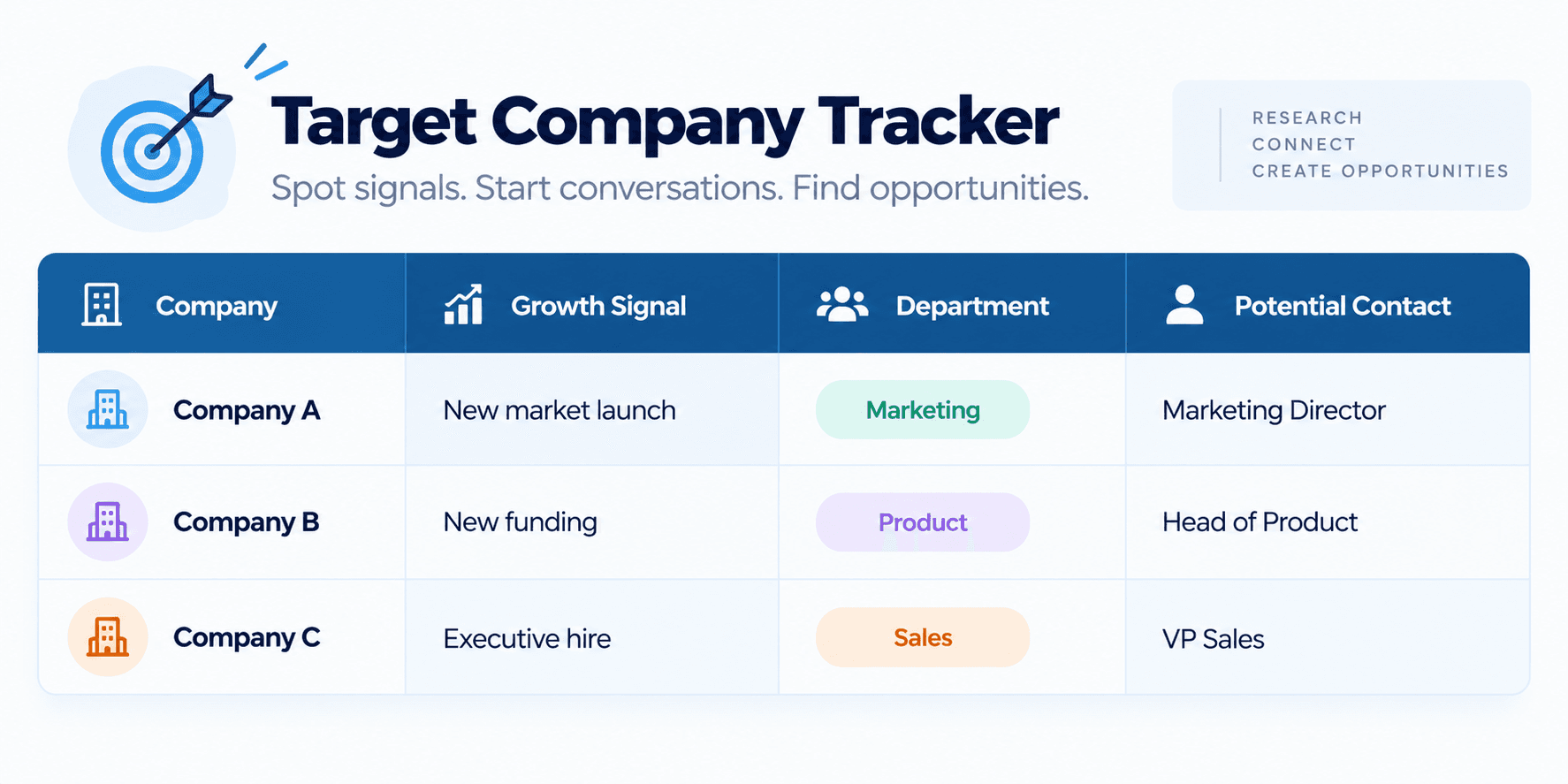
This turns networking into a targeted job search strategy rather than random connection requests.
2. Find the Hiring Manager—Not Just the Recruiter
Once you identify a company, don't immediately search for its recruiter.
The recruiter can be useful, but the person who understands the team's actual problems is often the hiring manager or functional leader.
Suppose you're interested in a product marketing position.
Instead of searching only for:
“Company X recruiter”
look for:
“Company X Head of Marketing”
or:
“Company X Director of Product Marketing”
or:
“Company X VP Marketing”
Then study their LinkedIn profile.
Look at:
What they currently work on
Recent posts
Their team's growth
Projects they mention
Skills they value
Problems they appear to be solving
Your goal is to understand the business problem before asking for a job.
That changes the entire conversation.
3. Use Informational Interviews as Diagnostic Conversations
This is where informational interview networking becomes powerful.
An informational conversation is not a disguised job interview.
You are not asking:
“Can you get me a job?”
Instead, you're asking someone experienced in your target area to help you understand the work, team, industry, or skills required.
For example:
“I'm exploring a move into B2B product marketing and noticed your team has been expanding in that area. I'd love to understand what skills are becoming more important in your field. Would you be open to a quick 15-minute conversation sometime next week?”
Notice what this message does not say.
It doesn't say:
“Are you hiring?”
It doesn't immediately attach a resume.
It doesn't ask for a referral.
It starts a professional conversation.
The 15-Minute Coffee Chat Script
Keep your first outreach short.
Message:
Hi [Name], I came across your work at [Company] and noticed your experience in [specific area]. I'm exploring opportunities in [field] and would really value your perspective on what skills teams are prioritizing right now. Would you be open to a quick 15-minute chat sometime next week?
If they agree, don't spend the entire conversation talking about yourself.
Try questions like:
Ask:
“What skills make someone particularly valuable on your team?”
“What challenges is your team dealing with right now?”
“What would you recommend someone with my background learn before making this transition?”
“How does your team typically approach hiring for this type of role?”
These questions are much more useful than:
“Are there any jobs available?”
You're trying to understand the problem behind the hiring need.
4. Turn the Conversation Into a Warm Referral
This is where many job seekers make a mistake.
They finish a great conversation and immediately ask:
“Can you refer me?”
That can feel transactional.
Instead, build naturally toward the opportunity.
Suppose the person says:
“We're actually planning to grow the team over the next few months.”
Now you have an opening.
You could respond:
“That's interesting. Based on what you've described, I think my experience with [relevant skill] could potentially be useful. If a suitable role opens up, would you be comfortable letting me know?”
If they seem genuinely interested, you can take the next step:
“If it helps, I'd be happy to send over a short overview of my background so you can see where my experience might fit.”
Now the conversation is no longer:
Stranger → Job request
It becomes:
Professional conversation → Relevant skill → Potential business need → Warm introduction
That's a much stronger position.
Research on employee referrals supports why this channel matters: studies have found that referrals can reduce recruiting and screening costs and can give employers additional information about candidates.
Don't Ask for a Job. Ask About a Problem.
This is one of the most important principles for finding unlisted jobs through outreach.
Weak networking sounds like:
“I'm looking for a job. Please let me know if your company is hiring.”
Better networking sounds like:
“I noticed your company is expanding into enterprise sales. What capabilities are becoming most important as the team grows?”
The second question demonstrates that you've done your homework.
And if your skills match the problem, the conversation can naturally move toward an opportunity.
What If There Is Already a Job Posting?
You can still use networking.
Suppose you find a public position you genuinely want.
Don't simply submit the application and disappear.
Instead:
Apply through the official channel.
Identify the hiring manager.
Find a relevant employee.
Start a thoughtful conversation.
Mention the specific role when appropriate.
Ask for insight rather than demanding a referral.
For example:
“I recently applied for the [Role] position and noticed you're part of the team. I'm particularly interested in the company's work around [specific area]. If you have a few minutes, I'd love to hear what the team values most in someone joining this function.”
Now your application has a human connection attached to it.
What Not to Do
Networking can easily become annoying when it's done poorly.
Avoid:
Sending mass connection requests
Quality beats quantity.
Asking for referrals immediately
Build context first.
Writing huge LinkedIn messages
Nobody wants to read your life story in a connection request.
Pretending to be interested
People can usually tell when the conversation is purely transactional.
Following up every two days
One thoughtful follow-up is better than repeated pressure.
Contacting executives when someone closer to the role is available
A relevant team member may be more useful than the company's CEO.
Build Your Own Hidden Job Market Tracker
You don't need a complicated CRM.
A simple spreadsheet can work.
Track:
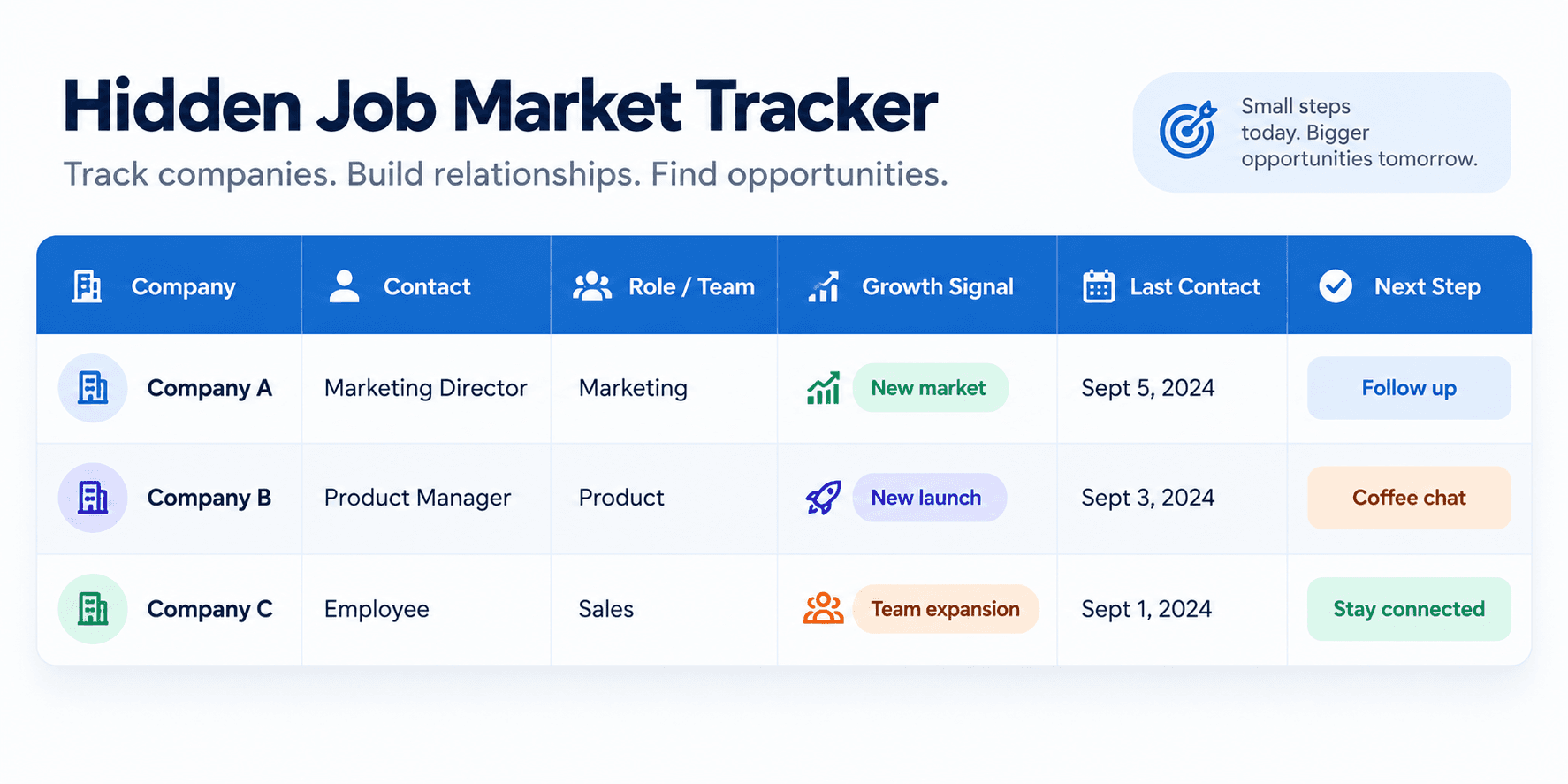
The goal is consistency.
Spend 30–45 minutes a few times each week researching companies, connecting with relevant professionals, and following up.
Over time, your network becomes a source of information—not just a list of LinkedIn connections.
The Hidden Job Market Works Best With a Normal Job Search
You don't have to choose between networking and job boards.
Use both.
Think of your job search as two lanes:
Public Market
Job boards → Applications → Interviews
Hidden Market
Company research → Networking → Conversations → Referrals → Opportunities
The strongest strategy is to keep both lanes active.
And if you're trying to move into a completely different industry, networking becomes even more valuable because conversations can help you understand which transferable skills employers actually value. If you're considering a career switch, you may also find our guide on how to switch from non-tech to tech roles useful.
Final Thought
Learning how to find unadvertised jobs isn't about discovering a secret list of vacancies.
It's about becoming better at noticing opportunities before they become crowded applications.
Watch companies. Track growth signals. Identify the people closest to the work. Start genuine conversations. Ask smart questions. And when your skills solve a problem the team actually has, let the relationship develop naturally toward an introduction or referral.
The goal isn't to avoid job boards completely.
It's to stop depending on them completely.
Because sometimes the best job search strategy isn't asking:
“Where are the jobs?”
It's asking:
“Where is the business growing—and who already knows about it?”