

Backchannel Reference Checks: A Candidate’s Guide to Protecting Your Reputation
Introduction
You have completed several interviews, received positive feedback, and believe a job offer is within reach. Then the hiring process suddenly slows down. The recruiter becomes less responsive, and you are left wondering what happened.
One possible explanation is an informal reference check.
During hiring, employers may speak with professional contacts who have worked with a candidate, even when those people are not on the candidate’s official reference list. These conversations are commonly called backchannel reference checks.
They can provide additional context about your work, communication style, leadership abilities, and professional relationships. However, informal feedback may also be incomplete or influenced by personal disagreements.
Understanding how backchannel checks work can help you prepare references, communicate more confidently, and make informed decisions about your next employer.
1. What Is a Backchannel Reference Check?
A backchannel reference check happens when a hiring manager, recruiter, or professional contact seeks informal feedback about a candidate outside the standard reference-checking process.
For example, an engineering director interviewing for a senior position might discover that a former colleague is connected to someone at the hiring company. The hiring manager may contact that mutual connection to ask about the candidate’s previous work.
These conversations can cover questions such as:
How effectively does the candidate collaborate with colleagues?
How do they respond to pressure or disagreement?
Can they be trusted with important responsibilities?
What are their strengths and areas for improvement?
Informal reference checks are not limited to executive positions, although the process may be more extensive for roles involving senior leadership, sensitive responsibilities, or significant hiring decisions.
Not every employer conducts backchannel checks, and their practices vary by company, industry, and location.
2. How to Prepare for Informal Reference Checks
You cannot control every conversation people have about your work. However, you can take practical steps to present an accurate picture of your professional experience.
Step 1: Review Your Professional Network
Review your LinkedIn connections and identify former managers, teammates, project partners, and other people familiar with your work.
Consider who can speak confidently about your contributions and working style. You do not need to investigate every connection or assume that someone who knows the hiring manager will discuss you.
Instead, focus on maintaining genuine professional relationships and ensuring that your work history, achievements, and public profiles are consistent.
Step 2: Prepare Your References in Advance
Choose references who have directly observed your work and can provide specific examples of your performance.
Before sharing their contact details with a prospective employer, ask for their permission. Explain the role, its responsibilities, and the projects you worked on together.
You can also remind them of relevant achievements, such as improving a process, resolving a technical problem, leading a project, or supporting a team through a difficult deadline.
The objective is not to script their answers. It is to help them recall your work accurately and provide useful context.
Step 3: Address Difficult Professional Relationships Honestly
Not every workplace relationship ends positively. You may have disagreed with a manager, challenged a business decision, or left an organisation during a difficult period.
If the disagreement is relevant to the role, prepare a concise and balanced explanation.
For example:
“During my previous role, my manager and I disagreed about the direction of a major project. I focused on explaining the risks and supporting my recommendations with evidence. Although we did not agree on every decision, the experience taught me to communicate trade-offs more clearly.”
This approach demonstrates reflection without attacking another person.
You do not need to volunteer every past disagreement during an interview. Discuss relevant issues honestly when appropriate, and avoid making claims about what a former colleague might say unless you have reliable information.
3. Formal Reference Checks vs. Backchannel Checks
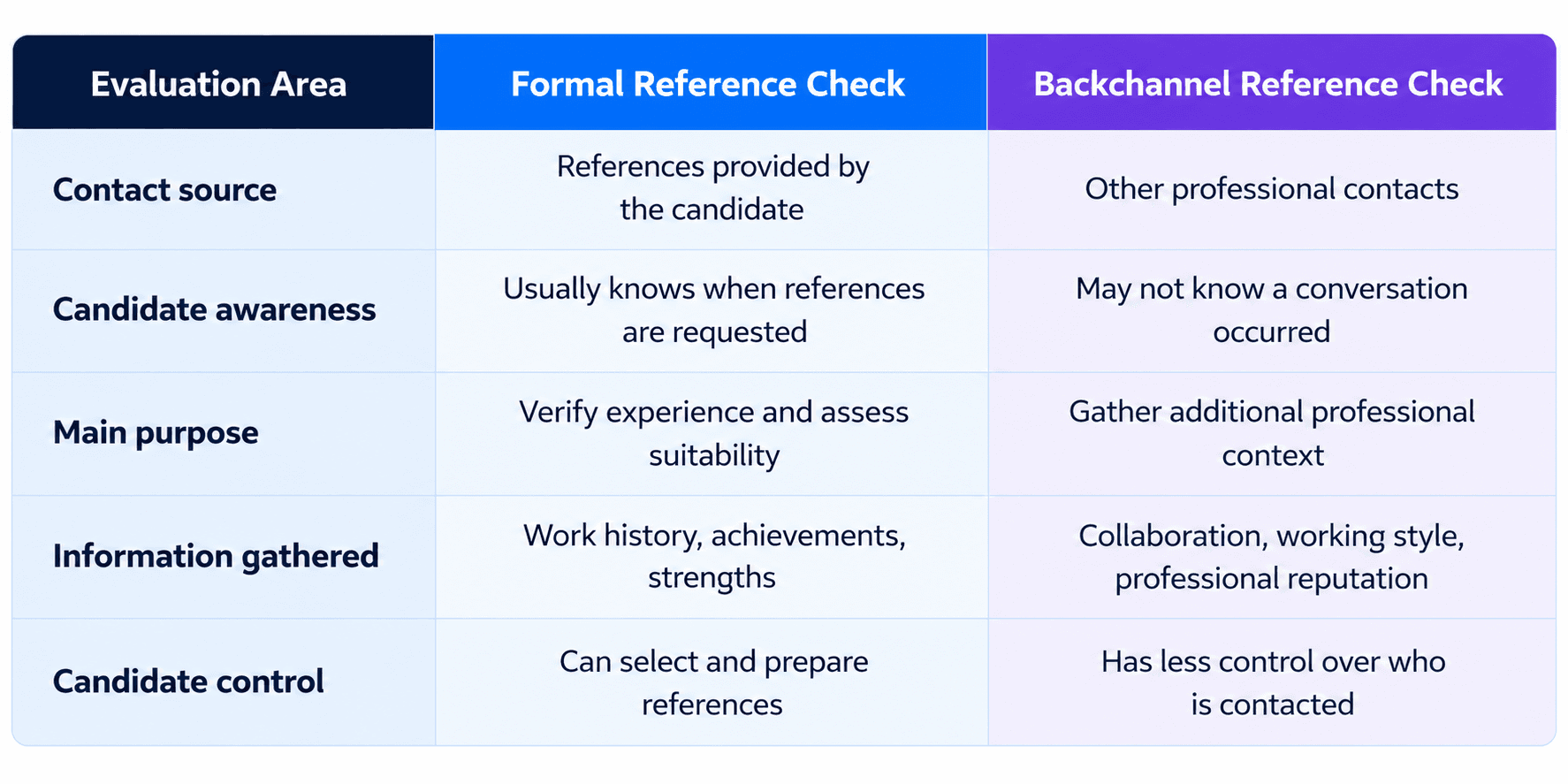
These are general distinctions, not universal rules. Formal checks can include detailed performance questions, while informal conversations may be brief or provide very little useful information.
4. How to Vet a Prospective Manager Through Professional Networking
Reference checking should not be a one-way process. You also need to understand the environment you are considering joining.
A promising job title or attractive salary does not necessarily mean that the team will suit your working style.
Before accepting an offer, consider speaking with former employees, professional contacts, or people familiar with the organisation.
Ask respectful, open-ended questions such as:
How would you describe the manager’s communication style?
How are disagreements and competing priorities handled?
What support does the team receive when deadlines become difficult?
Why do people tend to stay with or leave this team?
What would you recommend that a new employee understand before joining?
Look for patterns rather than treating one person’s opinion as conclusive evidence. A former employee may have valuable insight, but their experience may not reflect the current team or management structure.
Respect confidentiality, avoid requesting proprietary information, and remember that people may not feel comfortable discussing their former employer.
5. Practical Scripts for Professional Conversations
Script A: Asking a Former Colleague to Be a Reference
Hi [Name],
I hope you’re doing well. I’m currently interviewing for a [Role Title] position at [Company Name], and I wanted to ask whether you would be comfortable serving as a professional reference.
Since we worked together at [Previous Company], I thought you could speak to my contributions to [Project or Responsibility]. I’m happy to share the job description and a brief summary of the role.
No pressure if your schedule doesn’t allow it. Thank you for considering my request.
Best,
[Your Name]
Script B: Contacting a Former Employee Before Accepting an Offer
Hi [Name],
I noticed that you previously worked at [Company Name] on the [Team Name] team. I’m considering an opportunity there and would appreciate hearing about your experience, particularly the management style and team culture.
Would you be open to a brief conversation? I understand if you would prefer not to discuss your former workplace.
Thanks for your time,
[Your Name]
Script C: Explaining a Difficult Previous Work Relationship
“My previous role involved some differences of opinion about priorities and project direction. I learned to communicate disagreements more constructively, document decisions, and focus on shared objectives. I’m happy to explain the situation and what I would do differently today.”
Adapt this explanation to your actual experience. Never invent details or claim that a disagreement was resolved if it was not.
6. Common Mistakes to Avoid
Confronting colleagues over rumours: Do not send angry messages or accuse someone of damaging your career based on speculation. If you receive credible feedback, respond calmly and professionally.
Misrepresenting references: Never describe a former colleague as your manager if they were actually a peer. Accurate professional relationships help protect your credibility.
Trying to control every conversation: You cannot manage every opinion in your network. Concentrate on the quality of your work, honest communication, and relationships built on mutual respect.
Ignoring your current employer’s confidentiality: If you are still employed, tell the recruiter that contacting your current manager without your permission could compromise your position. Ask how reference checks will be handled before providing sensitive contact details.
Making assumptions about legal protections: Employment, privacy, and reference-checking rules vary across jurisdictions. If you believe an employer has mishandled your information or discriminated against you, consult an appropriate local employment professional or legal adviser.
For more practical advice on networking and finding opportunities beyond public job listings, explore our guide to the hidden job market.
7. Frequently Asked Questions
Are backchannel reference checks common?
Their use varies by employer and role. Some organisations rely on formal references, while others seek additional feedback through professional networks, particularly for positions involving leadership or significant responsibilities.
Can an employer contact my current manager?
Some employers may attempt to contact current or former colleagues, but practices differ. Tell the recruiter explicitly if your job search is confidential, and request that your current employer not be contacted without your permission.
What should I do if someone gives a negative reference?
Remain professional and avoid reacting to unverified information. If an employer raises a specific concern, respond with relevant facts, explain the context, and acknowledge any genuine lessons you learned.
How can I prepare for a reference check?
Choose appropriate references, obtain their permission, explain the role you are pursuing, and remind them of projects they directly observed. Keep your CV, interview answers, and professional history accurate and consistent.
Final Thoughts
Backchannel reference checks can influence how employers understand a candidate, but they are only one part of a hiring decision. Informal feedback may offer useful context, yet it can also reflect incomplete information or individual perspectives.
The most effective preparation is straightforward: build meaningful professional relationships, choose references carefully, address difficult experiences honestly, and evaluate prospective employers with the same care they use to evaluate you.
Your professional reputation is not built in a single reference call. It develops over time through your work, communication, integrity, and the way you treat the people around you.