

The First 90 Days: How to Succeed in Your First Corporate Job Without Burning Out
Starting your first corporate job can feel strangely overwhelming.
You finally get the job you've worked toward for years, and then suddenly you're expected to understand unfamiliar systems, communicate with experienced colleagues, attend meetings, manage deadlines, and figure out workplace norms that nobody actually explains.
At university, you usually know what success looks like. You have a syllabus, an assignment deadline, and a grading system.
Your first full-time job is different.
There may be no clear instruction manual. Your manager may not tell you exactly what to do every morning. And sometimes, the person who appears most confident isn't necessarily the person doing the best work.
That's why your first 90 days in a new job entry level should not be about proving that you know everything.
They should be about learning how the organization works, building trust, delivering a few meaningful wins, and gradually becoming independent.
Here's a practical 30-60-90 day plan to help you do exactly that—without turning your first job into a 60-hour-a-week survival exercise.
Why Your First Corporate Job Feels So Different
The transition from college to work can be a shock because the definition of success changes.
In college, you are often rewarded for individual performance. Complete the assignment, pass the exam, submit the project.
At work, your results depend on other people too.
You may need information from another team before completing your task. Your priorities can change because a customer has an urgent problem. A manager may give you a goal without explaining every step. And sometimes, doing excellent work means knowing when not to do something.
You are learning two things at once:
Your actual job + how the organization operates.
That second part includes things like:
How your manager prefers updates
Who makes important decisions
Which meetings actually matter
How teams communicate
When to ask for help
How priorities are changed
What “urgent” really means
How much detail different stakeholders need
Learning these unwritten rules is a major part of your first corporate job.
Your First 90 Days: The 30-60-90 Day Plan
Don't think of your first three months as one long probation period.
Break them into three stages:
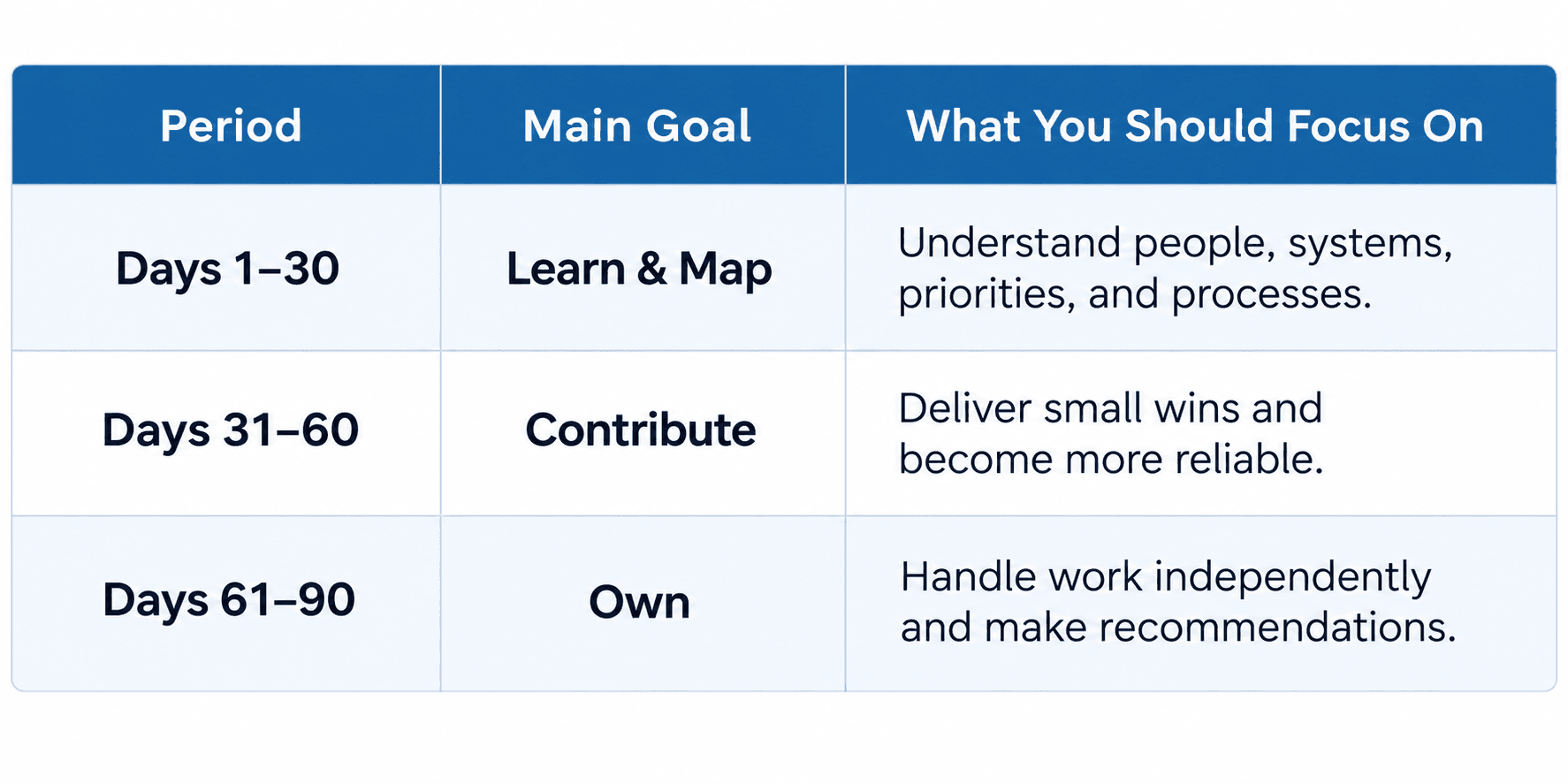
The progression is simple:
Understand → Contribute → Own
Let's break it down.
Days 1–30: Learn Before You Try to Fix Everything
Your biggest mistake in the first month would be assuming that every process you don't understand is a bad process.
You haven't seen the full context yet.
Maybe that spreadsheet exists because another system cannot export the required data. Maybe a seemingly unnecessary approval exists because of a regulatory requirement. Maybe the process looks inefficient because you're only seeing one part of it.
Your first month should therefore be an information-gathering sprint.
Build a Simple Stakeholder Map
Start identifying the people connected to your work. You don't need a complicated organizational chart.
Write down:
Who do I report to?
Who depends on my work?
Whose work depends on me?
Who approves important decisions?
Which teams can delay my projects?
For example, if you're working in a technology company, your work might involve Product, Engineering, QA, Legal, Sales, or Customer Success.
Understanding these relationships early will save you from sending the right question to the wrong person.
Learn the Systems
Create your own private onboarding checklist.
Document:
Important tools
Internal documentation
Recurring meetings
Key workflows
Team terminology
Important deadlines
Common processes
People responsible for different areas
Don't rely on memory.
A simple document can become incredibly useful when you're trying to remember something you learned during your second week.
Use the 15-Minute Rule
When you get stuck, don't immediately ask someone else to solve the problem for you.
Spend around 15 minutes checking available resources first:
Internal documentation
Previous project files
Company wiki
Knowledge base
Code repositories
Previous emails or messages
If you're still blocked, ask for help with context.
Instead of:
“I don't know how to do this.”
Try:
“I checked the onboarding documentation and tried the standard process, but I'm getting this error. I also tried the alternative workflow. Could you help me understand what I'm missing?”
That's a much stronger way to ask questions. It shows initiative without pretending you can solve everything alone.
Days 31–60: Start Building Your Reputation
By your second month, you should have enough context to start contributing more independently. This is where first corporate job tips become less about learning and more about building trust. Don't look for a massive project to prove yourself. Look for a small problem that matters.
Find a Micro-Win
A micro-win is a low-risk improvement that makes someone's work easier.
For example:
Fix outdated documentation.
Improve an onboarding checklist.
Clean up a recurring report.
Create a useful spreadsheet template.
Document a frequently reported issue.
Automate a repetitive task.
Organize scattered project information.
Improve a recurring team process.
These tasks aren't necessarily glamorous. That's exactly why they're useful.
Experienced employees often know these problems exist but don't have time to fix them.
If you solve one, people start associating you with something valuable:
“They make things easier.”
That's an excellent reputation to build early.
Become Predictable Before Trying to Become Impressive
One of the most underrated first 90 days in a new job entry level principles is reliability.
If you say you'll finish something Friday, finish it Friday.
If you realize you won't, communicate that before Friday.
If you make a mistake, acknowledge it.
If you don't understand a requirement, clarify it.
You don't need to become the team's star employee in month two.
Become the person your manager doesn't have to chase.
That creates trust.
Days 61–90: Move From Asking to Recommending
By the third month, you should gradually change how you communicate.
Early on, asking questions is completely normal.
But eventually, try to bring a proposed solution with the question.
Instead of:
“The client wants an export feature. What should I do?”
Try:
“The client needs an export feature. I looked at our current API limitations and found two options. A CSV export would take about two days, while a live integration would require more development. I'd recommend starting with CSV because it meets the immediate requirement without delaying the launch.”
Notice what changed. You're still asking for a decision. But you're no longer asking someone else to do all the thinking. That's the transition from task execution to ownership.
Don't Confuse Ownership With Doing Everything Yourself
Being independent doesn't mean refusing help. Strong employees know when to handle something themselves and when to escalate. If you're blocked by something that could affect a deadline, tell your manager early.
A useful update looks like:
“I'm currently blocked by the data access issue. I tried X and Y, but neither worked. If access isn't available by tomorrow, I can use the existing dataset instead, although that would reduce the analysis scope.”
Now your manager knows:
What happened
What you tried
What's at risk
What alternative exists
That's professional communication.
4 Rookie Mistakes to Avoid in Your First Job
1. Staying Silent When You're Stuck
Trying to hide a problem rarely makes it disappear. If you're going to miss a deadline, communicate early. Bad news delivered early can usually be managed. Bad news discovered at the deadline creates a trust problem.
2. Saying Yes to Everything
New employees often want to appear helpful. So they say yes to every request. Then three departments expect different things by Friday.
Before accepting additional work, ask:
“I'm currently prioritizing X and Y. Which should take priority if I add this?”
That's not being difficult. That's managing expectations.
3. Treating Workplace Messaging Like Casual Chat
Messages such as:
“Hey”
followed by several minutes of silence are frustrating in professional environments. Give context immediately.
Instead:
“Hi Sarah, I'm reviewing the Q3 report and need clarification on the revenue figures in section two. Do you know which dataset I should use?”
Clear communication saves everyone's time.
4. Burning Yourself Out to Prove Your Worth
Working late occasionally is part of professional life. Making excessive hours your default strategy is different. If you work unsustainable hours from your first week, people may eventually assume that's your normal capacity.
Learn to prioritize.
Ask questions.
Manage expectations.
Take breaks.
Your goal is not to survive 90 days.
Your goal is to build a career that lasts longer than 90 days.
Your Early Career Onboarding Checklist
Before completing your first three months, you should ideally be able to answer:
About your role
What are my main responsibilities?
How is my performance measured?
What does good work look like?
About your team
Who should I go to for different problems?
Who depends on my work?
How does my manager prefer updates?
About the company
What are the team's biggest priorities?
Which processes are most important?
What business goals does my work support?
About yourself
What can I now do independently?
What skills do I still need to develop?
What feedback have I received?
Which area could I take more ownership of?
If you can answer these questions, you're probably much further along than you think.
What If You Make a Big Mistake?
You will.
Almost everyone does.
The important part isn't avoiding every mistake. It's how you respond when one happens.
Use a simple sequence:
Acknowledge → Contain → Learn → Prevent
First, acknowledge what happened without making excuses. Then take reasonable steps to limit the impact. Next, identify why it happened.
Finally, create a checklist, process, or habit that reduces the chance of repeating it.
For example:
“I used the wrong dataset in the report. I've corrected the report and checked the downstream numbers. I've also added a source-verification step to my reporting checklist so I confirm the dataset before starting future reports.”
That's far more professional than trying to hide the error.
Final Thought
Your first corporate job is not a test of how quickly you can become an expert. It's the beginning of learning how professional organizations actually work.
During your first 30 days, listen and learn.
During days 31–60, solve small problems and build trust.
During days 61–90, start owning outcomes instead of waiting for instructions.
And throughout all three stages, remember one thing:
You don't need to prove your worth by exhausting yourself.
The employees who build strong careers aren't necessarily the ones who work the longest hours. They're the ones who learn quickly, communicate clearly, follow through on commitments, ask smart questions, and gradually become people others can rely on. That's what succeeding in your first corporate job really looks like.