

Mentorship vs Sponsorship: How to Build Career Champions
Early in your career, you will hear the same advice again and again:
“Find a mentor.”
A mentor can absolutely help. They can answer questions, share experience, review your decisions, and help you understand the skills you need to develop.
But there is another relationship that can have a very different impact on your career:
Sponsorship.
A mentor helps you become better.
A sponsor helps other decision-makers see what you are capable of.
Understanding the difference between mentorship vs sponsorship in your career can change how you build professional relationships, especially when you are trying to move into bigger roles, gain visibility, or take on high-impact projects.
The mistake many early-career professionals make is building a large network of people who give advice while having too few people who can actively advocate for their work.
That is where mentorship ends and sponsorship begins.
Mentorship vs Sponsorship: What's the Difference?
The simplest way to understand the difference is this:
A mentor develops you. A sponsor advocates for you.
A mentor might help you prepare for a difficult presentation, understand workplace politics, improve a technical skill, or think through a career decision.
A sponsor operates differently.
They may recommend you for an important project, mention your work when leadership discusses talent, introduce you to influential people, or support your readiness for a larger role.
The relationships can overlap, but they are not interchangeable.
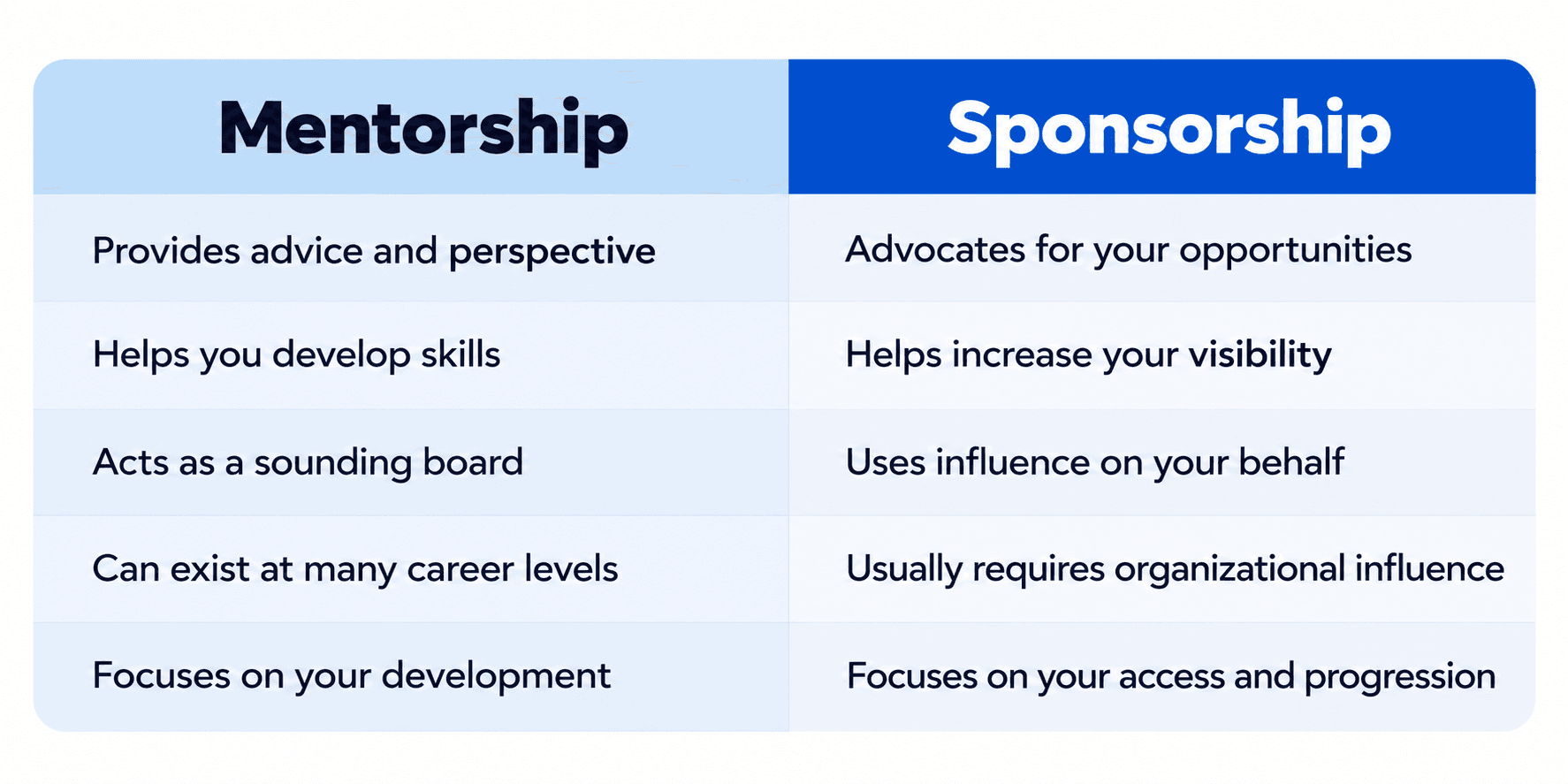
The key point is not that one relationship is better than the other.
You need both.
Why Being Over-Mentored Can Still Leave You Stuck
Imagine you have three experienced colleagues who regularly give you excellent advice.
They help you improve your communication.
They review your work.
They explain how the organization operates.
But when a high-visibility project becomes available, nobody in the decision-making room mentions your name.
That is the gap sponsorship can fill.
A mentor can tell you:
“You are ready to take on more responsibility.”
A sponsor can say:
“Give this person the opportunity to lead the project.”
That difference matters because career decisions are often influenced by visibility, reputation, organizational priorities, and the confidence senior leaders have in someone's ability to operate at a higher level.
This does not mean you should abandon mentors.
It means your professional network should contain different kinds of relationships.
How to Find an Executive Sponsor at Work
You cannot usually walk up to a senior executive and say:
“Will you be my sponsor?”
Sponsorship is normally built through trust, demonstrated performance, and repeated evidence that you can handle greater responsibility.
The source brief describes a four-step path: establish strong performance, identify decision-makers, solve meaningful problems, and give your champion evidence they can use. Pasted markdown
1. Build a Strong Performance Foundation
Before looking for sponsorship, make your core work reliable.
Meet deadlines.
Communicate risks early.
Deliver work that others can depend on.
A senior leader is unlikely to put their reputation behind someone whose basic execution is inconsistent.
You do not need to be perfect.
You do need to demonstrate that increased responsibility is something you can handle.
2. Identify the People Who Actually Influence Decisions
Your most senior contact is not necessarily your most useful sponsor.
Look beyond job titles.
Ask yourself:
Who influences promotion discussions?
Who leads strategically important projects?
Who has visibility with senior leadership?
Which leaders regularly interact with the teams where I want to grow?
Who understands the type of work I want to become known for?
This is part of networking with senior leaders early in your career: don't network simply to collect contacts. Build relationships around meaningful work.
3. Solve a Problem That Matters
One of the strongest ways to build credibility with a senior leader is to contribute to something they genuinely care about.
Instead of approaching an executive with:
“Can you help me advance my career?”
try becoming useful first.
Maybe their team has a reporting problem.
Maybe a process is inefficient.
Maybe an important customer issue needs attention.
Maybe a project needs someone willing to take ownership.
Find a problem where your skills can create measurable value.
Value creates visibility. Visibility creates credibility. Credibility can create sponsorship.
4. Make Your Impact Easy to See
Do not expect a potential sponsor to remember everything you have accomplished.
Keep evidence.
Track:
measurable results
projects you led
problems you solved
revenue or cost impact
customer outcomes
process improvements
leadership responsibilities
positive stakeholder feedback
This becomes useful when discussing promotions or larger opportunities.
It also connects naturally with a broader promotion business case: your sponsor should not have to reconstruct your contribution from memory.
Build Your Personal Board of Advisors
You do not need one person to solve every career problem.
A stronger approach is to build a small network where different people provide different forms of support.
The source brief recommends four complementary roles. Pasted markdown
1. The Sponsor
A senior leader who can advocate for opportunities and provide visibility.
2. The Craft Mentor
Someone who is excellent at your profession and can help you develop deeper expertise.
3. The Cultural Navigator
Someone who understands how your organization actually works, including informal expectations and decision-making patterns.
4. The External Reality-Checker
A trusted professional outside your organization who can give you an objective perspective.
This becomes your personal board of advisors.
It does not need to be a formal group that meets together.
Think of it as a professional support system.
Sponsorship Is a Two-Way Relationship
A sponsor is spending something valuable when they advocate for you: their credibility.
That means sponsorship should never be treated as a free career shortcut.
If a senior leader recommends you for an important opportunity, your responsibility is to make that recommendation look like a good decision.
Three habits matter.
Communicate Risks Early
If something goes wrong, do not allow your sponsor to discover it from someone else.
Explain:
What happened → Why it happened → What you are doing about it.
Be Honest in Private
You do not need to agree with your sponsor on everything.
Strong professional relationships can handle disagreement.
Challenge ideas respectfully in private and support agreed decisions professionally in public.
Make Your Sponsor Look Good
When your project succeeds, give credit appropriately.
If a senior leader created the opportunity or helped remove a major obstacle, acknowledge their contribution.
Good sponsorship relationships are built on mutual trust, not one-sided advantage.
The supplied brief describes this as protecting the sponsor's “political capital.” Pasted markdown
Can Your Manager Be Your Sponsor?
Yes.
Your manager can be one of your strongest career advocates because they directly observe your performance.
But there is an important limitation.
If your manager does not have enough organizational influence to affect promotion decisions, you may need additional relationships with senior leaders.
Your goal should not be to replace your manager.
Instead, build a broader network of credible advocates.
What If Your Sponsor Leaves the Company?
This is exactly why you should never build your entire career around one relationship.
People change companies.
Executives move departments.
Organizations restructure.
If your professional network depends entirely on one sponsor, your career visibility can disappear with that person's departure.
Continue building relationships across teams and levels.
That makes your professional reputation more resilient.
How Often Should You Talk to a Sponsor?
Sponsorship does not necessarily require a weekly meeting.
A senior executive may not have time for another recurring calendar invitation.
Instead, communicate when you have something valuable to share.
For example:
“We completed the customer migration ahead of schedule. The process reduced onboarding time by 28%. I wanted to share the result because it directly supports the transformation initiative we discussed.”
That is much more valuable than sending:
“Just checking in.”
High-signal communication makes senior relationships easier to maintain.
Mentorship vs Sponsorship: Which One Do You Need?
The answer is both—but for different reasons.
If you need to improve your skills, find a mentor.
If you need access to bigger opportunities, build relationships with potential sponsors.
If you want honest organizational context, find a cultural navigator.
If you need an unbiased perspective, develop external professional relationships.
The strongest early-career strategy is therefore not:
Mentor OR sponsor.
It is:
Mentor + Sponsor + Network + Evidence of Impact.
Frequently Asked Questions
Can I directly ask someone to become my sponsor?
You can express your career goals and ask for advice, but sponsorship is generally something that develops through demonstrated performance and trust rather than a formal request. Pasted markdown
How do I find an executive sponsor at work?
Identify leaders who influence important projects, talent decisions, or strategic priorities. Then build credibility by contributing meaningful work and creating genuine professional relationships.
What is the difference between a mentor and a sponsor?
A mentor primarily helps you develop through advice, feedback, and experience. A sponsor actively advocates for your visibility and access to career opportunities.
How many sponsors should I have?
There is no ideal number. Avoid depending entirely on one person and build a diverse network of trusted advocates across teams and levels.
What should I do if my sponsor leaves?
Continue building relationships with other leaders. A strong professional reputation should survive an organizational change rather than depending entirely on one sponsor. Pasted markdown
Final Takeaway
Your career is not built only through the skills listed on your résumé.
It is also shaped by who knows your work, who trusts your judgment, who gives you opportunities, and who is willing to advocate for you when you are not in the room.
That is the real distinction between mentorship vs sponsorship.
Mentors help you become better.
Sponsors can help make your potential visible to the people making important decisions.
So don't spend your entire early career collecting advice.
Build skills.
Deliver meaningful results.
Develop genuine relationships with senior leaders.
Create a diverse personal board of advisors.
And, most importantly, become someone that a respected leader can confidently put their name behind.
That is how professional relationships turn into career momentum.