
How to Turn an Entry-Level Internship into a Full-Time Job Offer
Landing a good internship is only the beginning. The real opportunity comes when you can turn that short-term experience into a full-time job offer.
For many students and recent graduates, an internship is the closest thing to a real audition. Your manager gets to see how you work, communicate, handle feedback, solve problems, and contribute to the team. That means getting the job offer is rarely about simply finishing your assigned tasks.
It is about becoming someone the team can already imagine working with as a full-time employee.
Whether you are interning as a software developer, marketing executive, analyst, designer, HR professional, or in another entry-level role, the strategy is largely the same: be reliable first, demonstrate measurable value, and make your interest in staying clear.
What Employers Look for in an Intern
Companies do not necessarily expect an intern to know everything from day one. They do, however, look for signs that the person can grow into a dependable employee.
Four qualities can make a significant difference.
1. Become Reliable at Your Core Work
Start with the work you were actually hired to do.
Before volunteering for additional projects, make sure you can consistently complete your existing responsibilities accurately and on time. If your manager has to repeatedly remind you about deadlines, fix avoidable mistakes, or explain the same process several times, taking on more work will not help your case.
Reliability creates trust.
Once your basic responsibilities are under control, look for opportunities to contribute beyond them.
For example, a marketing intern might first become dependable at creating campaign reports before suggesting improvements to the reporting process. Similarly, a development intern should understand the team's coding and review practices before proposing major technical changes.
First become dependable. Then become valuable.
2. Ask Good Questions, Then Work Independently
Asking questions is not a weakness during an internship. Repeatedly asking questions that could have been answered by checking existing documentation is.
When you receive a new assignment, clarify the important details early:
What exactly needs to be delivered?
Who is the target user or audience?
What does success look like?
What is the deadline?
Are there existing examples or guidelines?
Who should review the work?
Once you understand the requirement, take ownership of the execution.
A strong intern does not disappear with a task and return only when it is finished. They communicate progress, flag genuine blockers early, and try to solve manageable problems independently.
That balance — knowing when to ask and when to figure things out yourself — is one of the clearest signs of professional maturity.
Top Related Blog
3. Track Your Work and Show Your Impact
Do not assume your manager will remember everything you accomplished during a three-month internship.
Keep a simple weekly record of your work.
Instead of writing:
"Worked on social media campaigns."
Write something more specific:
"Created and scheduled 18 social media posts and helped improve the campaign's engagement rate."
Instead of:
"Fixed website issues."
Record:
"Resolved 12 front-end issues and documented the recurring problem for the development team."
The goal is not to exaggerate your contribution. It is to make your contribution visible and measurable.
Track things such as:
Projects completed
Problems solved
Processes improved
Reports or documentation created
Campaigns supported
Tools learned
Positive feedback received
Measurable results
By the end of the internship, you will have evidence to support your request for a full-time opportunity.
4. Build Relationships Beyond Your Manager
Your manager may be responsible for evaluating you, but they are rarely the only person forming an opinion about your work.
Make an effort to understand how other people and departments operate.
Talk to colleagues when appropriate. Attend team knowledge-sharing sessions. Ask thoughtful questions. Understand how your team's work affects other departments.
For example, a marketing intern can benefit from understanding how marketing works with sales and design. A software intern can learn how developers interact with product managers, designers, QA, and customer support.
This does not mean trying to network with everyone for the sake of getting an offer.
Instead, focus on becoming a useful and respectful member of the team.
A 12-Week Strategy for Converting an Internship
Your approach should change as your internship progresses.
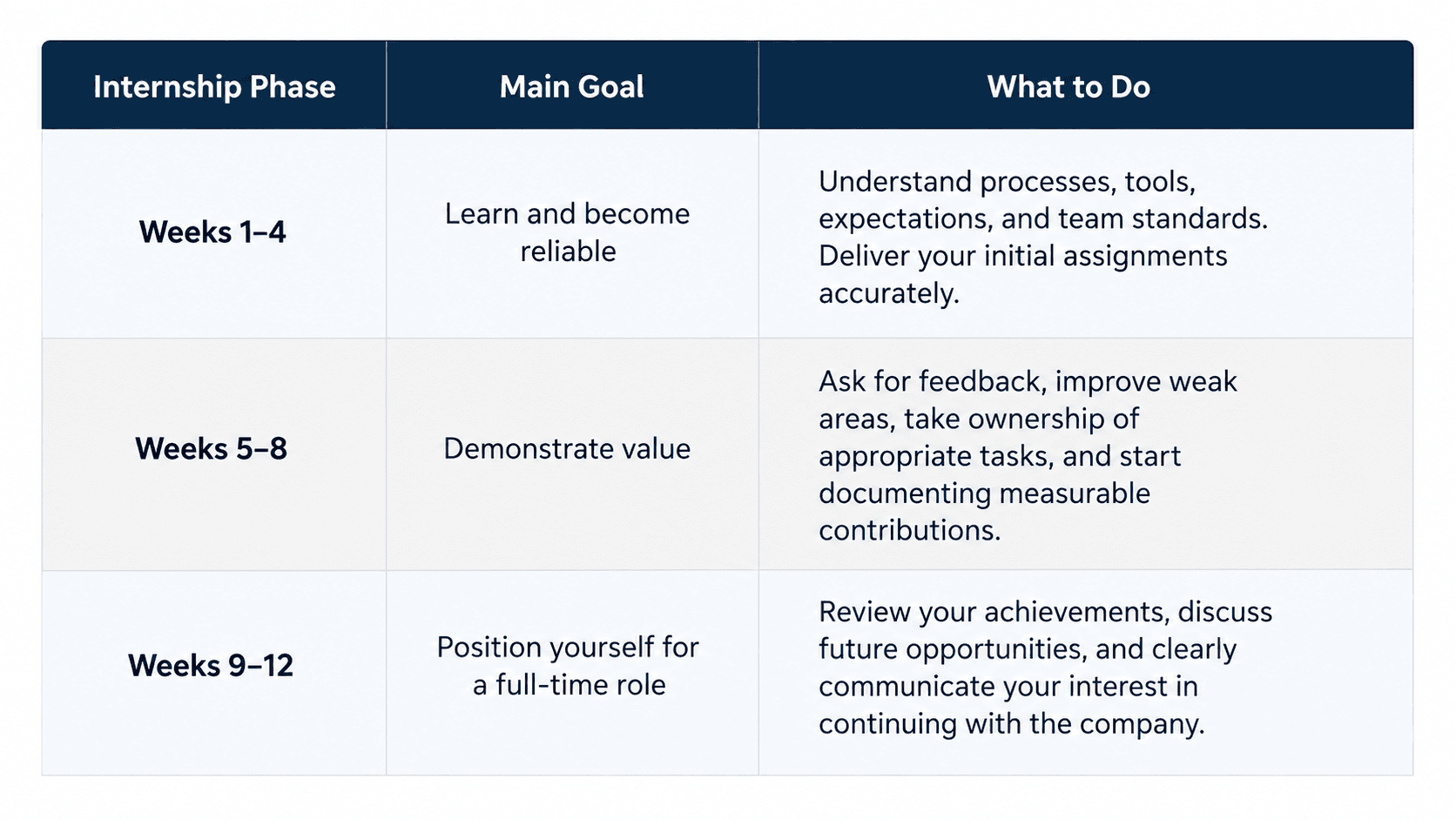
The exact timeline will vary depending on the internship, but the principle remains the same: learn first, contribute consistently, then make the transition conversation.
Ask for Feedback Before the Final Month
One of the biggest mistakes interns make is waiting until the internship is almost over to ask whether they are doing well.
Instead, ask for feedback around the middle of your internship.
You could say:
"I've really enjoyed working on [specific project]. I'm interested in continuing with the team in a full-time role after my internship. Based on my performance so far, what is one area I should improve to be ready for that level?"
This question does several things at once.
It communicates your interest without demanding an offer. More importantly, it gives your manager an opportunity to tell you what is missing.
If they identify a weakness, you still have time to address it.
Make Your Full-Time Interest Clear
Do not assume your manager automatically knows that you want a permanent position.
If you want to stay, say so professionally.
A simple conversation could be:
"I've really enjoyed working with the team and would be interested in exploring a full-time opportunity here. I'd appreciate your feedback on what I should focus on during the rest of my internship to put myself in the best position."
This is much better than saying:
"So, am I getting a job?"
The first approach starts a career conversation. The second puts the manager in a yes-or-no situation before you have established your case.
Prepare a Simple Record of Your Achievements
As your internship approaches its final weeks, prepare a concise summary of what you have accomplished.
Include:
Projects: What did you work on?
Contribution: What specifically did you do?
Results: What changed because of your work?
Skills: What tools, technologies, or professional skills did you develop?
Feedback: What positive feedback or recognition did you receive?
Next Steps: What could you contribute if you joined the company full-time?
This can become the foundation for your final conversation with your manager.
You are no longer saying, "I think I deserve a job."
You are showing:
Here is what I worked on. Here is the value I contributed. Here is what I learned. And here is how I can continue contributing.
3 Mistakes That Can Cost You a Full-Time Offer
1. Treating the Internship Like College Homework
An internship is not simply a list of assignments to complete and submit.
If you finish your task at 3 PM and spend the rest of the day waiting for someone to tell you what to do, you are missing an opportunity.
Once your priority work is complete, ask whether there is anything else you can help with. Review documentation. Learn the tools your team uses. Look for small problems you can solve without creating unnecessary work for others.
Initiative matters — but it should come after you have handled your core responsibilities properly.
2. Ignoring Communication and Team Norms
Professional ability is only part of workplace performance.
If you regularly miss messages, fail to communicate delays, skip important meetings, or provide no updates on your work, people may find it difficult to depend on you.
Learn how your team communicates.
Some teams rely heavily on project-management tools. Others use messaging platforms, email, daily stand-ups, or regular one-to-one meetings.
You do not need to be constantly online. You do need to be responsive, predictable, and clear about your work.
3. Waiting Until the Last Day to Mention Your Interest
This is perhaps the easiest mistake to avoid.
If you want a full-time position, communicate that interest before your final week.
Hiring decisions can depend on team requirements, budgets, available positions, and business needs — factors that may be outside your direct manager's control.
Expressing interest early gives your manager time to understand your goals and, where possible, consider you for relevant opportunities.
What If There Is No Full-Time Position?
Sometimes you can perform extremely well and still not receive an offer.
That does not automatically mean your internship was unsuccessful.
A company may not have an approved opening, the team may have a hiring freeze, or another candidate may be selected for a limited position.
If there is no immediate opportunity, ask your manager:
"I understand there may not be an opening right now. Based on my work here, what skills or experience would you recommend I develop to become a stronger candidate for a similar role in the future?"
You may also ask whether they would be comfortable providing a reference or recommending you for another suitable opening when one becomes available.
Your internship can still become valuable professional experience even when it does not immediately result in a permanent role.
The Real Goal of an Internship
The goal should not be to spend three months trying to convince everyone that you deserve a job.
Instead, focus on becoming the kind of person a team would want to keep.
Do your core work well. Learn quickly. Ask intelligent questions. Take ownership. Communicate clearly. Build professional relationships. Keep evidence of your contribution. And make your career goals known before the internship ends.
A full-time offer is never completely guaranteed because hiring depends on factors beyond your performance. But you can control the part that matters most: the professional reputation you build while you are there.
The best interns do not simply complete an internship.
They leave the team thinking:
"We should find a way to keep this person."