

From Management Consulting to Tech BizOps: A Practical Career Guide
Moving from management consulting into the technology industry can be an exciting career step. You may already have experience in market analysis, financial modeling, stakeholder management, and solving complex business problems. The challenge is translating those skills into a role where you are responsible for implementation, measurable results, and ongoing business performance.
For professionals exploring a management consulting to tech BizOps transition, Business Operations (BizOps), Strategy & Operations, and Product Operations are potential career paths worth considering.
However, these roles are not identical, and consulting experience alone may not be enough to secure a position. You will need to demonstrate practical analytical skills, understand how technology businesses operate, and show that you can turn recommendations into results.
This guide explains how to identify suitable roles, develop relevant skills, update your resume, and prepare for the transition.
1. Why Consultants Consider Tech BizOps
Management consulting often provides exposure to senior stakeholders, strategic decision-making, financial analysis, and different industries. These experiences can be valuable when moving into an internal strategy or operations role.
The main difference is ownership.
A consultant may recommend a new pricing strategy, while a BizOps professional helps evaluate, implement, and measure that strategy over time. This can involve working with product managers, engineers, sales teams, finance, and customer success.
Typical BizOps projects include:
Evaluating pricing models for a software product.
Investigating declining customer retention or increasing acquisition costs.
Improving sales processes and operational efficiency.
Building forecasts to support market expansion.
Measuring the business impact of new product features.
These responsibilities vary by company. Some BizOps teams focus on executive strategy, while others spend more time on analytics, planning, and execution.
2. BizOps vs. Product Strategy vs. Product Operations
Before applying, understand which role matches your strengths and interests.
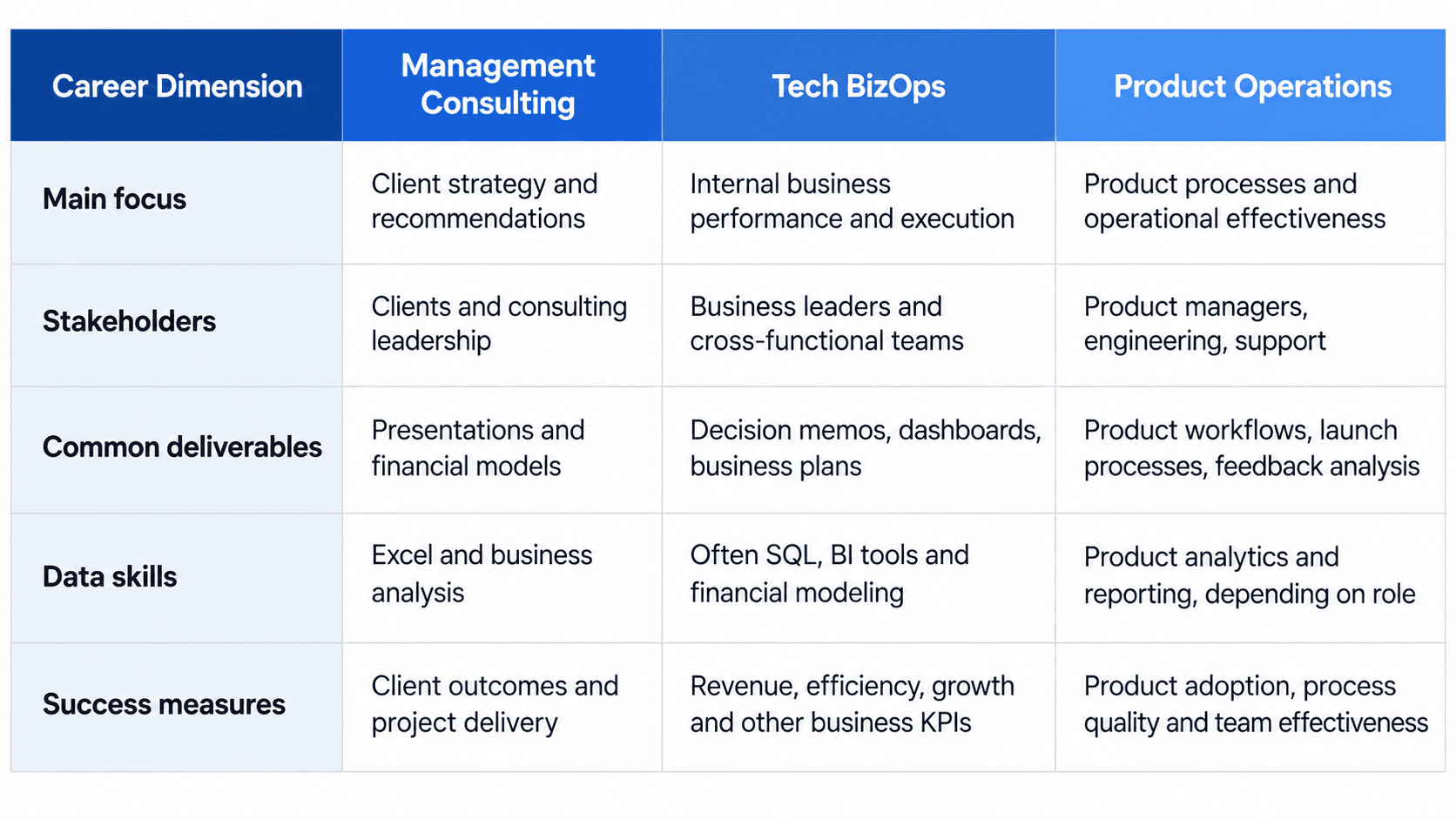
Which path should you choose?
BizOps may suit you if you enjoy business analysis, solving ambiguous problems, and working across departments. Product Strategy may be attractive if you want to influence product direction, positioning, and monetization. Product Operations may fit if you enjoy improving product-team processes, analytics, and launch execution.
Review individual job descriptions because responsibilities and technical requirements differ considerably.
3. Translate Consulting Experience Into Operational Skills
One of the most important parts of the transition is changing how you describe your experience.
Technology employers need evidence that you can work with incomplete information, collaborate with technical teams, and measure outcomes—not simply produce polished presentations.
Focus on three practical shifts.
Replace lengthy presentations with concise decision documents
Learn to communicate recommendations through short decision memos, clear assumptions, implementation plans, and measurable success criteria.
For example, instead of presenting a broad market opportunity, explain which customer segment to prioritize, why the opportunity matters, what resources are required, and how success will be measured.
Move from market sizing to product and business metrics
Market sizing remains useful, but many technology roles also require familiarity with metrics such as:
Customer Acquisition Cost (CAC).
Customer Lifetime Value (LTV).
Monthly Recurring Revenue (MRR).
Net Revenue Retention (NRR).
Conversion rates and customer retention.
Understand what each metric measures, how it is calculated, and how changes can affect business decisions.
Demonstrate execution and collaboration
Prepare examples showing how you handled implementation challenges, coordinated different stakeholders, managed competing priorities, or changed a recommendation after reviewing new evidence.
If your previous role involved recommendations rather than implementation, be transparent. Build practical projects that demonstrate your ability to take analysis further.
4. Technical Skills to Learn for Tech BizOps
You do not necessarily need to become a software engineer to enter BizOps. However, many analytical roles expect candidates to work independently with data.
Prioritize the following skills according to your target positions.
SQL: Learn filtering, joins, aggregation, subqueries, Common Table Expressions (CTEs), and window functions. Practice answering business questions using datasets rather than memorizing syntax alone.
Business intelligence tools: Explore platforms such as Tableau, Looker, or Power BI. Learn to build dashboards that explain revenue trends, conversion rates, and customer behavior.
Product analytics: Understand event tracking, funnel analysis, user segmentation, retention, and A/B testing. Familiarity with tools such as Amplitude or Mixpanel can help when relevant to the role.
Financial and spreadsheet modeling: Practice scenario analysis, pricing models, revenue forecasting, and unit economics.
Start with SQL and business metrics if you are targeting data-heavy BizOps roles. Avoid spending time learning every tool before checking what employers actually require.
5. A Practical 90-Day Career Transition Roadmap
A focused plan can help you build evidence of your skills while continuing your job search.
Days 1–30: Build your analytical foundation
Review 15–20 relevant job descriptions.
Identify recurring technical and business requirements.
Practice SQL using realistic business datasets.
Study SaaS metrics, pricing, retention, and unit economics.
Create a shortlist of suitable job titles and companies.
Days 31–60: Build a portfolio project
Choose a technology company and analyze a specific business problem, such as improving subscription retention or evaluating a pricing change.
Create a concise case study containing the problem, available evidence, assumptions, proposed solution, risks, and success metrics.
Where possible, support your conclusions with a small dataset, SQL analysis, or a simple dashboard. Clearly label assumptions and avoid presenting estimates as actual company data.
Publish the project on LinkedIn or a personal portfolio so recruiters can review your thinking.
Days 61–90: Prepare for applications and interviews
Update your resume to highlight measurable business outcomes, analytical work, and cross-functional collaboration.
Practice business cases involving revenue growth, marketplace economics, customer churn, and operational efficiency. Prepare for SQL assessments when the role requires them.
Network with people working in BizOps, Strategy & Operations, and Product Strategy. Ask about their responsibilities and hiring expectations rather than relying only on job titles.
6. How to Position Your Resume for Tech Roles
Your resume should communicate the business problem you addressed, the work you personally performed, and the result.
Avoid vague statements such as:
“Supported strategic initiatives and synthesized insights across multiple workstreams.”
Instead, describe the actual work more precisely:
“Analyzed customer and market data to identify pricing opportunities and presented recommendations to senior leadership.”
Whenever possible, add verified figures showing revenue impact, cost savings, efficiency improvements, or the scale of the project. Never invent metrics to make an achievement appear stronger.
For more career-transition guidance, explore the UNIBLIP Career Change Hub.
7. Frequently Asked Questions
What roles can management consultants target in technology?
Depending on experience and skills, potential roles include BizOps Associate, Strategy & Operations Manager, Product Strategy, Business Operations Analyst, and Product Operations. Seniority depends on the candidate's experience and the employer's requirements.
Can a management consultant move directly into Product Management?
Yes, it is possible, but consulting experience does not automatically establish product management skills. Employers may expect evidence of user research, product prioritization, technical collaboration, and product delivery. BizOps or Product Operations can be alternative paths, but neither guarantees a later move into Product Management.
Do tech BizOps roles pay more than consulting?
Compensation varies by geography, company stage, seniority, and the specific role. Compare base salary, bonuses, equity terms, vesting schedules, and benefits using current offers and reliable market data. Do not assume equity will outperform cash compensation.
What is the best way to prepare for BizOps interviews?
Practice structured business cases, SQL when required, financial modeling, and examples of cross-functional problem-solving. Be ready to explain your assumptions, trade-offs, recommendations, and how you would measure results.
Conclusion
Transitioning from management consulting to tech BizOps is less about abandoning your consulting background and more about applying it differently.
Your analytical ability, communication skills, and strategic thinking can provide a strong foundation. To become a competitive candidate, combine those strengths with practical data skills, technology-business knowledge, and clear evidence of execution.
Start by selecting a target role, studying its requirements, building a relevant portfolio project, and tailoring your applications. A focused approach will help you evaluate opportunities more effectively and prepare for the realities of working inside a technology business.
Explore more: Visit the UNIBLIP Career Change Hub for additional career-transition resources.