

How to Transition Into Tech After 40: A Practical Career Change Guide
Changing careers after 40 can feel risky, especially if your background is outside technology. You may be wondering whether employers will consider you too experienced, whether you need to learn coding from scratch, or whether starting over means taking a major pay cut.
The good news is that how to transition into tech after 40 does not necessarily mean starting your career again from zero.
Your previous experience can become an advantage if you choose the right technology role and connect your existing industry knowledge with modern digital skills.
Instead of competing with younger candidates for entry-level developer positions, experienced professionals can often make a stronger career pivot by targeting roles in product management, technology operations, implementation, solutions, program management, AI governance and industry-specific technology.
Can You Transition Into Tech After 40?
Yes. But the smartest approach is usually not to erase your previous career.
A 15- or 20-year career may have already given you skills that technology companies need: leadership, stakeholder management, problem-solving, budgeting, compliance, customer relationships and industry knowledge.
The technology industry increasingly serves traditional sectors such as healthcare, finance, education, manufacturing and logistics. That creates opportunities for professionals who understand both business problems and technology solutions.
The lesson for career changers is simple: experience itself is not the problem. Positioning is.
The Best Tech Career Paths After 40
You do not necessarily need to become a full-time software engineer to enter the technology industry.
Your best route depends on your existing career, transferable skills and the type of technology work you want to do.
1. Product Management
Product managers connect customer needs, business objectives and technology teams.
If you already understand customers, operations or a specific industry, that knowledge can become a significant advantage.
For example, someone with years of banking experience could target FinTech product roles, while a healthcare professional could explore HealthTech products.
2. Technical Program Management
Technical Program Managers coordinate complex projects involving engineering, product, security and business teams.
Professionals with experience in project management, operations, risk management or cross-functional leadership can potentially transfer these skills into technology organizations.
You do not need to become the strongest programmer on the engineering team. You need to understand technology sufficiently to communicate, manage dependencies and keep projects moving.
3. Solutions and Implementation Roles
Technology companies need professionals who can help customers adopt their software.
Implementation specialists, solutions consultants and customer-facing technology professionals often combine business knowledge with technical understanding.
This can be particularly valuable for someone moving from an industry they already understand.
4. AI Governance, Risk and Compliance
Artificial intelligence is creating new requirements around governance, privacy, security, compliance and responsible deployment.
Professionals from law, auditing, finance, risk management, compliance and regulated industries may have transferable knowledge that can be applied to AI-related roles.
The key is to add enough AI and technology knowledge to your existing expertise rather than trying to become an AI engineer overnight.
Career Pivot to Tech Over 40: Use Your Industry Experience
One of the strongest strategies for a career pivot to tech over 40 is what you can think of as domain advantage.
Instead of asking:
"How can I compete with younger technology professionals?"
Ask:
"Which technology companies need someone who understands my industry?"
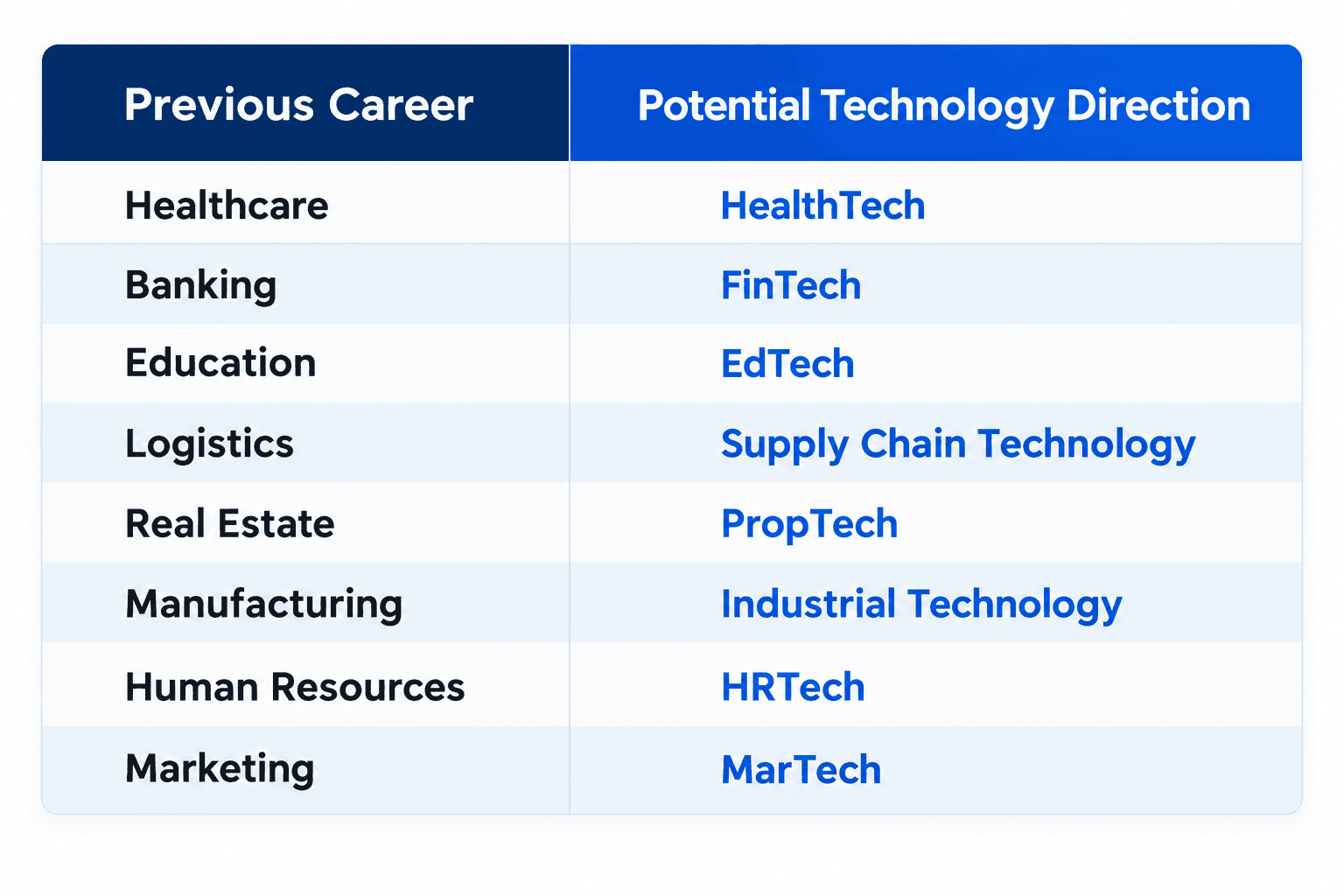
Consider these examples:
Previous CareerPotential Technology DirectionHealthcareHealthTechBankingFinTechEducationEdTechLogisticsSupply Chain TechnologyReal EstatePropTechManufacturingIndustrial TechnologyHuman ResourcesHRTechMarketingMarTech
You already understand the problems faced by customers in that industry.
A technology company may be able to teach you its product, but your years of real-world industry experience are much harder to replicate.
That is the foundation of a strong mid-career technology transition.
How to Overcome Ageism in a Tech Job Search
Ageism can be a concern for experienced professionals, but your job search materials can either reinforce or reduce assumptions about your age.
If you are trying to overcome ageism in a tech job search, focus your resume and LinkedIn profile on relevance rather than simply listing everything you have done.
Modernize Your Resume
Focus on recent experience and measurable achievements.
Instead of writing:
Managed employees and projects.
Write:
Led a cross-functional team of 12 and reduced project delivery time by 24%.
The second version demonstrates impact rather than simply describing responsibility.
Highlight Current Technology Skills
Show that you are actively learning modern tools.
Depending on your target role, this could include:
AI tools
Cloud platforms
Jira
Figma
Notion
Slack
CRM platforms
Data analytics
Automation platforms
Generative AI workflows
You don't need to list every tool you've ever touched. Focus on the technologies relevant to the job you want.
Remove Outdated Information
Your resume does not need to contain your entire professional history.
Prioritize experience that supports your current career direction and demonstrate how your previous achievements relate to the technology role you are targeting.
Do You Need to Learn Coding to Move Into Tech After 40?
Not necessarily.
This is one of the biggest misconceptions surrounding a midlife career change to software and technology.
If your goal is to become a software engineer, then programming skills are obviously important.
But the technology industry contains many roles that sit between business and technology.
You could explore:
Product management
Technology project management
Business analysis
Solutions consulting
Implementation
Customer success
Technical sales
Data analytics
AI operations
Cybersecurity governance
Technology compliance
UX research
The right choice depends on your existing experience.
For someone with 20 years in finance, becoming a junior frontend developer may mean throwing away much of their competitive advantage.
Moving into FinTech product operations or technology risk may create a much more logical bridge.
A Practical 90-Day Tech Career Transition Plan
You do not need to learn everything before applying for your first technology position.
A focused 90-day plan can be more effective.
Days 1–30: Choose Your Target
Select one primary technology role.
Research 20–30 job descriptions and identify the skills employers repeatedly request.
Do not try to prepare for five completely different careers simultaneously.
Days 31–60: Build Your Technology Foundation
Spend approximately 5 hours per week developing the skills directly connected to your target role.
For example:
Product Management:
Product discovery, user research, analytics, Agile and product roadmaps.
Technology Management:
Cloud fundamentals, Agile, project management and technical communication.
AI-related roles:
Generative AI, AI workflows, automation, data privacy and responsible AI concepts.
Solutions roles:
SaaS platforms, APIs, cloud fundamentals, customer implementation and technical communication.
Days 61–90: Build Proof of Skill
Courses alone are not enough.
Create something that demonstrates what you can actually do.
Examples include:
A product case study
An AI automation workflow
A technology implementation plan
A dashboard
A process-automation project
A product requirements document
An industry-specific technology analysis
Your goal is to show employers:
"I understand my industry, and I know how modern technology can solve its problems."
How to Explain a Career Change After 40
Don't apologize for changing careers.
Instead, connect your previous experience with the new direction.
For example:
"I spent 18 years working in healthcare operations and developed a deep understanding of the problems hospitals face. I am now combining that industry experience with product and technology skills to help build digital solutions for healthcare organizations."
This explanation is much stronger than:
"I am 42 and want to try something completely different."
Your career change should look like progression, not a restart.
Do You Need a Coding Bootcamp?
Not automatically.
Before spending thousands of dollars on a bootcamp, determine what role you actually want.
If your goal is software engineering, structured programming education may make sense.
But if you want product management, business analysis, technology operations or solutions consulting, a coding bootcamp may not provide the best return on your time and money.
Start with job descriptions.
Find the skills employers are asking for, identify your gaps and learn specifically for those gaps.
Frequently Asked Questions
Can I really transition into tech after 40?
Yes. The most practical approach is usually to combine your existing professional experience with new technology skills rather than starting completely from zero.
What is the easiest tech career to transition into after 40?
There is no single easiest role. Product management, business analysis, implementation, technology operations, customer success and solutions roles can be suitable depending on your previous career.
Can I move into tech without coding?
Yes. Many technology roles do not require professional-level programming. However, learning basic technical concepts can make you more effective and credible.
How do I overcome ageism when applying for tech jobs?
Keep your resume focused on relevant achievements, demonstrate current technology skills, use modern tools and clearly explain how your previous experience creates value for the employer.
Should I leave my current job before switching to tech?
Usually, there is no need to resign immediately. Building skills, networking and creating a portfolio while maintaining your current income can reduce financial risk during the transition.
Final Takeaway
A career change into tech after 40 does not have to mean starting from the bottom.
Your biggest advantage may actually be the experience you already have.
The most effective strategy is to identify where your existing industry knowledge intersects with technology, develop the skills required for that intersection and build visible proof that you can operate in a modern technology environment.
Don't compete solely on age, coding speed or the number of certificates you have.
Compete on experience + technology + industry expertise.
That combination can become your strongest advantage in a mid-career technology transition.