

Transition from Individual Contributor to Manager: A Practical 90-Day Guide
Getting promoted from a high-performing individual contributor to a manager sounds like the natural next step in a career.
But for many people, the first few weeks feel surprisingly uncomfortable.
As an individual contributor, your work is usually visible. You write code, solve problems, design products, close campaigns, complete projects, or deliver measurable outcomes.
As a manager, your success becomes less visible.
Your calendar fills with 1-on-1 meetings. You spend more time making decisions, resolving conflicts, communicating with stakeholders, and helping other people succeed.
And at the end of the week, you may find yourself asking:
“What did I actually accomplish?”
That feeling is one of the biggest challenges in the transition from individual contributor to manager.
The answer is simple but difficult to accept:
Your job has changed.
You are no longer primarily responsible for producing the work yourself. Your job is to create the conditions that allow your team to do its best work.
This guide explains the biggest IC-to-management transition challenges and provides a practical framework for your first 90 days as a manager.
Individual Contributor to Manager: Why the Transition Feels So Difficult
An experienced engineer, designer, marketer, or other specialist often builds their career around personal expertise.
You become valuable because you can solve difficult problems.
Then you become a manager, and suddenly that same strength can become a weakness.
You may feel tempted to:
Fix problems yourself
Review every small decision
Jump into technical work
Give people the solution instead of the problem
Correct work before someone has had a chance to learn
Measure your own productivity instead of team performance
This creates the “super-IC manager” problem.
You are technically capable, so doing the work yourself feels faster.
But if your team constantly depends on you, you've created a bottleneck rather than a stronger team.
Management is not simply the next level of individual contribution.
It is a different profession.
Maker vs. Multiplier: The Mindset Shift
The biggest change is how you define success.
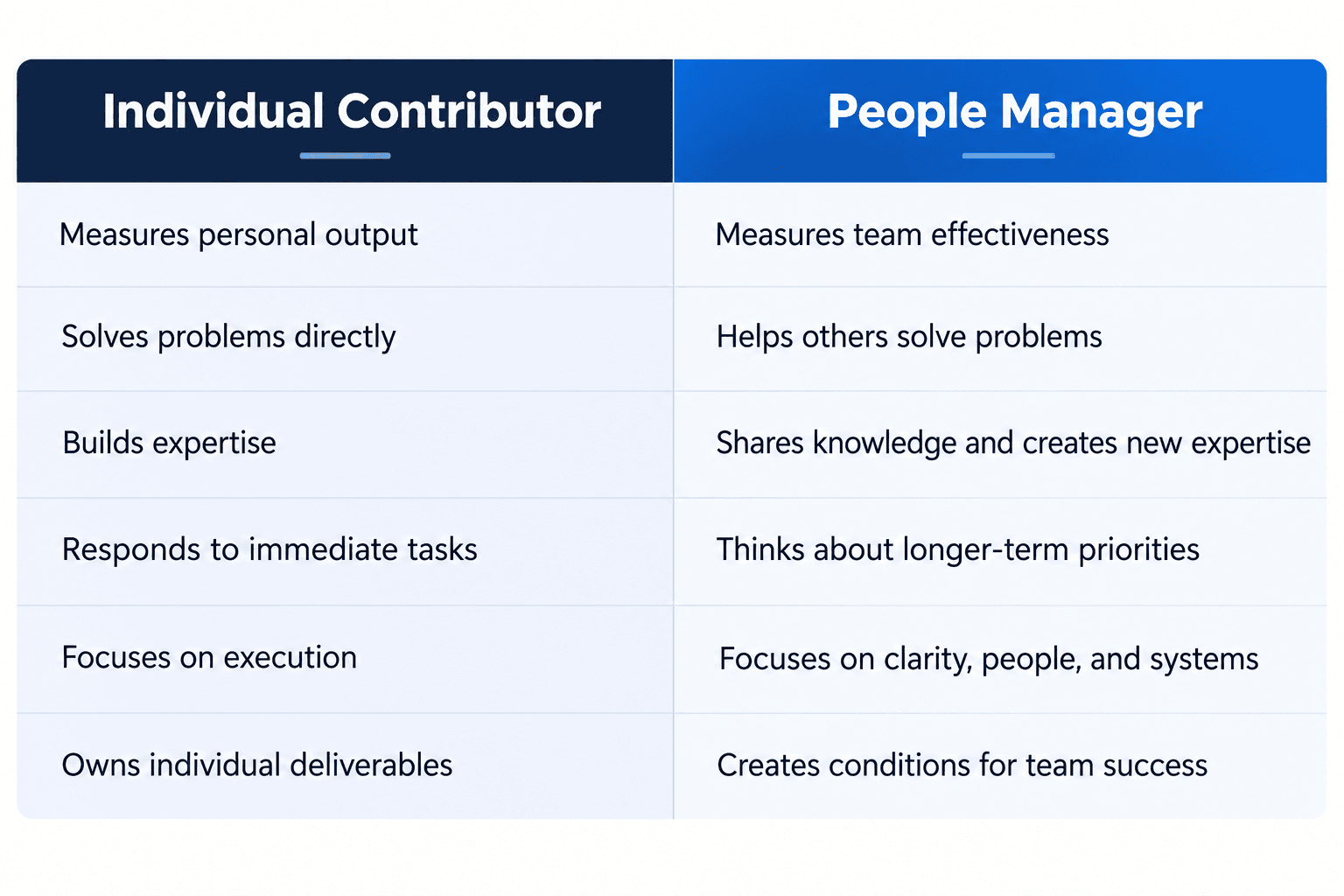
As an IC, finishing a difficult project can give you immediate feedback.
As a manager, the impact of your work may take weeks or months to become visible.
A difficult conversation today might prevent a resignation six months later.
A good coaching session might help an employee become a stronger contributor next year.
A process improvement might prevent dozens of future problems.
That is the multiplier effect.
The First 90 Days as a New Manager
Your first three months shouldn't be about proving that you're the smartest person in the room.
They should be about listening, understanding, building trust, and gradually improving how the team operates.
A useful approach is to divide your transition into three phases.
Days 1–30: Listen Before You Change
Your first month should be primarily about discovery.
Don't arrive with a long list of processes you want to change.
Instead, learn how the team actually works.
Schedule regular 1-on-1 conversations and ask questions such as:
What is working well?
What is frustrating you?
What is slowing the team down?
Which decisions take too long?
What support do you need from me?
What would you change if you were the manager?
What are you worried about that leadership may not see?
Pay attention to patterns.
If three different people independently mention the same problem, you probably aren't dealing with an individual issue. You're looking at a system problem.
Your goal during the first 30 days:
Understand before you optimize.
Days 31–60: Build Team Operating Rhythms
Once you've listened to the team, start improving the way work happens.
This could include:
Clearer priorities
Better 1-on-1 structures
More effective team meetings
Defined ownership
Better documentation
Faster decision-making
Clear escalation paths
Improved communication with stakeholders
Don't change everything at once.
Choose one or two high-impact problems and fix them properly.
For example, if engineers constantly wait for product decisions, the real problem may not be engineering productivity.
The bottleneck could be unclear decision ownership.
Your role is to identify that dependency and remove it.
This is one of the biggest differences between moving from engineer to engineering manager and simply becoming a senior engineer with more meetings.
Days 61–90: Move From Team Operations to Strategy
By the third month, you should start looking beyond individual problems.
Ask:
Where is this team going?
Understand:
Business priorities
Product roadmap
Technical risks
Hiring needs
Skill gaps
Team capacity
Cross-functional dependencies
Upcoming organizational changes
You should also become better at communicating upward.
Executives don't necessarily need every technical detail.
They need to understand:
What are we trying to achieve?
What is blocking us?
What risks should we know about?
What decision do you need from leadership?
A strong manager translates information between the team and the wider organization.
Managing Former Peers: The Hardest Part of the Transition
One of the most uncomfortable IC to management transition challenges is becoming the manager of people who were previously your peers.
You may have shared jokes, complained about management together, or worked side-by-side on difficult projects.
Now you have to give them feedback and make decisions that affect their work.
Two extreme approaches usually fail.
Don't pretend nothing changed.
Your role has changed, and pretending otherwise creates confusion.
Don't become authoritarian overnight.
You don't need to prove that you're “the boss.”
Instead, acknowledge the transition openly.
You could say:
“Our roles have changed, but I still value the working relationship we've built. My responsibility now is to help remove obstacles, support your development, and make sure your work gets the visibility it deserves.”
That creates clarity without creating unnecessary distance.
Most importantly, avoid favoritism.
Your former friends should not receive special treatment, and people who were less close to you should not feel disadvantaged.
Consistency builds credibility.
How to Delegate Without Micromanaging
Delegation is one of the biggest skills new managers need to develop.
Suppose an engineer is struggling with a task that you could personally finish in 20 minutes.
Your instinct may be:
“Give me the keyboard. I'll fix it.”
That's exactly what you should avoid doing repeatedly.
Instead, try these three principles.
1. Delegate the problem, not your solution
Explain the desired outcome and constraints.
For example:
“We need API latency below 150ms. Find the best approach and walk me through your recommendation.”
You provide direction without taking ownership away from them.
2. Accept that their solution may look different
Your team doesn't need to reproduce your exact working style.
If the solution meets the requirements and doesn't introduce unacceptable risk, allow people to own it.
3. Use mistakes as coaching opportunities
If you always correct mistakes before employees experience the consequences, they never develop independent judgment.
Your job is to help people become better decision-makers, not permanent dependents.
Letting Go of Coding as a Manager
One of the most difficult parts of letting go of coding as a manager is losing the immediate satisfaction of technical work.
You don't necessarily have to stop coding completely.
However, your management responsibilities should not suffer because you are trying to remain the team's strongest individual contributor.
Avoid becoming the person responsible for every critical-path technical task.
If the team cannot function when you're away from your keyboard, something is wrong.
Your technical knowledge should become an asset for coaching, decision-making, risk assessment, and hiring — not a reason to take every difficult task back from your team.
Run Better 1-on-1 Meetings
1-on-1s are not status meetings.
They are one of your most important tools for understanding the people you manage.
Instead of spending the entire meeting asking:
“What did you finish this week?”
use questions such as:
What is going well?
What's frustrating you?
Is anything blocking your work?
Is there a decision you're waiting for?
What skill would you like to develop?
How can I support you better?
Not every 1-on-1 needs to produce an action item.
Sometimes the most valuable outcome is simply understanding what your employee isn't comfortable saying in a larger meeting.
Give Feedback Before Small Problems Become Big Problems
New managers often avoid difficult feedback because they don't want to damage relationships.
That usually makes the problem worse.
If someone's communication is repeatedly causing confusion, don't wait six months to mention it.
Give feedback while the situation is still specific and manageable.
Focus on:
Situation → Behavior → Impact → Next step
For example:
“During yesterday's client presentation, we moved into technical implementation details before establishing the business requirement. The client seemed confused about the main objective. Next time, let's lead with the business outcome and introduce technical details afterward.”
The feedback is direct, but it doesn't attack the person's character.
That's the difference between useful coaching and personal criticism.
How Do You Know You're Becoming a Good Manager?
You are probably moving in the right direction when:
Your team makes decisions without waiting for you
People bring problems to you early
Employees understand their priorities
Team members receive useful feedback regularly
You have fewer operational bottlenecks
Your employees are becoming more capable
You can take time away without everything stopping
The strongest sign is not that your team needs you more.
It's that your team can perform well without needing you for every decision.
Frequently Asked Questions
How much time should a new engineering manager spend coding?
There is no universal percentage that applies to every organization or role. During the first 90 days, however, management responsibilities should take priority over hands-on execution. If coding prevents you from supporting your team, managing priorities, or handling critical communication, you're probably spending too much time in execution.
What should I do if a former peer resents my promotion?
Don't try to force the relationship back to how it was before.
Treat them professionally, recognize their expertise, give them autonomy, and make expectations clear. If the resentment continues to affect performance or team dynamics, address it directly in a private conversation.
What are the biggest IC-to-management transition challenges?
The biggest challenges usually include letting go of hands-on execution, delegating effectively, managing former peers, giving difficult feedback, running productive 1-on-1s, and learning to measure success through team outcomes rather than personal output.
Can I return to an individual contributor role?
Yes. Management does not have to be a one-way career decision. Many technology organizations have both management and senior individual-contributor career paths, allowing experienced professionals to move between them when the role and organization support it.
What books can help first-time managers?
Useful starting points include The Manager's Path by Camille Fournier, High Output Management by Andy Grove, and Resilient Management by Lara Hogan.
Final Thoughts
The transition from individual contributor to manager is not simply a promotion.
It is a change in how you create value.
As an IC, your expertise produces the output.
As a manager, you create the environment in which other people can produce better output.
That means learning to delegate, coach, communicate, resolve conflicts, remove bottlenecks, and give your team enough ownership to grow.
Your first 90 days are not about proving that you deserve the management title.
They're about building trust, understanding the team, improving the operating system around the team, and gradually shifting from maker to multiplier.
The moment you stop asking “What did I personally build this week?” and start asking “What became possible because I helped my team succeed?”, the transition begins to make sense.