

How to Break into Product Management Without Experience
You don't need “Product Manager” written on your résumé to start building product management skills.
But there's a frustrating problem with breaking into product management: many job descriptions ask for previous PM experience, even when you're applying for an entry-level role.
So how do you get experience when you haven't had the title?
The answer is to stop thinking only about the job title and start thinking about the work.
Product managers solve customer problems, prioritize what gets built, work across teams, and connect product decisions to business results. If you've already worked in engineering, design, marketing, analytics, operations, customer success, or a specific industry, you may already have part of that skill set.
The challenge is showing employers that you can apply it to product work.
Here are three practical ways to make the transition.
What Does a Product Manager Actually Do?
Product management sits between customers, business goals, and technology.
A PM doesn't simply tell developers what to build. Their job often involves figuring out:
What problem should we solve?
Who has this problem?
How important is it?
What should we build first?
What trade-offs do we need to make?
How will we know whether the solution worked?
That means strong PMs need more than technical knowledge. They need structured thinking, communication, customer understanding, prioritization, and business awareness.
If you enjoy figuring out why something should be built before deciding how to build it, product management may be a good career direction for you.
3 Ways to Break Into Product Management
There isn't one perfect route into product management. Your best option depends on where you are in your career.
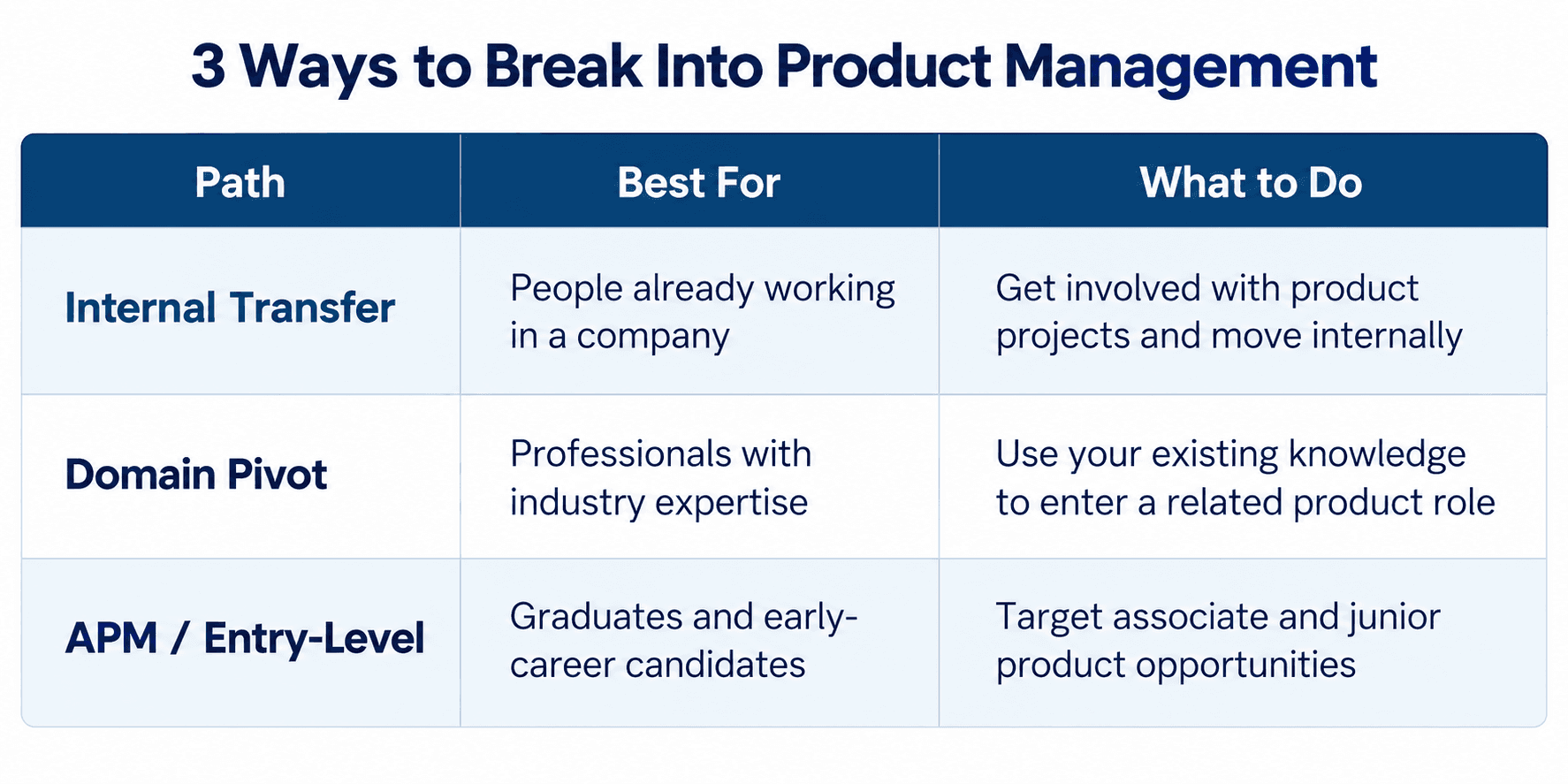
1. Try an Internal Transfer
If your company already has a product team, look there first.
You already understand the company's customers, processes, products, and culture. That's a major advantage over an external candidate starting from scratch.
You can start getting closer to product work by:
Helping with customer research
Writing user stories or requirements
Analyzing product data
Supporting product launches
Conducting competitor research
Working with designers and engineers
Asking a PM if you can shadow their work
You don't need to wait for an official transfer before developing product experience.
If you consistently contribute to product-related work, your eventual move becomes much easier to explain:
“I wasn't a PM before, but I was already doing several parts of the job.”
2. Use Your Existing Industry Experience
A career change doesn't always mean starting from zero.
Suppose you've spent several years working in healthcare. Instead of applying to every consumer-tech PM role, look at companies building products for healthcare professionals or organizations.
Your existing knowledge can be valuable because you already understand:
Customer problems
Industry terminology
Common workflows
Regulations
Buying decisions
Operational challenges
The same principle works across finance, education, logistics, retail, cybersecurity, manufacturing, and other industries.
Your previous career isn't necessarily baggage.
It can be your competitive advantage.
The goal is to combine your domain expertise with product skills.
Related Topic
3. Look for APM and Adjacent Roles
If you're a recent graduate or early in your career, look for Associate Product Manager (APM) and junior product opportunities.
But don't search only for “Product Manager.”
Consider roles such as:
Associate Product Manager
Junior Product Manager
Product Analyst
Product Operations
Product Specialist
Business Analyst
These roles can expose you to product decisions, users, data, and cross-functional teams.
Read the responsibilities carefully. A role with a different title may still give you the experience you need for a future PM position.
Build a PM Portfolio That Proves How You Think
If you don't have formal PM experience, a portfolio can give recruiters something concrete to evaluate.
You don't need five complicated projects.
One strong product case study is better than five shallow ones.
Choose an app or product you know well and identify a genuine user problem.
Then structure your case study around five questions.
1. What Is the Problem?
Don't start with your feature idea.
Start with the user's problem.
For example:
“Users abandon the checkout process because they have difficulty understanding the final cost before payment.”
Then explain how you identified the problem.
2. Who Is the User?
Be specific.
“Everyone” isn't a useful target audience.
Identify the particular user group affected and explain why the problem matters to them.
3. What Would You Build?
Now introduce your solution.
Explain how it addresses the problem and what you would include in the first version.
A simple Figma prototype or user flow can make your case study easier to understand.
4. What Would You Prioritize?
You can't build everything at once.
Explain what you would build first and what you would leave for later.
A framework such as RICE can help organize prioritization around reach, impact, confidence, and effort.
But don't use frameworks just to sound impressive.
Your reasoning matters more than the acronym.
5. How Would You Measure Success?
Choose metrics that connect directly to your goal.
Depending on the product, that could include:
Conversion rate
Activation
Retention
Task completion
Revenue
Customer satisfaction
Explain why the metric matters.
That's what demonstrates product thinking.
Prepare for the PM Interview
Product interviews often test how you approach unfamiliar problems.
You might hear:
“How would you improve a navigation app for tourists?”
Don't immediately start listing features.
First clarify:
Who is the user?
What problem are they facing?
What matters most to them?
What constraints exist?
Which solution should we prioritize?
For product-design questions, frameworks such as CIRCLES can help you organize your response.
You may also face analytical questions such as:
“Daily rides on a platform suddenly dropped by 10%. What would you investigate?”
A strong answer doesn't immediately guess the cause.
First investigate whether the change is:
Across all users or one segment
Limited to one location
Connected to a recent product release
Caused by a tracking issue
Related to external events
The interviewer isn't only looking for the correct answer.
They're watching how you think when the answer isn't obvious.
5 Skills to Build Before Applying
You don't need to become an expert in everything.
Focus on these foundations:
Product thinking: Learn to identify and validate customer problems.
Data literacy: Understand basic metrics, funnels, retention, and experiments.
Communication: Practice explaining decisions clearly.
Prioritization: Learn to make trade-offs when time and resources are limited.
Technical understanding: You don't have to be a developer, but understanding how products are built will help you work effectively with engineering teams.
And don't forget business knowledge. A product isn't successful simply because users like it. It also needs to create sustainable value for the business.
Avoid These Common Career-Change Mistakes
Applying Only for PM Titles
Your first step into product may be an APM, product analyst, product operations, or internal role.
Collecting Courses Instead of Building Evidence
Courses can teach concepts, but employers also want to see how you apply them.
Designing Features Without Defining the Problem
A polished prototype isn't useful if you can't explain why the feature should exist.
Memorizing Frameworks
Frameworks should help you think, not replace your thinking.
Trying to Change Careers Overnight
Give yourself time to develop real skills, build evidence, and understand what product management actually involves.
Your 90-Day Product Management Plan
You don't need to wait until you feel completely ready.
Days 1–30: Learn
Study product discovery, user research, metrics, prioritization, and product development.
At the same time, analyze products you already use. Ask yourself:
What problem does this product solve?
Days 31–60: Build
Choose one product and create a detailed case study. Document the problem, users, research, solution, trade-offs, and success metrics.
Days 61–90: Apply
Start applying for relevant APM, junior PM, product analyst, product operations, and internal opportunities. At the same time, connect with people working in product and learn from their career paths.
Don't just ask for a referral. Ask thoughtful questions about how they entered the field and what skills helped them most.
Final Thoughts
Breaking into product management without experience is challenging, but your lack of a PM title doesn't mean you have nothing valuable to offer. Your current career may already have pieces of what product teams need.
An engineer understands technical constraints.
A designer understands user experience.
An analyst understands data.
A marketer understands customers.
An operations professional understands processes.
A domain expert understands a specific industry.
Your job is to connect those strengths with product thinking.
Build something. Solve a real problem. Explain your decisions. Learn how to prioritize. Practice communicating your reasoning. You don't need to convince an employer that you've already been a Product Manager.
You need to show them that you're ready to start doing the work.
Frequently Asked Questions
Can I become a Product Manager without experience?
Yes. Many people transition into product from engineering, design, analytics, marketing, operations, customer success, and other backgrounds. The key is demonstrating relevant skills and product thinking.
Do I need an MBA to become a Product Manager?
No. An MBA can be useful for some career paths, but it isn't a universal requirement for product management.
How can I get PM experience without a PM job?
Start by contributing to product-related work in your current role, build product case studies, analyze existing products, and look for internal or adjacent roles that involve product decisions.
What should a Product Manager portfolio include?
A strong case study should explain the user problem, target audience, research, proposed solution, prioritization, trade-offs, and success metrics.
What is an APM role?
An Associate Product Manager role is generally an early-career product position designed to provide experience working on product-related responsibilities. Requirements vary by company.