
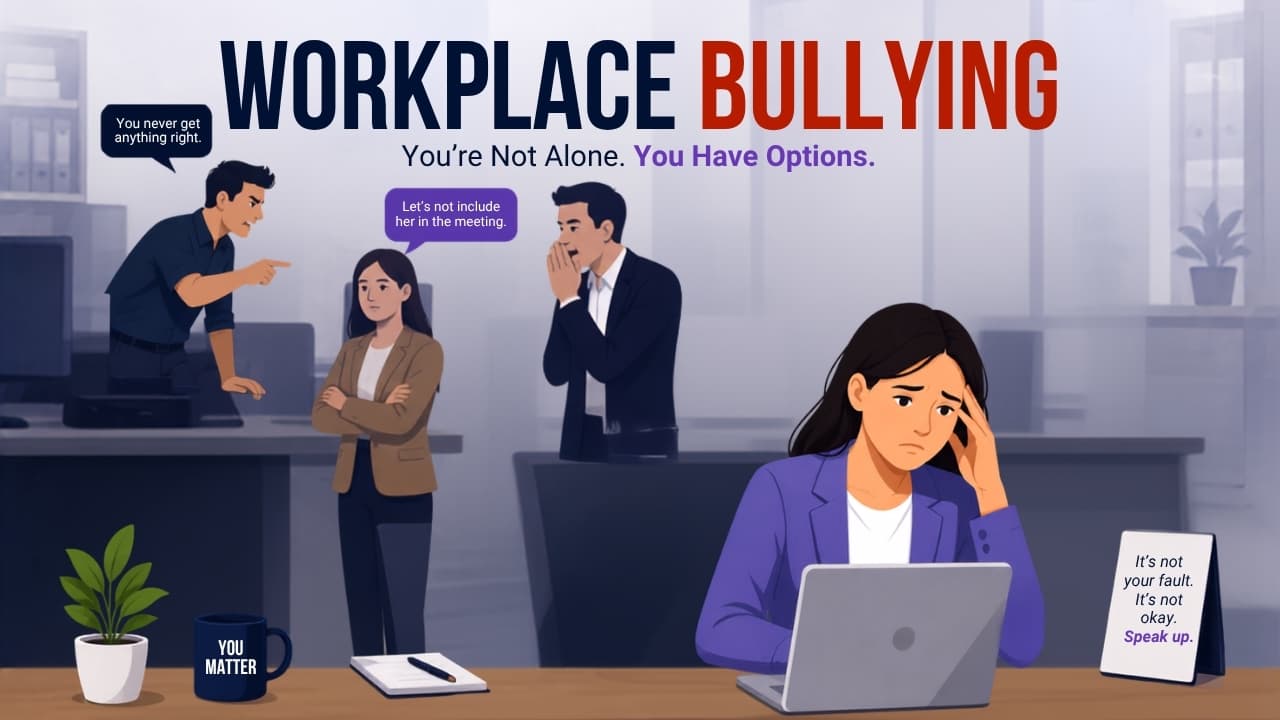
You walk into work on Monday morning and already know what is coming.
The comments.
The unnecessary criticism.
The messages that make you question whether you actually did anything wrong.
Maybe your manager constantly humiliates you in front of colleagues. Maybe someone deliberately leaves you out of important conversations. Or perhaps you're repeatedly given impossible deadlines and then blamed when the work isn't finished.
At first, you tell yourself:
“Maybe I'm overthinking it.”
Then it happens again.
And again.
Eventually, work starts affecting your confidence, sleep, relationships and life outside the office.
If that sounds familiar, don't simply tell yourself to “toughen up.”
Workplace bullying is a serious workplace issue, and you don't have to handle it alone.
The first step is understanding what is actually happening and what you can safely do about it.
What Is Workplace Bullying?
Not every difficult conversation, disagreement or piece of criticism is bullying.
In Australia, Safe Work Australia describes workplace bullying as repeated and unreasonable behaviour directed towards a worker or group of workers that creates a risk to health and safety. Examples can include intimidating or aggressive behaviour, humiliating comments and other unreasonable conduct.
That means three things matter:
1. It is repeated
A single unpleasant interaction may be serious, but workplace bullying generally involves a pattern of behaviour.
2. The behaviour is unreasonable
The conduct goes beyond what a reasonable person would consider acceptable in the circumstances.
3. It creates a health or safety risk
The behaviour may affect your psychological or physical wellbeing.
There is also an important distinction: reasonable management action carried out in a reasonable way is not workplace bullying, even if you find the feedback or decision uncomfortable.
What Can Workplace Bullying Look Like?
Bullying isn't always someone shouting across the office.
Sometimes it's much harder to recognise.
It could involve:
Repeated humiliation or insults
Aggressive or intimidating behaviour
Deliberately excluding someone from work-related activities
Spreading damaging rumours
Constantly undermining someone's work
Withholding information they need to perform their job
Repeatedly setting unreasonable work expectations
Using threats or intimidation
One incident may be a warning sign rather than the full legal definition of bullying. The important thing is to look for a pattern and its impact.
What Should You Do If You're Being Bullied at Work?
1. Start Documenting What Happens
When you're dealing with repeated behaviour, memory alone isn't enough.
Keep a factual record of incidents.
Write down:
Date and time
What happened
What was said or done
Who was present
Relevant emails or messages
How the incident affected your work
Avoid turning your notes into an emotional diary.
Write what you can actually establish.
For example:
Weak:
“My manager is always trying to embarrass me.”
Stronger:
“During Monday's team meeting, my manager said X in front of six colleagues and later sent Y message.”
Specific records can help you explain the situation clearly if you need to raise a formal concern.
2. Check Your Workplace Bullying Policy
Before making a formal complaint, find out what process your organisation has.
Look through your:
Employee handbook
Workplace policies
HR portal
Grievance procedures
Health and safety procedures
Your workplace may have a specific process for reporting bullying or inappropriate behaviour.
You don't need to figure everything out alone.
Depending on your workplace, support may be available from HR, a manager you trust, a health and safety representative or a union representative.
3. Consider Speaking to the Person — Only If It's Safe
Sometimes the person may not understand the impact of their behaviour.
If you feel physically and emotionally safe doing so, you may choose to address the behaviour directly.
Keep it calm and specific.
For example:
“When you speak to me like that in front of the team, I find it inappropriate and difficult to work effectively. I would like you to raise concerns with me privately.”
You don't have to confront the person.
If you feel threatened, intimidated or unsafe, skip this step and use another reporting route.
The Fair Work Commission specifically advises that speaking directly to the person is an option only where it is safe to do so.
4. Report the Behaviour Through the Right Channel
If the behaviour continues, or you don't feel comfortable addressing it directly, raise the issue through your workplace's reporting process.
Depending on the organisation, this could mean speaking with:
Your manager
HR
A health and safety representative
A union representative
Another designated complaints contact
Bring your documentation.
Focus on behaviour, dates, evidence and impact, rather than labels.
Instead of saying:
“My manager is a bully.”
Explain:
“These incidents have happened repeatedly over the past three months. Here are the dates, what occurred and the effect they have had on my work.”
That gives the organisation something concrete to investigate.
5. Know When to Escalate
If internal reporting doesn't resolve the problem, you may have other options.
In Australia, eligible workers can apply to the Fair Work Commission for an order to stop workplace bullying where the legal requirements are met. The Commission's current guidance says applicants generally need to be workers in a constitutionally covered business, still connected to the workplace, and experiencing or facing a risk of continued bullying that creates a health and safety risk.
The Commission also says workers should, where safe, try workplace processes first, although you don't have to confront the alleged bully if it isn't safe.
Because workplace laws differ by country and circumstances, don't assume that an Australian process applies elsewhere. If you're outside Australia, check your local employment or workplace-safety authority and consider getting independent legal advice.
What Not to Do When You're Being Bullied
Some reactions can make an already difficult situation worse.
Don't retaliate
Responding with your own insults or intimidation can escalate the conflict and make the situation harder to resolve.
Don't delete evidence
Keep relevant emails, messages and records in accordance with workplace policies and applicable privacy rules.
Don't assume it will disappear
If there is a repeated pattern, hoping it will simply stop may leave the problem unresolved.
Don't isolate yourself
Talk to someone you trust.
A supportive colleague, friend, family member, union representative or professional can help you see the situation more clearly.
Don't put your safety at risk
You never need to confront someone directly just because a workplace guide says you should.
If you feel unsafe, use a safer reporting route.
What If You're Not Sure Whether It's Bullying?
That's okay.
You don't have to diagnose the situation yourself.
Start by asking:
Is this happening repeatedly?
Would a reasonable person consider the behaviour unreasonable?
Is it affecting my health, safety or ability to work?
Then seek an outside perspective.
The Fair Work Commission also provides an eligibility checker and explains that its information is not a substitute for independent legal advice.
Your Workplace Bullying Action Plan
1. Recognise the pattern — Look at repeated behaviour rather than one isolated disagreement.
2. Document incidents — Record dates, actions, witnesses and relevant evidence.
3. Check workplace policies — Understand your organisation's reporting process.
4. Get support — Speak with someone you trust.
5. Address it if safe — Consider a calm, direct conversation only when appropriate.
6. Report it — Use HR, management, health and safety or other formal channels.
7. Escalate when necessary — Explore external workplace authorities or independent legal advice.
You Don't Have to Normalise a Toxic Workplace
Going to work shouldn't mean spending every day wondering who will embarrass you, undermine you or make you feel unsafe.
And dealing with workplace bullying doesn't mean starting a war with your employer.
The strongest approach is usually the most practical one:
recognise the pattern, document the facts, get support, use the appropriate reporting process, and protect yourself.
You may not be able to control another person's behaviour.
But you can control how you respond to it.
And if the situation is affecting your health or safety, don't wait until the damage becomes impossible to ignore.
You deserve to work in an environment where professionalism doesn't come at the cost of your wellbeing.