
Reverse Job Searching: How to Vet Employers Before Accepting a Job
A job interview is not just an opportunity for a company to evaluate you. It is also your chance to decide whether the organization deserves your skills, time, and commitment.
Many candidates spend hours preparing answers, researching interviewers, and polishing their resumes. Yet they ask very few questions about management practices, workplace culture, financial stability, or the expectations attached to the role.
That imbalance can lead to disappointing career decisions.
Reverse job searching changes this approach. Instead of focusing exclusively on getting hired, you investigate whether a prospective employer is the right fit for your professional goals and personal priorities.
In this guide, you will learn how to evaluate employers, identify workplace culture red flags, ask effective reverse job search questions for interviewers, and conduct responsible research before accepting an offer.
1. Why Reverse Job Searching Matters
A company's website may highlight its mission, employee benefits, and exciting projects. However, these descriptions rarely explain what happens when deadlines are missed, priorities change, or employees disagree with management.
The consequences of joining the wrong organization can include persistent stress, limited career progression, unexpected restructuring, and an unhealthy work environment.
Reverse job searching helps reduce these risks by treating recruitment as a two-way evaluation process.
Before accepting a position, consider four important areas:
Financial stability: Does the company appear financially sustainable?
Leadership quality: Are management responsibilities and expectations reasonably clear?
Workplace culture: Can employees raise concerns, challenge decisions, and maintain appropriate boundaries?
Career development: Are performance expectations and promotion opportunities transparent?
No research method can eliminate every risk. However, gathering information from multiple sources helps you make a more informed decision.
2. How to Vet an Employer Before Joining
A structured employer evaluation makes it easier to identify potential concerns without relying on a single review or interview response.
Check company stability
Research the company's recent announcements, financial disclosures, funding history, and hiring activity where this information is publicly available.
For startups, consider asking about funding milestones, revenue sources, and the company's priorities for the next 12 months. You do not necessarily need access to confidential financial information to understand its general direction.
For established businesses, review annual reports, public filings, leadership announcements, and credible news coverage.
A hiring freeze or declining headcount does not automatically mean layoffs are coming. Look for multiple indicators and ask reasonable questions about the company's current priorities.
Research leadership and team turnover
Look at the professional histories of the hiring manager and relevant department leaders. Frequent leadership changes or repeated vacancies may justify further investigation, although there can be legitimate reasons for employee departures.
During the interview, ask how long the current team has worked together and how the department has changed over the past year.
The goal is not to judge a company based on one person's departure. It is to understand whether the role offers a reasonably stable and supportive working environment.
Review workplace feedback carefully
Employee review platforms can provide useful insights into management, workload, compensation, and career growth.
However, individual reviews reflect individual experiences and may not represent the entire organization. Pay attention to recurring themes across multiple reviews, especially when they are recent and relate to the specific department you are considering.
Compare these observations with what you hear from recruiters, hiring managers, and potential colleagues.
3. Reverse Job Search Questions for Interviewers
General questions such as "How would you describe your culture?" often produce broad answers. More specific questions encourage interviewers to explain how the organization handles real situations.
Questions for the hiring manager
"Can you describe a recent situation when someone on the team disagreed with your decision? How was it resolved?"
"What would success in this role look like after the first 90 days?"
"How do you prioritize work when several important deadlines conflict?"
"What are the biggest challenges someone joining this team should expect?"
Listen for concrete examples rather than promises. A manager who can explain expectations, acknowledge challenges, and describe how disagreements are handled may provide a clearer picture of the working environment.
Questions for potential teammates
"What surprised you most during your first three months here?"
"How does the team usually respond when a project falls behind schedule?"
"How often do people need to work outside normal hours?"
"What do you appreciate most about working with this team, and what would you change?"
These questions can reveal everyday realities that may not appear in a formal job description.
Questions about growth and performance
"How are performance reviews conducted?"
"What criteria determine promotions and salary increases?"
"Can you share an example of how someone on this team developed professionally?"
"What training or mentoring opportunities are available?"
Clear answers can help you understand whether the organization invests in employee development or leaves career progression largely undefined.
4. Workplace Culture Red Flags to Watch For
Certain interview responses deserve closer attention. They are not automatic proof of a toxic workplace, but they can help you decide what to investigate further.
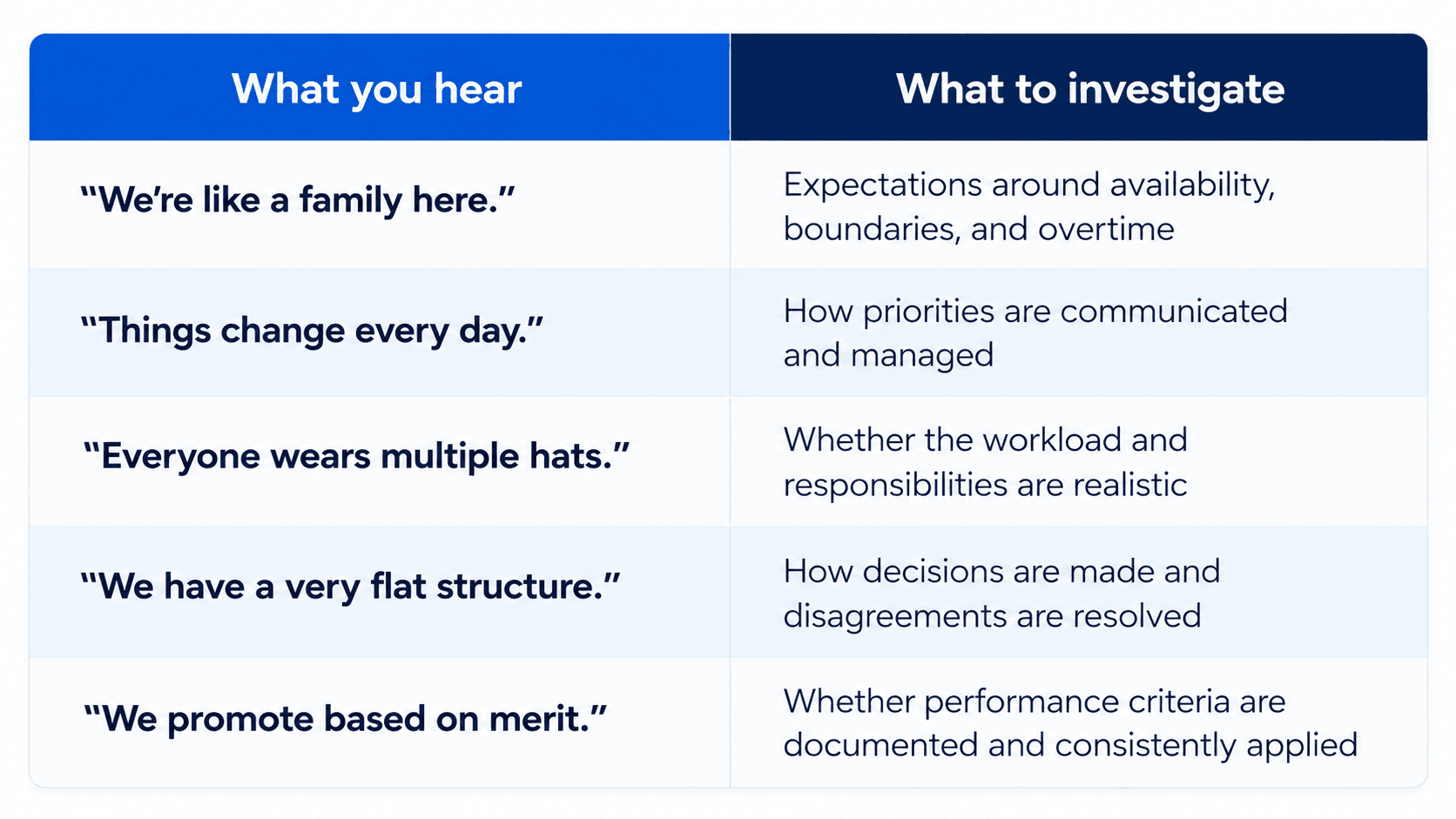
Also pay attention to the interview process itself.
Repeatedly cancelled interviews, contradictory information about the role, disrespectful communication, or pressure to accept an offer before reviewing its terms may indicate problems with organization or candidate treatment.
Consider the complete pattern rather than making a decision based on one awkward interaction.
5. How to Conduct Ethical Backchannel Research
Speaking with former employees can provide additional context about a prospective employer, especially when their experience relates to the department or manager you would be joining.
Start with professional contacts, former colleagues, or people who voluntarily share their experiences publicly. If you contact someone on LinkedIn, explain your situation politely and make it easy for them to decline.
For example:
"Hi [Name], I noticed that you previously worked at [Company] in [Department]. I'm considering an opportunity there and would appreciate your perspective on the team culture and management approach. If you're comfortable sharing, would you be open to a brief conversation? No worries if you'd prefer not to."
Respect confidentiality and avoid requesting proprietary information or personal details about other employees.
Do not treat silence as proof that something is wrong. People may be busy, uncomfortable discussing a former employer, or simply unwilling to participate.
Instead, look for consistent, independently supported patterns across several sources.
6. Common Employer-Vetting Mistakes
Relying on online ratings alone: Reviews can identify useful themes, but they should be combined with other evidence.
Asking difficult questions too aggressively: Frame questions around understanding expectations and working practices, rather than accusing the company of having problems.
Ignoring your own priorities: A fast-paced environment may suit one person but be unsuitable for someone who values predictable hours. Decide what matters most to you before interviews begin.
Skipping conversations with future colleagues: When possible, request a brief conversation with someone who understands the team's daily work. If the company cannot arrange one, ask why and seek other ways to assess the role.
Accepting unnecessary time pressure: Review the written offer, compensation details, benefits, and relevant contractual terms before committing. Ask for reasonable time to make your decision.
7. Frequently Asked Questions
Will asking challenging interview questions hurt my chances?
Thoughtful questions usually help clarify expectations and demonstrate preparation. Ask respectfully, listen carefully, and adapt your questions to the interviewer's role.
What should I ask when interviewing at a startup?
Ask about the company's current priorities, business model, funding milestones where relevant, expected responsibilities, and how success will be measured. Early-stage companies may have more uncertainty, so clarify what that means for your role.
How can I assess work-life balance during an interview?
Ask about typical working hours, overtime during major launches, on-call responsibilities where applicable, and how managers handle competing deadlines.
What is the biggest red flag in a hiring process?
There is no single universal warning sign. Repeatedly inconsistent information, disrespectful behavior, unclear responsibilities, and pressure to accept an offer without reasonable review are all reasons to investigate further.
Conclusion
Reverse job searching helps you make career decisions based on evidence rather than excitement or pressure.
Research company stability, understand the hiring manager's approach, ask specific questions about workplace culture, and seek additional perspectives where appropriate. Most importantly, compare what you learn with your own professional goals and personal boundaries.
A successful job search is not simply about finding a company willing to hire you. It is about finding a role in which you can contribute, develop your skills, and build a sustainable career.
Explore the UNIBLIP Job Search Hub for more guidance on job hunting, interview preparation, and career development.