
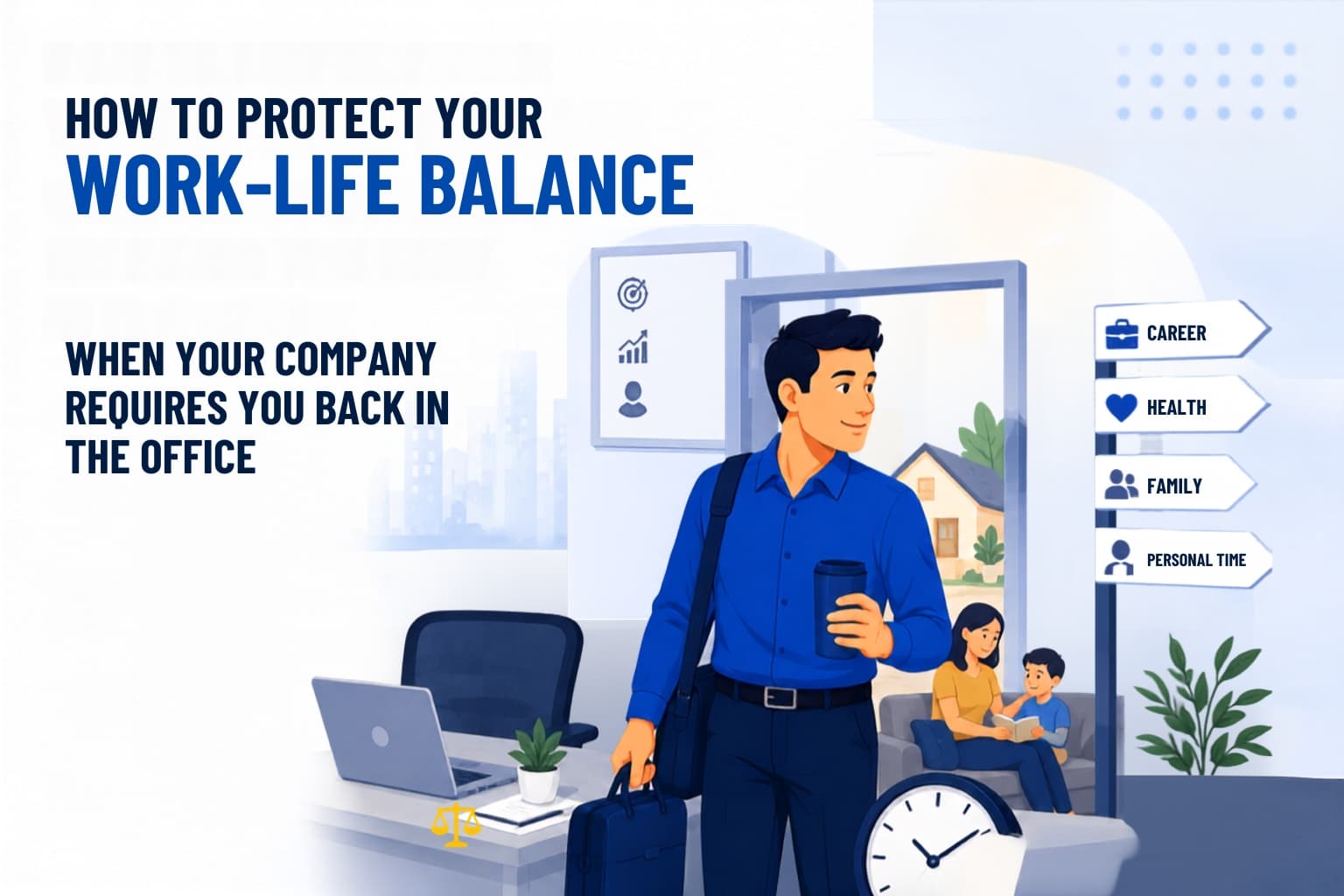
How to Protect Your Work-Life Balance When Your Company Requires You Back in the Office
Returning to the office can be a bigger adjustment than simply changing where you work.
For many employees, remote or hybrid work became part of their daily routine. They had more control over commuting, family responsibilities, meals, appointments, and personal time. A return-to-office requirement can suddenly change all of that.
The challenge is not necessarily working in an office. It is making sure the new arrangement does not turn your workday into a longer, more stressful routine.
If your company now requires you to spend more time in the office, these practical strategies can help you protect your work-life balance.
1. Calculate How Much Time Your New Routine Takes
Start by looking beyond your official working hours.
A return to the office may add:
Commuting time
Transportation costs
Meal expenses
Childcare arrangements
Preparation time
Less time for exercise or personal responsibilities
For example, if your commute takes an hour each way, you are adding two hours to your working day even though your official hours have not changed.
Understanding this impact can help you decide where adjustments are needed.
2. Create a New Routine
Do not try to maintain your old remote-work schedule after returning to the office.
Prepare for the new routine instead.
You could:
Prepare clothes and meals the night before
Organise your work bag in advance
Plan your commute
Set realistic morning and evening routines
Keep important personal tasks outside your busiest work hours
The goal is not to make every minute productive.
The goal is to create a routine that you can maintain without constantly feeling rushed.
3. Discuss Flexibility With Your Manager
If the new schedule is creating a genuine problem, have a professional conversation with your manager.
Avoid simply saying:
“I don't want to come into the office.”
Explain the specific issue and suggest a practical solution.
For example:
“The new schedule has significantly increased my commute time. Would it be possible to adjust my start time slightly so I can maintain my productivity while managing the commute better?”
If your company allows hybrid work, you could also ask whether one remote day per week is possible.
Focus on how the arrangement can work, rather than only explaining why you dislike it.
Top search terms
4. Set Boundaries Around Your Working Hours
One common problem after returning to the office is staying late simply because other people are still working.
Being physically present does not automatically mean you are more productive.
If your responsibilities can reasonably be completed within your working hours, avoid making unnecessary overtime a regular habit.
If additional hours are genuinely required, discuss the workload and priorities with your manager rather than silently accepting an unsustainable schedule.
5. Don't Bring the Office Home Every Evening
A long commute followed by several hours of additional work can quickly destroy your personal time.
Occasionally, working late may be unavoidable.
But if you regularly finish your office day and then continue working at home, the problem may be your workload rather than your productivity.
Ask yourself:
Is this work genuinely urgent, or could it have been completed during the working day with better prioritisation?
If this happens frequently, discuss your workload or deadlines with your manager.
6. Protect Your Focus at the Office
Office environments can create more interruptions than remote work.
Colleagues may stop by, meetings may appear unexpectedly, and conversations can break your concentration.
Protect time for important work by:
Blocking focus time on your calendar
Limiting unnecessary meetings
Using headphones when appropriate
Working in a quieter space when possible
Letting colleagues know when you need uninterrupted time
You can politely say:
“I need to finish this report by 2 p.m. Can we discuss this afterwards?”
A reasonable boundary does not make you unhelpful.
7. Protect Your Personal Commitments
Your personal life should not automatically become secondary every time your work schedule changes.
If returning to the office affects childcare, appointments, exercise, family responsibilities, or other important commitments, look for practical solutions early.
Depending on your workplace, you might be able to:
Adjust your start or finish time
Use hybrid days strategically
Change meeting times
Share responsibilities at home
Use available workplace benefits
The earlier you address the problem, the more options you are likely to have.
8. Use Office Days for Valuable Work
If you are required to be in the office, make the time worthwhile.
Use office days for activities that benefit from being physically together, such as:
Team discussions
Brainstorming
Mentoring
Collaboration
Networking
Meeting colleagues
Career conversations
Try not to spend the entire day doing work that could be completed just as effectively from home if your workplace allows flexibility for those tasks.
9. Watch for Signs That Your Routine Is Not Sustainable
It is normal to need time to adjust.
However, constantly feeling exhausted is different from simply needing a few weeks to settle into a new routine.
Pay attention if you are regularly experiencing:
Extreme tiredness
Constantly working late
Losing most of your evening to work
Difficulty managing personal responsibilities
Poor recovery between workdays
Increasing frustration with your job
These signs may indicate that your workload, commute, or schedule needs to be reconsidered.
10. Decide Whether the Job Still Fits Your Life
Sometimes the issue can be solved with better boundaries or a small schedule adjustment.
Sometimes it cannot.
If flexibility was an important part of your previous working arrangement and your employer has permanently removed it, consider whether the job still fits your long-term priorities.
Before making a decision, consider:
Salary and benefits
Commute time and cost
Career growth
Flexibility
Workload
Alternative job opportunities
Your personal priorities
Do not make a major career decision based only on frustration from a difficult week. Look at the complete picture.
Final Thoughts
Returning to the office does not have to mean giving up your work-life balance.
Understand how the new arrangement affects your time, create a sustainable routine, protect your working hours, and communicate professionally when you need flexibility.
Most importantly, remember that being committed to your career does not mean being available every hour of the day.
Your job is an important part of your life, but it should not consume the rest of it.