
The Technical Portfolio Addendum: How Senior Tech Leaders Showcase Their Work
Introduction
A strong resume can open the door to an interview, but explaining years of complex technical work in just a few bullet points is challenging.
Imagine leading a major cloud migration, coordinating several engineering teams, improving system reliability, and reducing infrastructure costs. Your resume might summarise the achievement in two lines, leaving little room to explain the decisions behind it.
This is where a technical portfolio addendum can help.
It is a short document that accompanies your resume and provides additional detail about selected projects, architectural decisions, challenges, and measurable outcomes. For Staff Engineers, Principal Architects, Engineering Directors, and Product Leaders, it can give interviewers a clearer picture of how they approach complex problems.
Here is how to create one that communicates technical depth without overwhelming the reader.
1. Why Senior Professionals May Need a Portfolio Addendum
Traditional resumes prioritise readability, relevant experience, and concise achievements. That format works well for initial screening, but it may not provide enough space to explain complex engineering decisions.
Consider a resume bullet such as:
“Led the migration of a legacy platform to an event-driven architecture, improving reliability and reducing infrastructure costs.”
This communicates the outcome, but it leaves several questions unanswered:
Why was the existing architecture no longer suitable?
Which alternatives did the team evaluate?
How were data consistency and system failures handled?
What trade-offs influenced the final design?
How was the project's business impact measured?
A portfolio addendum provides space to answer these questions without turning your resume into a lengthy technical document.
It is particularly useful when applying for roles that involve system design, technical strategy, platform architecture, or cross-functional leadership. It is optional, however, and should be tailored to the expectations of the employer.
2. A Three-Part Structure for Technical Case Studies
A useful addendum presents each project through three connected sections: context, technical decisions, and outcomes.
Part 1: Business Context and Constraints
Start by explaining the problem the project needed to solve.
Describe the business objective, the existing technical limitations, and the constraints that influenced the work. These might include performance requirements, regulatory obligations, budget limitations, legacy systems, or a fixed delivery deadline.
For example, you might explain that a billing platform experienced performance problems during peak demand and needed a redesign without interrupting existing customer transactions.
Keep this section focused. Interviewers need enough context to understand the problem, not a complete history of the organisation.
Part 2: Architecture and Design Trade-Offs
Explain how you approached the problem and why you selected a particular solution.
Depending on the project, this could include event streaming, database design, caching, API architecture, cloud infrastructure, or service security.
More importantly, explain the alternatives you considered and the reasons behind your decision.
For example, you might describe why an asynchronous event-processing design was more suitable than a fully synchronous workflow, given the system's throughput and resilience requirements.
Mention the trade-offs honestly. A design choice that improves scalability may introduce additional operational complexity. Showing that you understood these consequences demonstrates thoughtful engineering rather than simply listing technologies.
Part 3: Measurable Technical and Business Outcomes
Finish with evidence of what changed as a result of the project.
Relevant measures may include:
Improvements in response time or system availability.
Reduced infrastructure or operational costs.
Faster deployment cycles.
Lower failure rates or fewer recurring incidents.
Increased customer adoption or revenue opportunities.
Use verified figures wherever possible, and explain the measurement period or baseline when necessary.
If you cannot disclose exact numbers, use an approved range or describe the outcome qualitatively. Never invent performance metrics to make a project appear more impressive.
3. How to Protect Confidential Information
Senior professionals often work on projects covered by confidentiality agreements, internal security policies, or intellectual property restrictions. Your portfolio must respect those obligations.
Avoid including:
Proprietary source code or confidential algorithms.
Customer information or identifiable client details without permission.
Internal credentials, security configurations, or sensitive architecture diagrams.
Unreleased product plans, restricted financial data, or confidential patent information.
You can often explain your engineering approach using generic architectural patterns and anonymised examples, provided doing so complies with your obligations.
For example, instead of naming a client, describe the organisation as a large financial services platform. Instead of publishing an internal infrastructure diagram, create a simplified illustration using generic components.
Anonymisation does not automatically make confidential information safe to disclose. If you are unsure whether a detail can be shared, seek permission or leave it out.
4. Resume vs. CV vs. Portfolio Addendum
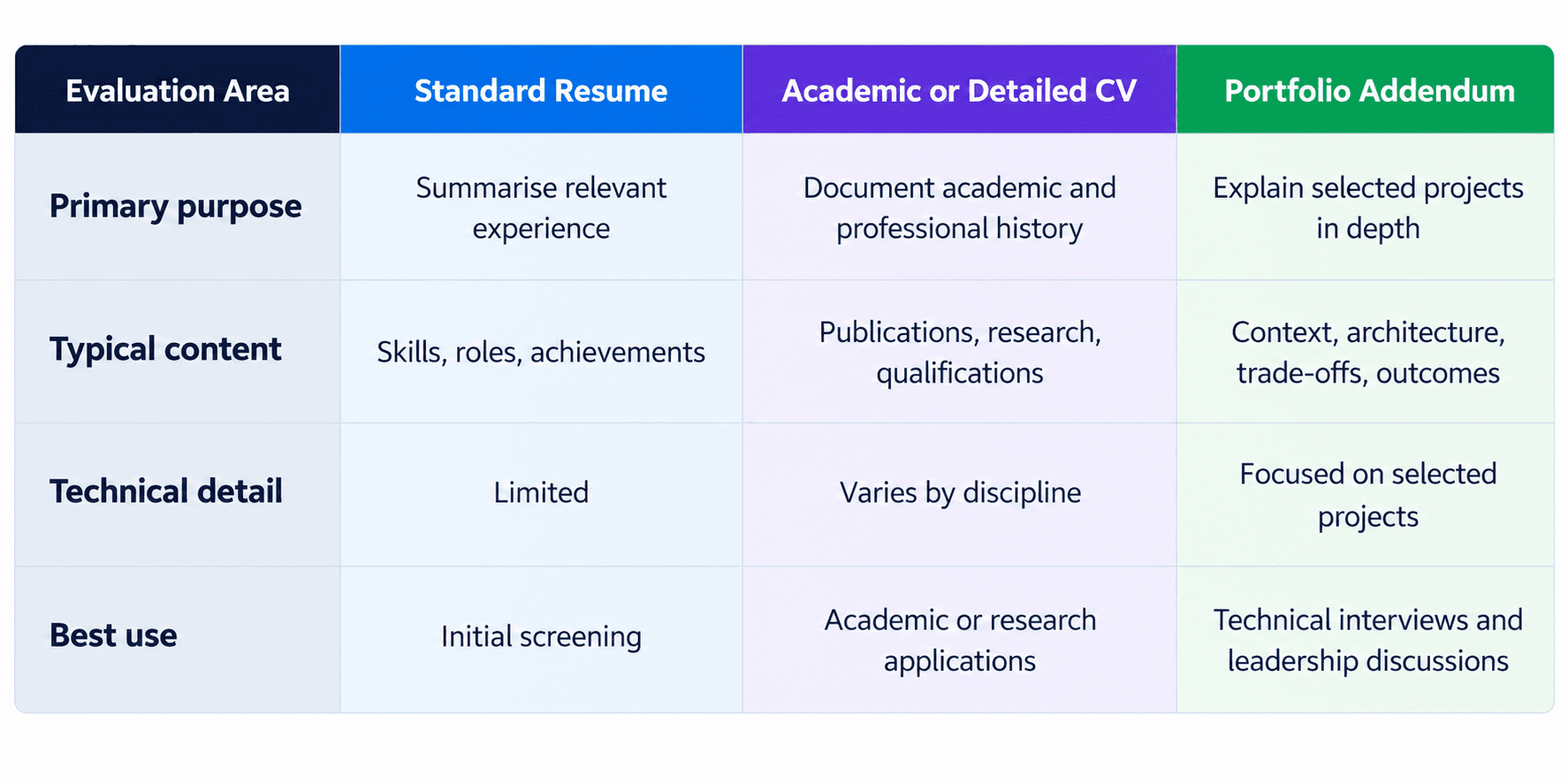
These formats serve different purposes. A portfolio addendum complements a resume; it does not need to replace it.
5. A Practical One-Page Portfolio Template
Use the following structure as a starting point and adapt it to your experience.
[YOUR NAME] — TECHNICAL PORTFOLIO ADDENDUM
Companion to your resume | [Professional email] | [LinkedIn profile]
CASE STUDY: [PROJECT NAME]
Role: [Your role]
Duration: [Project timeline]
Scale: [Relevant scope, if shareable]
1. Context and Constraints
Describe the business problem, existing limitations, project objectives, and key constraints in two or three sentences.
2. Architecture and Decisions
Approach: Explain the architecture or method you selected.
Key decisions: Describe the most important technical choices and why they made sense.
Trade-offs: Summarise the alternatives considered and the limitations of your solution.
3. Results and Impact
Technical result: [Verified performance, reliability, or quality improvement].
Business result: [Verified savings, efficiency improvement, or customer impact].
Your contribution: [What you personally led, designed, or delivered].
Repeat this structure for a second project if space permits.
A single well-documented case study can be more useful than several superficial examples. Prioritise projects that demonstrate the skills required for your target position.
6. Common Mistakes to Avoid
Making the document too long: Keep the addendum concise. One page is a useful target, not a universal hiring requirement.
Listing technologies without explaining decisions: Naming Kafka, Kubernetes, or PostgreSQL does not demonstrate architectural judgement by itself. Explain the problem each technology helped solve.
Claiming results without evidence: Use measurements you can substantiate and distinguish your individual contribution from the team's overall achievement.
Sharing confidential material: Do not assume that removing a company name makes internal information safe to publish.
Sending it to every recruiter automatically: Follow the employer's application instructions. If supplemental documents are accepted, share the addendum when it helps the reviewer understand your relevant experience.
For more guidance on presenting measurable achievements on your resume, explore our guide to writing effective resume bullets.
7. Frequently Asked Questions
Should a technical portfolio addendum be one page?
One page is a practical starting point because it encourages concise explanations. More detailed portfolios may be appropriate for specialised architecture roles, provided the employer is interested in reviewing them.
Can Product Managers use a portfolio addendum?
Yes. Product leaders can document product strategy, customer research, prioritisation decisions, launch planning, pricing experiments, and measurable business outcomes.
Should I include architecture diagrams?
A simple diagram can help explain a complex system, provided it is readable and does not reveal confidential information. Use generic components and labels where appropriate.
Will an addendum work with applicant tracking systems?
Compatibility depends on the document's structure and the employer's software. Use selectable text, standard headings, a simple layout, and a text-based PDF when permitted. No format guarantees perfect parsing.
How many projects should I include?
Start with one or two strong case studies that closely match the target role. Focus on the complexity of the problem, your contribution, the decisions you made, and the results you can demonstrate.
Final Thoughts
A technical portfolio addendum helps bridge the gap between a concise resume and the deeper discussions that take place during senior technical interviews.
By explaining the problem, the reasoning behind your decisions, and the results you achieved, you give hiring teams a more complete view of your capabilities.
Keep the document focused, protect confidential information, and use evidence rather than exaggerated claims. The goal is not to make your experience look bigger; it is to make the value of your actual work easier to understand.