
Action Plan to Improve Communication Skills: A Practical Guide
Good communication is not about using complicated words or speaking perfectly. It is about expressing your ideas clearly, listening carefully, understanding others, and responding with confidence. Whether you are a student, working professional, job seeker, manager, entrepreneur, or someone who simply wants better relationships, communication skills can make a significant difference in your personal and professional life. The good news is that communication is a skill you can develop with consistent practice.
If you are looking for an action plan to improve communication skills, this guide gives you a simple, realistic framework that you can follow every day.
Why Communication Skills Matter
Communication affects almost every area of life.
At work, clear communication can help you explain ideas, collaborate with colleagues, handle meetings, and build professional relationships. During interviews, your ability to communicate confidently can influence how employers perceive your knowledge and personality.
In everyday life, effective communication can help you express your thoughts, avoid misunderstandings, and develop stronger relationships.
Strong communication generally involves several connected skills:
Speaking clearly and confidently
Active listening
Asking relevant questions
Understanding body language
Writing clearly
Managing tone and emotions
Explaining complex ideas simply
Adapting communication to different people and situations
Improving these areas does not require changing your personality. It requires awareness, practice, and feedback.
Your Action Plan to Improve Communication Skills
Instead of trying to improve everything at once, focus on one communication habit at a time.
Here is a practical six-step action plan.
1. Identify Your Communication Weaknesses
Before improving your communication, understand where you currently struggle.
Ask yourself:
Do I hesitate while speaking?
Do I struggle to find the right words?
Do I speak too quickly?
Do I interrupt people?
Do I have difficulty explaining my ideas?
Do I avoid speaking in groups?
Do I struggle with professional writing?
Do I find it difficult to start conversations?
Does my body language show confidence?
Do people often misunderstand what I mean?
Write down your three biggest communication challenges.
For example, you may realize that your vocabulary is fine but you struggle with confidence. Someone else may speak confidently but fail to listen properly.
The goal is not to become a perfect communicator. The goal is to identify the specific skills you need to improve.
Related Blog
2. Practice Active Listening
Many people focus on what they are going to say next instead of listening to the person speaking.
That can create misunderstandings. Active listening means giving the speaker your attention and trying to understand both the message and the meaning behind it.
Try these habits:
Put your phone away during important conversations.
Avoid interrupting.
Maintain natural eye contact.
Ask follow-up questions.
Briefly summarize what you understood.
Pay attention to tone and body language.
For example, instead of immediately giving advice, you could say:
“So, if I understand correctly, your main concern is…”
This simple habit can make conversations more meaningful and help you become a better communicator.
3. Improve Your Speaking Skills
You do not need an advanced vocabulary to communicate effectively.
In many situations, simple and clear language is more powerful than complicated language.
Start practicing how you structure your thoughts.
A useful structure is:
Point → Reason → Example → Conclusion
For example:
“I think employees should receive communication training because clear communication reduces misunderstandings. For example, better communication during team projects can prevent confusion about responsibilities. That is why communication training can improve collaboration.”
This structure helps you organize your thoughts before speaking.
Daily Speaking Exercise
Spend 10 minutes every day speaking about a topic.
You can talk about:
Something you learned today
A news topic
Your work
A book or movie
A problem you solved
Your future goals
Record yourself on your phone and listen to the recording.
Pay attention to:
Repeated words
Long pauses
Unclear sentences
Speaking speed
Pronunciation
Filler words such as “um,” “actually,” and “like”
Do not judge yourself harshly. Use the recording to identify one thing to improve the next day.
4. Work on Confidence and Body Language
Communication is not only about words. Your posture, facial expressions, gestures, eye contact, and tone can influence how your message is received.
To appear more confident:
Sit or stand upright.
Keep your shoulders relaxed.
Make comfortable eye contact.
Avoid constantly looking at the floor.
Use natural hand gestures.
Speak at a controlled pace.
Pause instead of filling silence with unnecessary words.
Confidence does not mean speaking loudly or dominating a conversation.
Real communication confidence means being comfortable expressing your thoughts while respecting the other person.
If you feel nervous during conversations, start with low-pressure situations. Speak to a colleague, participate in a small discussion, ask a question in class, or introduce yourself to someone new. Small wins gradually make bigger conversations easier.
5. Improve Your Written Communication
Communication skills also include writing. Emails, reports, messages, presentations, resumes, proposals, and social media posts all require clear written communication.
Before sending an important message, ask:
Can the reader understand my main point quickly?
A simple professional writing structure is:
Purpose → Important details → Required action
For example, instead of writing a long paragraph explaining a problem, clearly state what happened, why it matters, and what you need from the reader. You should also develop the habit of proofreading.
Check:
Grammar
Spelling
Sentence length
Clarity
Tone
Unnecessary repetition
Reading regularly can also improve vocabulary, sentence structure, and writing style.
However, don't focus only on learning new words. Learn how words are used in real communication.
6. Practice Communication Every Day
The biggest mistake people make is treating communication improvement as something they can learn in a single course or book. Communication is a practical skill. You improve it by using it.
Create a simple daily routine:
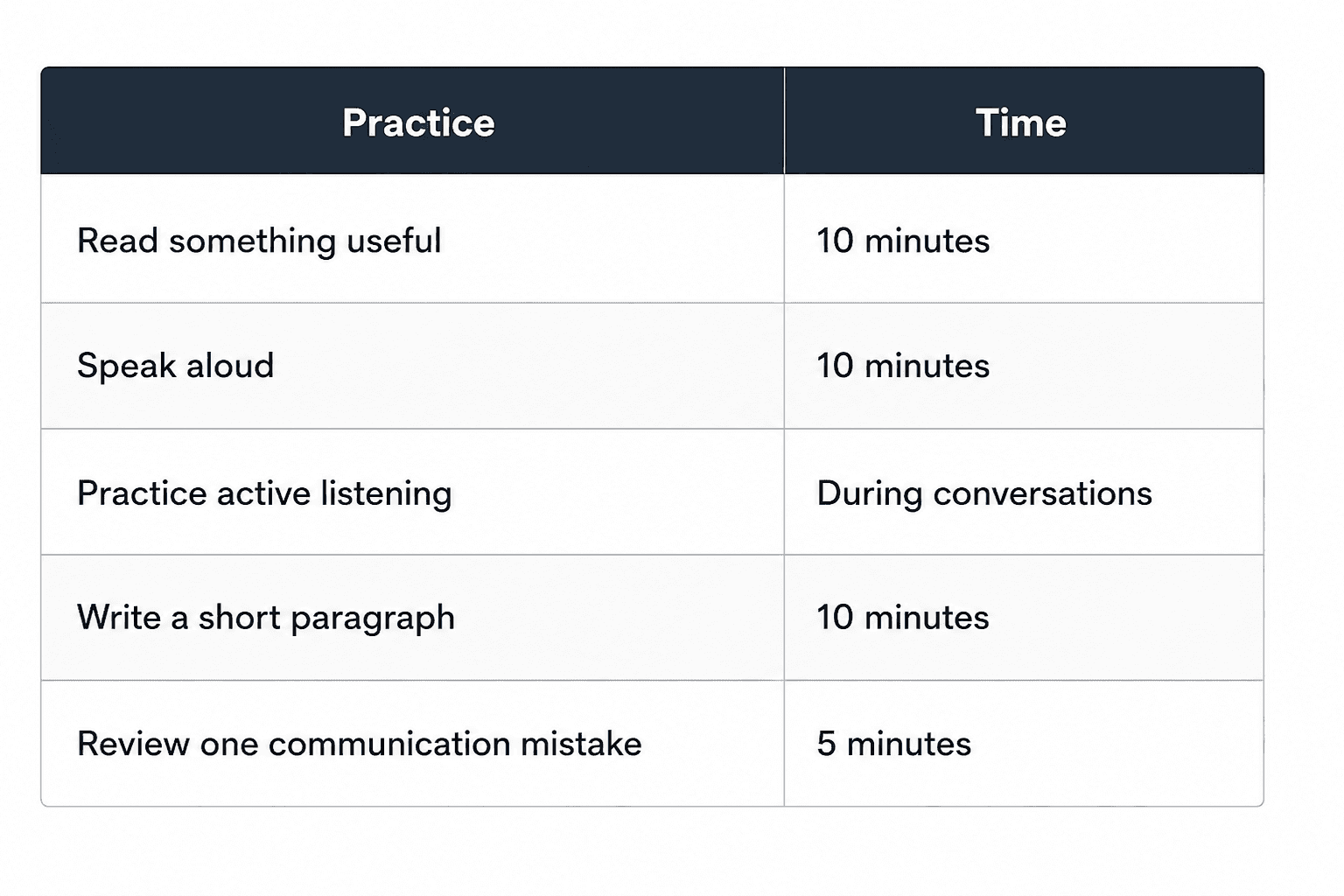
You don't need hours of practice.
30–35 minutes of intentional practice each day can be more useful than occasional intensive practice.
A 30-Day Communication Skills Improvement Plan
If you want a structured approach, use this four-week plan.
Week 1: Awareness and Listening
Focus on understanding your current communication habits.
Practice:
Active listening
Avoiding interruptions
Eye contact
Asking better questions
Recording short conversations or practice speeches
Your goal is to become more aware of how you communicate.
Week 2: Speaking Clearly
Focus on expressing your ideas.
Practice:
Speaking for 5–10 minutes daily
Using simple language
Structuring your thoughts
Reducing filler words
Controlling speaking speed
Your goal is clarity, not perfection.
Week 3: Confidence and Body Language
Focus on how you present yourself.
Practice:
Confident posture
Natural eye contact
Controlled gestures
Voice modulation
Speaking in small groups
Challenge yourself to start at least one conversation you would normally avoid.
Week 4: Real-World Application
Now combine everything.
Practice communication during:
Meetings
Interviews
Presentations
Team discussions
Networking
Everyday conversations
Ask someone you trust for honest feedback.
A useful question is:
“What is one thing I do well when communicating, and what is one thing I should improve?”
Specific feedback can help you identify blind spots that are difficult to notice yourself.
Common Mistakes to Avoid
While improving communication, avoid these common mistakes:
Trying to Sound Too Professional
Using complicated vocabulary does not automatically make communication better.
Clear communication is usually more effective than impressive-sounding language.
Focusing Only on Speaking
Good communication involves listening, writing, reading, non-verbal communication, and emotional awareness too.
Expecting Immediate Confidence
You may still feel nervous even after practicing. That is normal.
Confidence usually develops through repeated exposure to situations that initially feel uncomfortable.
Memorizing Scripts
Scripts can be useful for presentations or interviews, but everyday conversations cannot always be predicted.
Instead of memorizing every sentence, learn how to organize your thoughts.
Ignoring Feedback
If multiple people point out the same communication problem, take it seriously.
Feedback can be one of the fastest ways to identify areas for improvement.
How to Measure Your Communication Improvement
Improvement becomes easier when you track it.
At the beginning of each week, rate yourself from 1 to 10 on:
Speaking confidence
Clarity
Listening
Vocabulary
Body language
Writing
Conversation skills
Repeat the assessment every week.
Also track practical achievements.
For example:
Week 1: I spoke for five minutes without stopping.
Week 2: I participated in a team discussion.
Week 3: I gave a short presentation.
Week 4: I confidently started a conversation with someone new.
These small achievements show progress that a simple numerical score may not capture.
Final Thoughts
Improving communication skills is not about becoming someone else. It is about becoming better at expressing your ideas, understanding other people, and handling conversations with greater confidence.
The most effective action plan to improve communication skills is one that you can actually follow consistently.
Start small.
Listen more carefully. Speak more clearly. Write with purpose. Pay attention to your body language. Ask for feedback. Most importantly, practice communication in real situations rather than only studying it.
You do not need perfect English, an extensive vocabulary, or a naturally outgoing personality to become a strong communicator.
You need clarity, awareness, practice, and consistency.
Start with one communication habit today, and build from there.