
8 Critical AI Resume Mistakes Ruining Your Job Search (And How to Fix Them in 2026)
Imagine this: You find your dream job, copy-paste the job description into an AI tool, click generate, and hit submit within five minutes. You feel efficient, productive, and ahead of the curve. There’s just one massive problem—thousands of other applicants are using the exact same prompt.
By 2026, AI has become an unavoidable part of the hiring ecosystem. Reports show that over 81% of job seekers leverage AI tools to draft applications, while 93% of recruiters rely on AI software to screen incoming candidates.
Using AI isn’t the issue. The real issue? Letting AI strip away your unique human experience.
When your resume sounds like a robot generated it, hiring managers instantly tune out. Here is how to fix the most common AI resume traps, humanize your application, and stand out in a hyper-competitive job market.
1. Ditching Overused "AI Buzzwords" for Real Metrics
AI model outputs tend to default to safe, generic corporate jargon. If your resume summary is packed with phrases like:
Results-driven professional
Strategic dynamic leader
Proven track record of success
...you’re blending into the background. Recruiters read these exact lines dozens of times an hour.
The Fix: Show, Don't Tell
Replace empty adjectives with verifiable, concrete metrics.
Generic AI Output:
"Managed social media channels and successfully drove engagement gains."
Humanized & Optimized Version:
"Engineered cross-platform content strategies across LinkedIn and Instagram, boosting organic monthly engagement by 28% in Q2."
2. Keyword Stuffing Without Proof
AI tools excel at pulling keywords straight from job descriptions. However, stuffing your skills section with Salesforce, SQL, or Agile Project Management when you've barely touched those tools is a recipe for disaster.
Recruiters and hiring managers will test you during technical screens or behavioral interviews. Unsubstantiated keywords destroy credibility instantly.
The Fix:
Include keywords only where you can back them up with real-world examples.
If you have entry-level exposure to a tool, frame it honestly (e.g., "Proficient in Excel; foundational working knowledge of SQL").
3. Letting AI Write Bloated, Unreadable Resumes
Ask AI to summarize a 5-year career, and it will often pump out a 3-page wall of text packed with fluff. More words do not equal more value.
recruiters scan a resume in about 6 to 7 seconds. If your core accomplishments are buried under AI-generated bloat, your application goes straight to the rejection pile.
Quick Audit Questions:
Does this bullet point directly prove I can do the target job?
Can I remove 3–5 filler words from this sentence without losing its meaning?
If a line doesn't add immediate value, cut it.
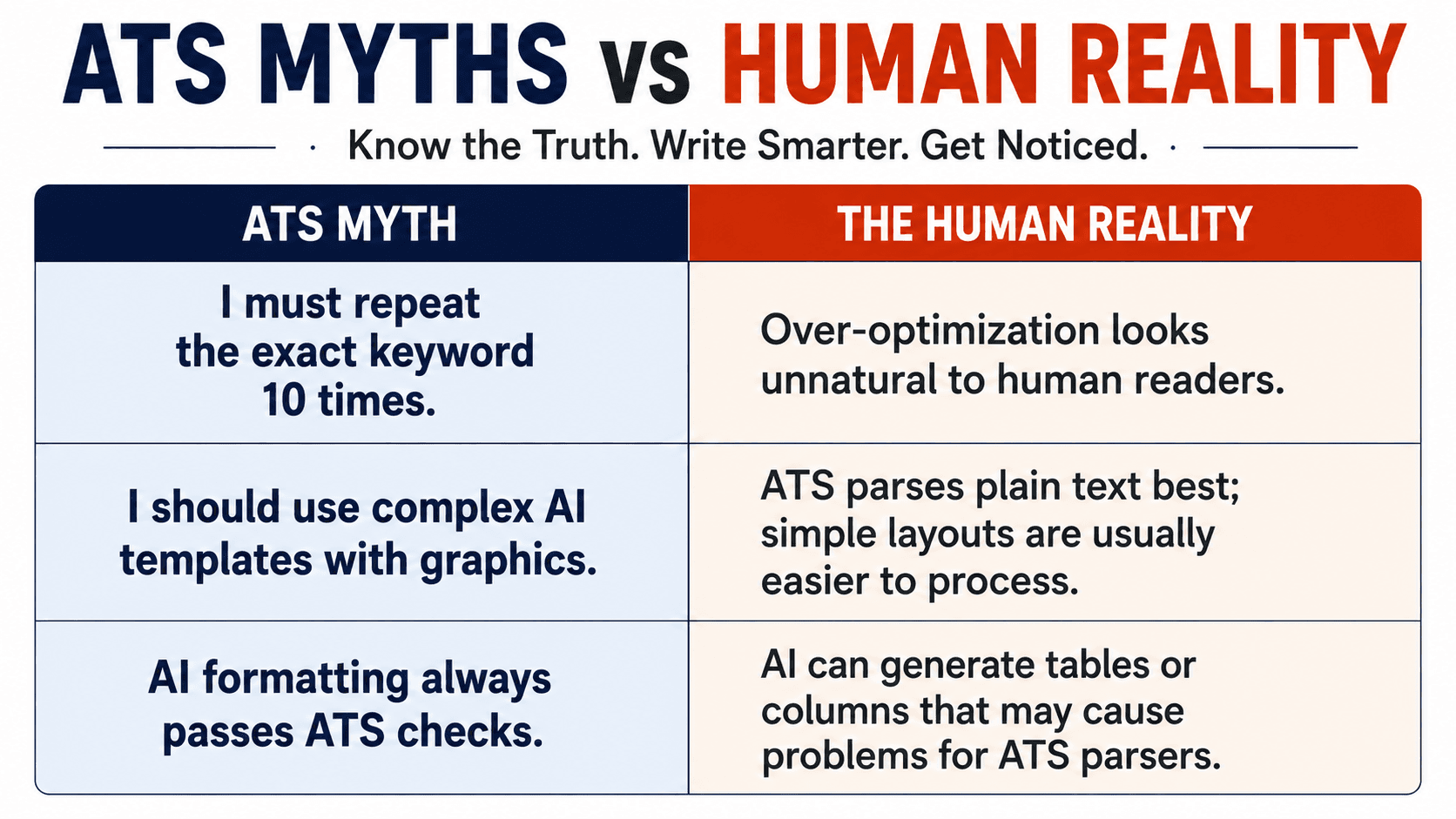
4. Optimizing Strictly for ATS While Forgetting the Human Reader
Applicant Tracking Systems (ATS) organize incoming resumes, but a human recruiter still makes the final hiring decision.
Writing exclusively for an algorithm leads to awkward phrasing, unnatural keyword placement, and robotic formatting.
5. Allowing AI to Fabricate Accomplishments
This is where candidates get into serious trouble. AI is notorious for inflating basic duties into grandiose claims.
What you told AI: "I pulled weekly reports for the marketing team."
What AI wrote: "Architected end-to-end data reporting infrastructure that revolutionized executive decision-making."
While it sounds impressive on paper, this level of exaggeration is easily exposed during an interview.
The Rule of Thumb:
Let AI refine your grammar and structure, but never let it invent your story. Supply the raw numbers, facts, and actual outcomes yourself.
6. Creating Discrepancies Between Your Resume and LinkedIn
Recruiters almost always cross-reference your resume with your LinkedIn profile.
If your AI-generated resume lists your title as "Senior Product Strategist (2021–2024)" but your LinkedIn reads "Associate Product Specialist (2022–2025)", red flags go up immediately.
What to Check for Consistency:
Employment start and end dates
Company names and official job titles
Core certifications and educational degrees
7. Prioritizing Application Quantity Over Quality
With AI, you can apply to 100 jobs a day with a single click. But spray-and-pray strategies rarely work.
Recent hiring data reveals that 86% of job seekers use AI to boost application volume, yet 93% fear that generic AI applications are making it harder for qualified candidates to get noticed.
Submitting 10 highly targeted, tailored applications yields significantly higher interview rates than sending 100 generic, AI-spun resumes.
8. Listing Skills Without Context
Claiming you possess "Strong Leadership" or "Advanced Data Analysis" means very little without context.
Weak: "Possess excellent team leadership and communication skills."
Strong: "Led a cross-functional team of 6 designers and developers to ship a SaaS product 2 weeks ahead of deadline."
Always pair a skill with an actionable result or project context.
The Human-First AI Resume Workflow
To make AI work for you instead of against you, follow this 6-step framework:
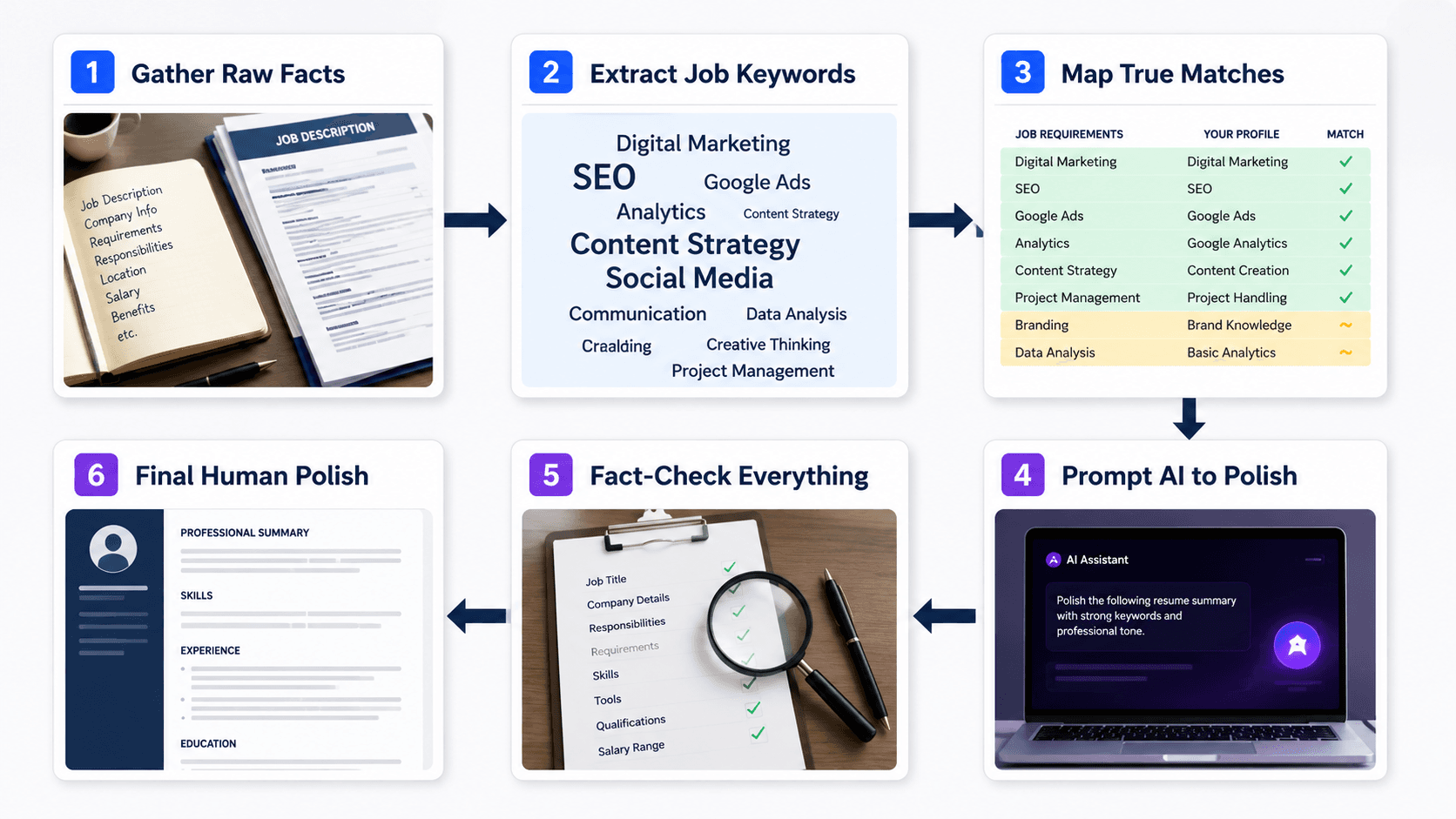
Dump Your Raw Data: Draft your genuine career accomplishments, bullet points, and metrics in plain text.
Analyze the Job Description: Highlight 4–6 core requirements from the job posting.
Prompt for Structure: Ask AI: "Here is my real experience [paste text] and here is the job description [paste text]. Help me rewrite my bullet points for clarity and conciseness while keeping all facts 100% accurate."
Fact-Check Every Line: Verify that every metric, tool, and outcome reflects your actual experience.
Human Polish: Read the draft out loud. If it sounds like an essay generated by a machine, rephrase it using your natural professional voice.
Key Takeaways
AI is a co-pilot, not the driver: Use AI to format, edit, and brainstorm—never to manufacture experience.
Metrics win interviews: Replace vague buzzwords with hard numbers and concrete outcomes.
Relevance > Length: Tailor your resume specifically for the role instead of listing every task you’ve ever done.
Keep it authentic: Ensure your resume, LinkedIn profile, and interview responses tell a consistent, honest story.