

How to Answer "Tell Me About a Time You Failed" in an Interview (The Post-Mortem Method)
During the middle of an interview, the tone shifts. The interviewer leans forward and asks:
"Can you tell me about a time you failed or made a significant mistake at work?"
Your heart rate spikes. Your instinct is to protect yourself.
Some candidates resort to a disguised compliment: "I failed because I cared too much about perfection and stayed late every night." Interviewers see through this instantly.
Other candidates panic and share a catastrophic blunder: "I missed a regulatory deadline that cost our client $80,000." That response raises immediate competence concerns.
Hiring teams in the US, UK, Canada, and Australia do not ask this question to judge your past mistakes. They ask it to evaluate three specific qualities: intellectual honesty, emotional resilience under pressure, and systematic process improvement.
Mastering this question requires filtering your story through a structured post-mortem method.
Step 1: The Failure Severity Filter
To select the right scenario, run your past experiences through this decision filter before the interview:
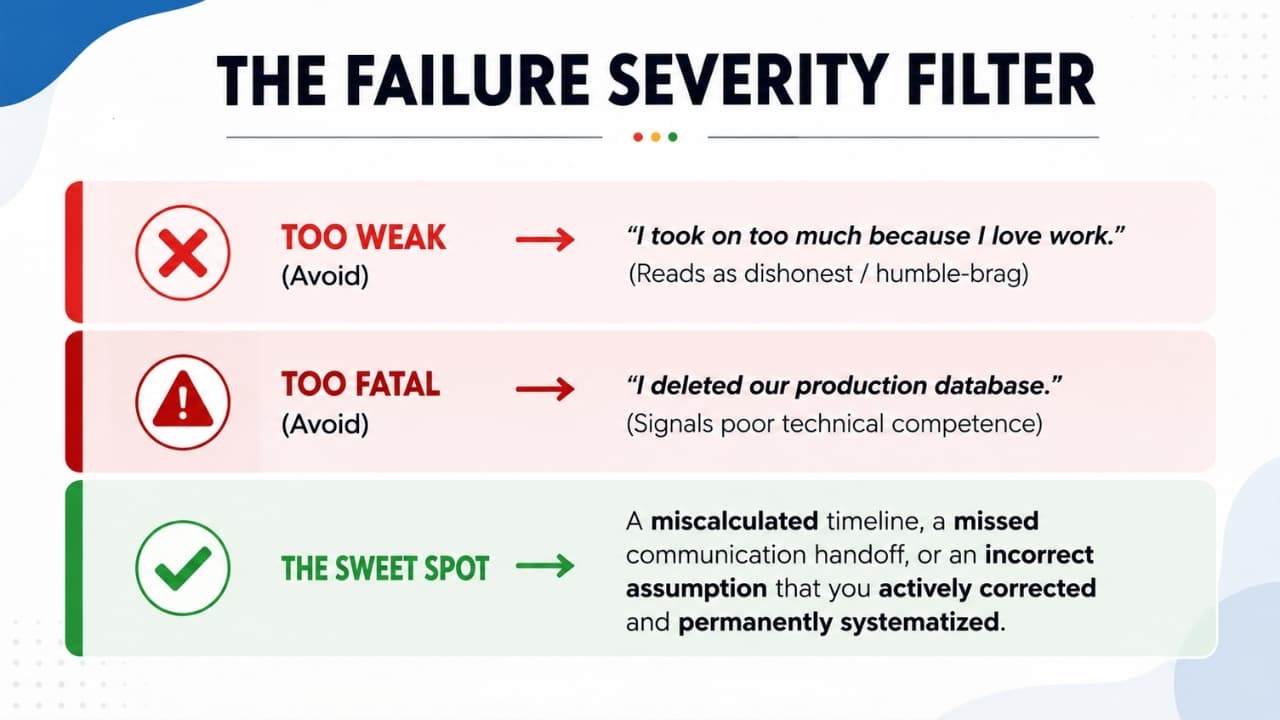
The ideal story focuses on an early-stage assumption or operational oversight that you personally took ownership of and transformed into a permanent process fix.
Step 2: The 4-Part Post-Mortem Structure
Structure your response using a 90-second arc that shifts the focus away from the error and toward your problem-solving response:
Context & Ownership (20s): State the goal, what went wrong, and take full personal responsibility without blaming colleagues, clients, or tools.
Immediate Triage (20s): Explain the immediate operational steps you took to contain the damage.
The Root-Cause Analysis (20s): Explain why the oversight occurred.
The Permanent System Fix (30s): Detail the new checklist, software, or workflow you built to ensure the error never happened again.
Two Word-for-Word Scripts
Script 1: For Project Managers, Team Leads, and Operations
Focus: Miscalculated project scope and delayed client rollout.
"Early in my role as a Project Coordinator, I was managing a vendor software migration for our UK division. I estimated our testing timeline based on standard vendor estimates rather than building in a buffer for internal security audits.
Two weeks before launch, our compliance team flagged three integration exceptions. Because I hadn't accounted for that review window, we missed our target launch date by five business days.
I immediately notified our stakeholders, took full ownership of the timeline miscalculation, and scheduled daily 15-minute triage syncs with IT security to resolve the blockers.
Once the rollout was complete, I built a mandatory 14-day security checklist directly into our Jira project templates. Over the next two years, our team delivered twelve consecutive migrations on schedule with zero unbudgeted delays."
Script 2: For Analysts, Marketers, and Individual Contributors
Focus: Misinterpreted data baseline leading to an underperforming campaign.
"During my second year in growth marketing, I launched a paid acquisition campaign based on historical conversion data from Q4. I failed to account for seasonal purchasing drops that occur every January in our sector.
Within the first ten days, our cost per lead was 25% higher than projected. Rather than letting the budget burn hoping it would self-correct, I paused the lowest-performing ad sets, presented the data directly to my director, and reallocated the remaining budget toward high-intent organic search channels.
The campaign recovered to hit 90% of our revised quarterly pipeline target. More importantly, I introduced a seasonal anomaly model into our monthly forecasting spreadsheet, which our entire marketing team still uses to calibrate spend."
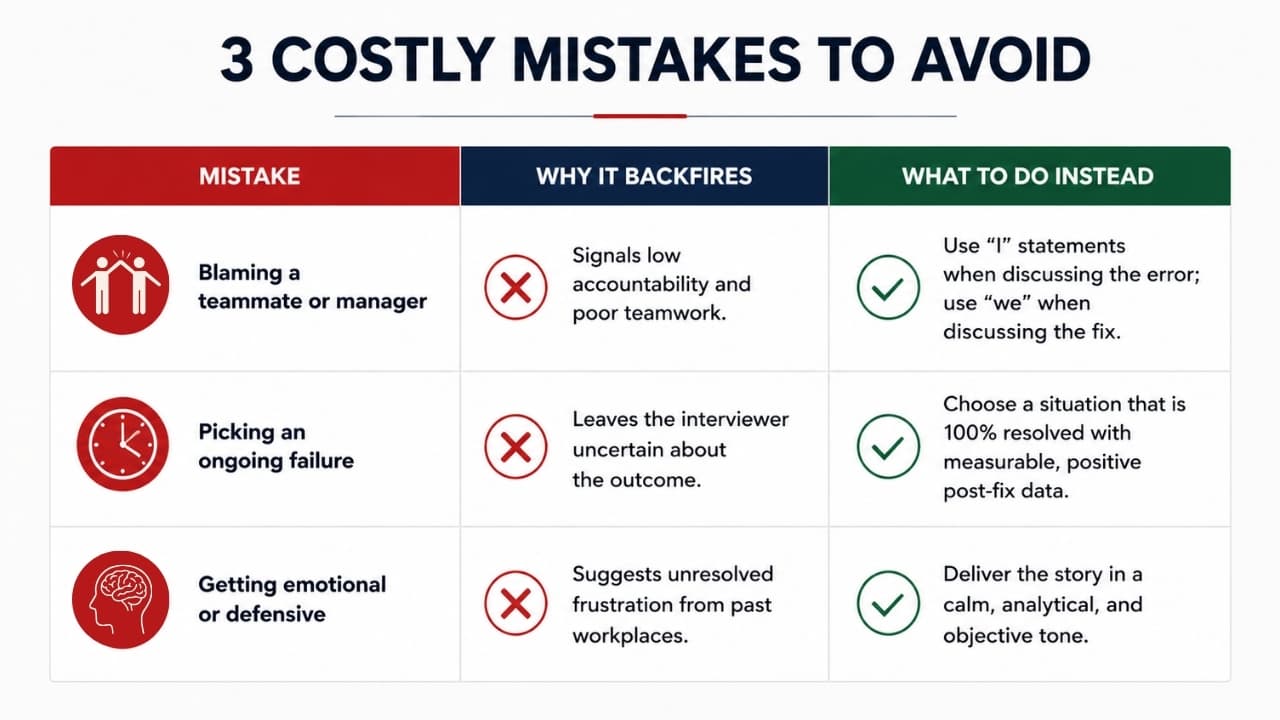
3 Costly Mistakes to Avoid
What to Do Next
Open your notes and write down two past professional mistakes from at least 12 months ago.
Verify that both fall into the "Sweet Spot" category (process or assumption errors, not core skill deficits).
Practice timing your answer out loud. Spend no more than 30 seconds describing the mistake, and dedicate the remaining 60 seconds to the remediation and lasting system fix.
Key Takeaways
Own the mistake cleanly: State the failure directly in your opening sentence without deflecting blame onto external factors.
Never use humble-brags: Avoid clichés like "I'm a perfectionist"; authentic vulnerability builds trust with senior interviewers.
Show immediate triage: Demonstrate that you kept a cool head and took swift corrective action when the issue arose.
Emphasize the permanent fix: Dedicate at least half of your response to the preventative systems, templates, or workflows you implemented afterward.
Keep the resolution historical: Choose an incident that occurred far enough in the past to demonstrate long-term behavioural improvement.
