

Reverse Interviewing: 5 Questions to Spot a Toxic Work Culture Before You Accept
At the end of a forty-five-minute interview, the hiring manager closes their notebook, looks up, and asks: "Do you have any questions for us?"
Many candidates treat this moment as a formality. They ask safe, surface-level questions like "What does a typical day look like?" or "What do you enjoy most about working here?"
In response, the interviewer delivers an enthusiastic, rehearsed answer about collaboration, flexible dynamics, and team camaraderie.
Six weeks into the role, the reality surfaces: unmonitored scope creep, after-hours messaging expectations, and a manager who requires daily sign-offs on basic operational tasks.
An interview is a two-way business evaluation. Practicing reverse interviewing—the deliberate process of asking structured, diagnostic questions to evaluate your prospective manager and team—is your single most effective tool for vetting company culture before signing an employment agreement.
The Problem with Direct Culture Questions
When you ask an interviewer directly, "Is this a supportive environment with good work-life balance?", you force them into sales mode. No hiring manager will admit to running an understaffed, chaotic department.
To bypass rehearsed corporate PR, you must replace abstract questions with scenario-based inquiries.
You are not evaluating their stated values; you are evaluating their actual operational history.
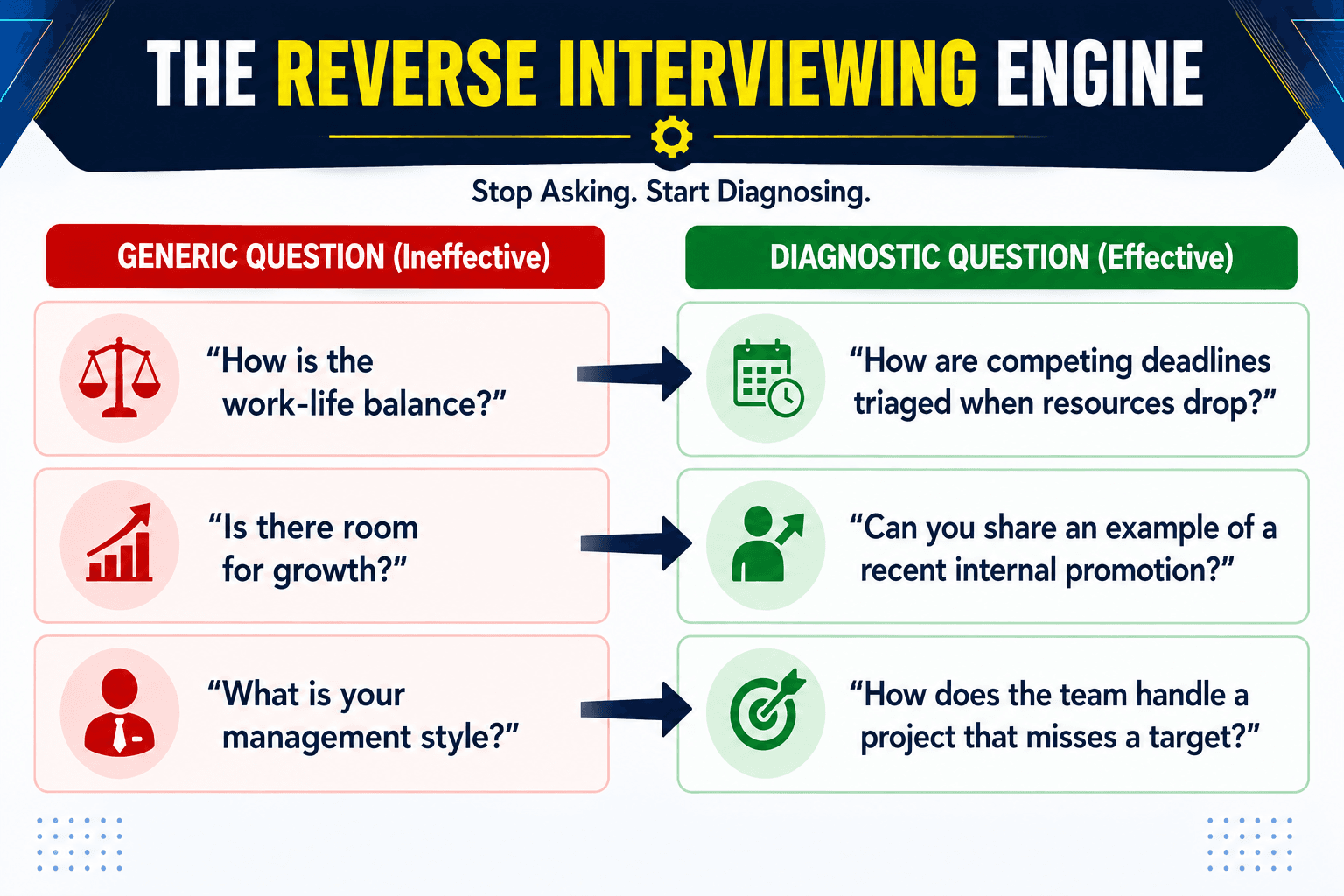
5 Diagnostic Reverse Interview Questions & How to Decode the Answers
1. "Can you tell me about a time a project missed its deadline or target, and how the team handled the fallout?"
What it diagnoses: Psychological safety and accountability.
Green Flag Signal: The interviewer speaks calmly about post-mortem audits, process adjustments, and shielding the team while solving root causes.
Red Flag Signal: The interviewer assigns blame to individual departments, sighs, or mentions that "missing targets is not tolerated here."
2. "Why is this position open right now?"
What it diagnoses: Attrition velocity and organizational stability.
Green Flag Signal: Clean expansion due to documented business growth, or the previous employee was promoted internally into a named leadership role.
Red Flag Signal: Vague statements about the predecessor "not being the right culture fit," or discovering the role has turned over multiple times within twelve months.
3. "When two executive stakeholders have conflicting priorities for your team, how does leadership resolve the trade-off?"
What it diagnoses: Boundary protection and executive alignment.
Green Flag Signal: Clear governance frameworks (e.g., impact-effort matrices, weekly backlog grooming) where management makes the hard call on what gets deprioritized.
Red Flag Signal: Statements like "Our people are agile rockstars who find a way to get everything done," which is corporate code for unpaid, unmanaged overtime.
4. "Can you describe the specific development path of someone on this team who was promoted in the last 18 months?"
What it diagnoses: Real career progression versus empty promises.
Green Flag Signal: A concrete name and clear timeline: "Sarah started in client reporting, completed our leadership track, and transitioned to Senior Account Lead last August."
Red Flag Signal: Hesitation, followed by abstract generalities: "We are currently finalizing our formal growth tracks for the upcoming fiscal year."
5. "What is the team’s protocol for asynchronous communication and after-hours escalations?"
What it diagnoses: Digital boundaries and respect for rest periods.
Green Flag Signal: Explicit guidelines regarding Slack/Teams usage, scheduled emails, and clear thresholds for what constitutes an actual operational emergency.
Red Flag Signal: Proud declarations of a "24/7 client-first responsiveness" or laughing off after-hours messaging as "just part of the industry."
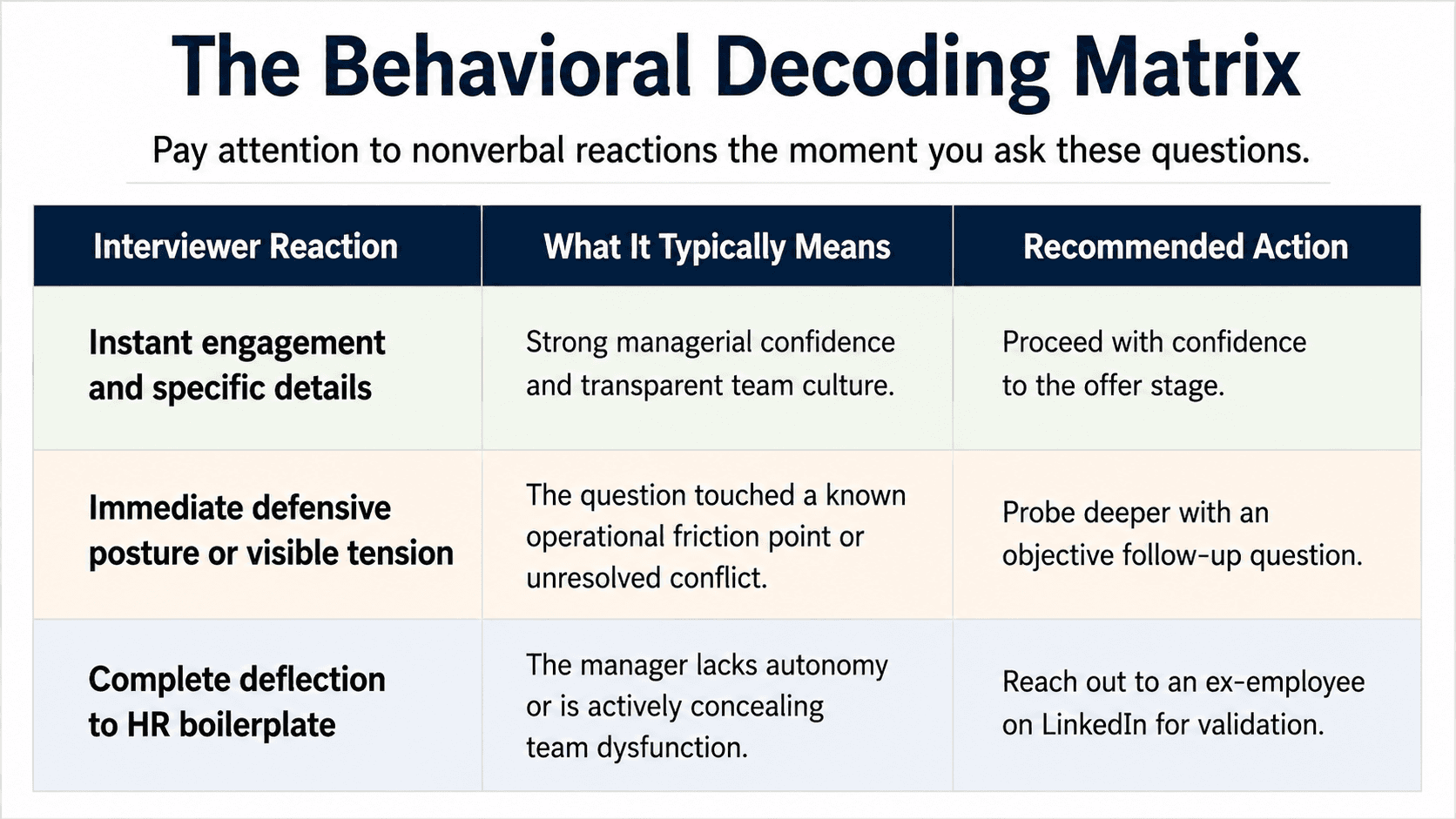
The Behavioral Decoding Matrix
Pay attention to nonverbal reactions the moment you ask these questions:
What to Do Next
Before your next interview stage:
Select two diagnostic questions from this list that match your biggest personal career non-negotiables (e.g., growth or work-life boundaries).
Write them down in your interview notebook.
Frame your delivery with professional curiosity rather than confrontation: "I want to make sure I deliver immediate value to your team, so I’d love to understand..."
Treating the interview as an equal partnership protects your well-being, saves you from painful career missteps, and commands immediate respect from high-quality employers.
Key Takeaways
Treat the interview as a mutual audit: Use the final ten minutes to evaluate your prospective manager’s operational style.
Ask about real situations: Replace generic questions about "culture" with questions about missed deadlines, past promotions, and conflicting priorities.
Clarify role origin: Always find out whether the vacancy is an expansion role or a backfill to gauge turnover risks.
Watch the first two seconds: An interviewer’s immediate micro-reaction to a probing question is often more telling than their scripted answer.
Demand concrete examples: If a manager cannot name a single real employee who progressed internally, treat career growth promises with caution.