

Quiet Quitting vs. Healthy Boundaries: How to Protect Your Peace Without Hurting Your Career
You finish your work at 6 PM. Your laptop is closed. Your phone is on silent. You aren't answering another Slack message tonight.
Is that quiet quitting?
Not necessarily.
What if you complete your responsibilities properly, communicate clearly with your team, contribute during working hours, and simply don't want your job to consume every evening and weekend?
That's not laziness. That's a boundary.
The confusion around quiet quitting comes from treating every refusal to work beyond normal expectations as disengagement. But there's a meaningful difference between doing your job without sacrificing your entire life and mentally checking out of it.
Understanding that difference matters because you can protect your time without putting your career on autopilot.
What Is Quiet Quitting, Really?
Despite its name, quiet quitting doesn't mean actually leaving your job.
The term generally describes employees who do the minimum required by their role and withdraw discretionary effort from work. Gallup uses a similar concept for employees who are “not engaged”—people who meet basic expectations but are psychologically less connected to their work and workplace.
But there's an important nuance.
Doing your job properly is not quiet quitting.
You don't have to answer emails at midnight, volunteer for every project, or work every weekend to prove that you're committed.
The warning sign is what happens during the work you're actually being paid to do.
Are you still trying to produce good work?
Do you communicate with your team?
Do you care about the outcome?
Are you learning and developing?
Do you take ownership when something genuinely matters?
If the answer is yes, setting limits isn't necessarily disengagement.
Healthy Boundaries Are Different
Healthy workplace boundaries are about deciding where your professional responsibility ends and your personal time begins.
That might mean:
Finishing work at an agreed time
Turning off work notifications after hours
Asking your manager to prioritize competing tasks
Declining meetings that aren't relevant to your role
Taking your full lunch break
Saying no to work that doesn't fit your current capacity
Taking vacation without feeling guilty
Communicating when an "urgent" request isn't actually urgent
The goal isn't to do less for the sake of doing less.
The goal is to protect your energy so you can consistently do good work without relying on exhaustion to maintain your performance.
And that distinction is becoming increasingly important. Gallup's 2026 research on India, for example, found that only 23% of employees were engaged in 2025, while 59% were “not engaged.” The research points to factors including weak communication, limited career growth, poor recognition and workplace culture as important contributors to disengagement.
So the answer to disengagement isn't simply “work harder.”
Sometimes the workplace itself needs to change.
Quiet Quitting vs. Healthy Boundaries
The easiest way to understand the difference is to look at what happens in everyday situations.
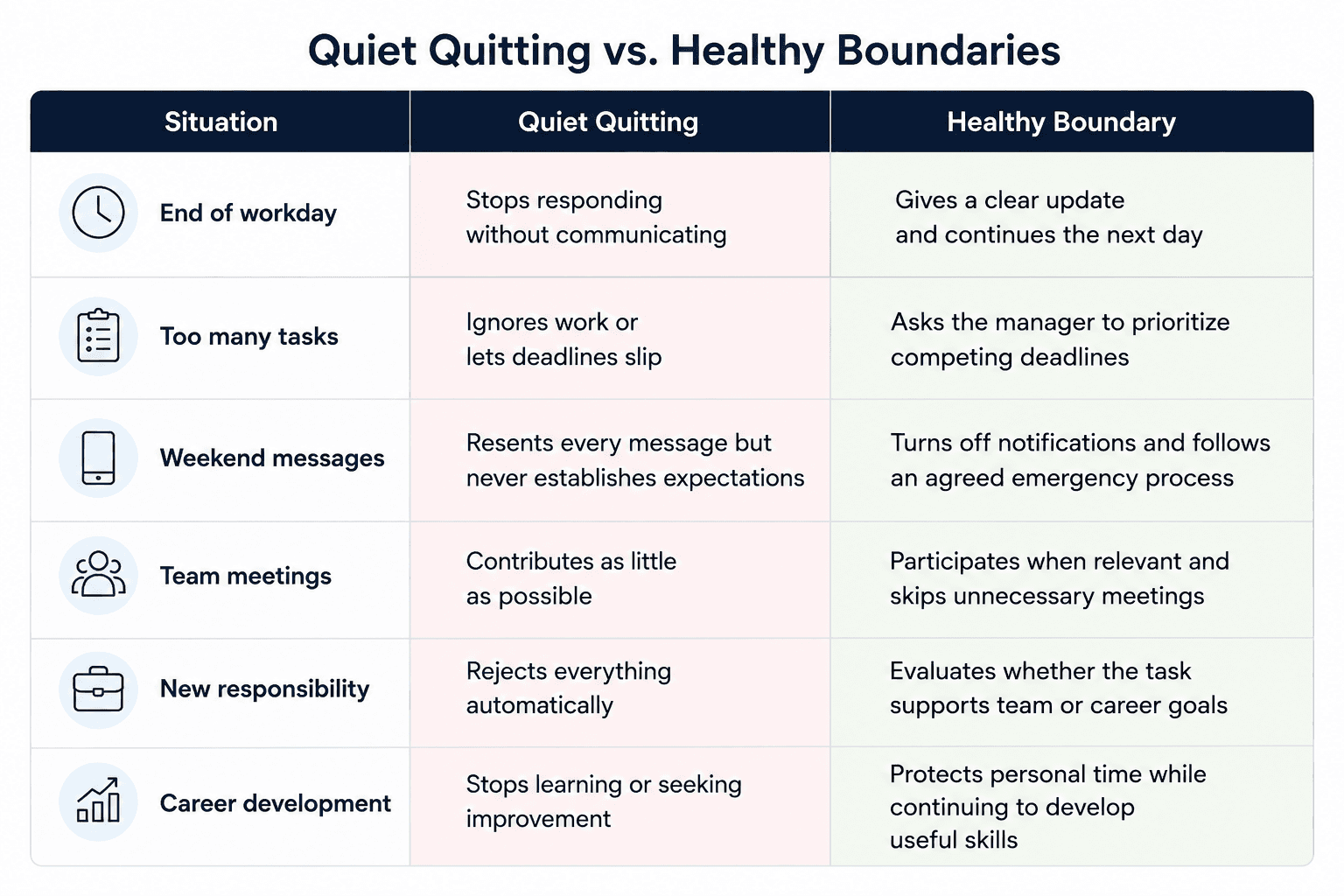
The biggest difference is intent and behavior.
Healthy boundaries say:
“I want to do good work, but I also need sustainable limits.”
Quiet quitting, in its disengaged form, says:
“I don't really care what happens as long as I meet the minimum.”
Those are very different positions.
How to Set Boundaries Without Looking Uncommitted
The biggest mistake people make with boundaries is communicating them poorly.
You don't want to sound like:
“That's not my problem.”
You want to sound like:
“Here's what I can realistically deliver, and here's what we need to prioritize.”
That small difference can completely change how your message is received.
1. When Your Manager Gives You Too Much Work
Don't silently accept five competing priorities and hope everything somehow gets done.
Ask your manager to help establish the order.
Try:
“I can take this on. I’m currently working on X and Y as well. Which one would you like me to prioritize so I can make sure the most important deadline stays on track?”
This does something important.
You're not refusing the work.
You're making the trade-off visible.
2. When Someone Messages You After Hours
You don't necessarily need to respond immediately simply because you received a notification.
If it's not genuinely urgent, you can respond during your normal working hours.
For example:
“Thanks for sending this over. I’ll review it first thing tomorrow morning and get back to you.”
If your workplace regularly expects after-hours availability, however, don't assume a boundary can be solved through messaging alone. Discuss expectations with your manager and clarify what actually counts as an emergency.
A boundary works better when the other person knows the rule.
3. When You're Invited to Another Unnecessary Meeting
Meetings can quietly consume a huge part of the working day.
Instead of declining without explanation, offer an alternative.
Try:
“I’m currently focused on the sprint deadline. Since I only need the final decisions from this meeting, would it work if I review the notes afterward instead?”
You're showing that you're protecting your focus for a business reason, not simply avoiding collaboration.
4. When You Are Asked to Take on Permanent Extra Work
Occasionally helping outside your normal responsibilities is part of professional life.
The problem is when a temporary favor quietly becomes your permanent workload.
If that happens, ask:
“I’m happy to continue supporting this, but it has become a regular part of my workload. Can we discuss whether this should officially become part of my responsibilities and how we should prioritize it alongside my current work?”
That turns an uncomfortable conversation into a professional one.
And if your responsibilities have permanently expanded, it may also be appropriate to discuss compensation, title, development opportunities, or workload expectations. Indeed similarly recommends evaluating whether additional responsibilities are temporary or becoming a permanent change before deciding how to respond.
Don't Let Boundaries Become Career Stagnation
Here's where the conversation gets interesting.
Protecting your personal time is healthy.
But if you use “boundaries” as a reason to reject every opportunity that requires effort, your career can eventually stop moving.
For example:
“I don't want to learn that new tool.”
“That's outside my job description.”
“I'm not joining that project.”
“I don't want any additional responsibility.”
“I'm only doing exactly what I'm told.”
Those statements might protect you from short-term effort, but they can also prevent you from building new skills.
The better approach is to ask:
“Is this extra effort helping me grow, or is it simply consuming my time?”
That's a much smarter career filter.
Use the 3-Question Test Before Saying Yes
Before automatically accepting extra work, ask yourself:
1. Does it matter?
Will this project meaningfully contribute to the team, customer, company, or an important business goal?
2. Does it help me grow?
Will I gain a useful skill, stronger experience, greater visibility, or an opportunity to work with people who can help my career?
3. What does it replace?
If you're already at capacity, don't pretend you can simply add another task.
Ask what should move down the priority list.
This is one of the most useful habits you can develop at work:
Don't just accept more work. Understand the trade-off.
Protect Your Time Without Becoming Invisible
There's another career risk people sometimes overlook.
If you become so focused on protecting your boundaries that you stop participating, communicating, or building relationships, you can become less visible within your organization.
You don't need to attend every meeting or answer messages at all hours.
But you should still:
Share useful ideas
Communicate progress
Help teammates when it genuinely matters
Take ownership of important projects
Build relationships
Learn new skills
Speak up when you see a problem
Look for opportunities that align with your goals
In other words:
Reduce unnecessary work, not meaningful contribution.
That's the balance.
A Better Career Strategy: High-Value Work, Not Maximum Work
You don't need to become the person who works the longest hours.
You want to become the person whose work matters.
Imagine two employees.
Employee A works late every night, attends every meeting, answers every message immediately, and says yes to almost everything.
Employee B works within clear hours, communicates priorities, delivers important projects reliably, improves inefficient processes, and occasionally takes on challenging work that develops valuable skills.
Who is building the stronger long-term career?
It's not automatically Employee A.
Visibility, reliability, skills, relationships, and results matter more than simply being busy.
That's why a sustainable career strategy is not about maximizing the number of hours you work.
It's about increasing the value of the hours you do work.
What to Do If You're Already Disengaged
If you recognize yourself in quiet quitting, don't immediately blame yourself.
Your disengagement may be telling you something.
Ask:
Am I exhausted?
Maybe you need better boundaries or time away from work.
Am I bored?
You may need a more challenging project or new skill.
Do I feel unappreciated?
A conversation about feedback, recognition, or career progression may be necessary.
Is my workload unrealistic?
Talk to your manager about priorities and capacity.
Do I see any future here?
If there is no meaningful development path, it may be time to explore other opportunities.
The goal isn't to force yourself to care about a job that consistently gives you reasons not to.
The goal is to figure out why you've disengaged and what needs to change.
The Bottom Line
You don't have to choose between burning yourself out and quietly checking out.
There's a third option:
Do good work. Protect your time. Keep learning. Communicate clearly.
Healthy boundaries shouldn't be an excuse to stop caring about your career. They should give you the energy and focus to build one that can actually last.
So the next time someone sends you a message at 9 PM, don't automatically feel guilty for not responding.
And don't automatically ignore it either.
Ask a better question:
“Is this genuinely urgent, or have we simply created a workplace where everything feels urgent?”
That question can help you protect your peace without sacrificing your professionalism.
Quick Checklist: Are You Setting Boundaries or Quiet Quitting?
You're probably setting healthy boundaries if you:
Complete your responsibilities reliably
Communicate when your capacity is limited
Protect your personal time
Continue developing relevant skills
Contribute to important team goals
Take ownership of meaningful work
Discuss priorities instead of silently ignoring requests
You may be drifting toward disengagement if you:
Stop caring about the quality of your work
Avoid contributing even when your input matters
Consistently do the minimum despite having capacity
Stop learning or developing professionally
Withdraw from your team
Ignore important communication
Feel completely disconnected from your work
If the second list sounds familiar, the answer may not be “work harder.”
It may be time to change the workload, have a difficult conversation, find a better role, or rethink what you want from your career.
Frequently Asked Questions
Is quiet quitting the same as setting boundaries?
No. Setting boundaries means establishing reasonable limits while continuing to meet your responsibilities and contribute meaningfully. Quiet quitting is generally used to describe reduced discretionary effort and psychological disengagement from work.
Can setting boundaries hurt your career?
Not necessarily. Clear, professional boundaries can help you manage priorities and maintain sustainable performance. The risk comes when boundaries become an excuse to avoid important responsibilities, learning opportunities, or meaningful collaboration.
How can I say no to extra work professionally?
Avoid a blunt “no” when the real issue is capacity. Explain your current priorities and ask which task should take precedence. This makes the workload trade-off visible and gives your manager an opportunity to reprioritize.
Should I respond to work messages after hours?
That depends on your role, workplace expectations, and whether the issue is genuinely urgent. If after-hours availability isn't required, you can establish clear expectations and respond during your normal working hours.
How do I protect work-life balance without hurting my career?
Focus on results rather than hours. Deliver important work reliably, communicate clearly, develop valuable skills, and protect time outside work. The goal is sustainable performance, not maximum availability.