

How to Build Executive Presence and Speak Confidently in Leadership Meetings
You can be one of the strongest performers on your team and still struggle to get noticed for leadership opportunities.
You deliver quality work. You meet deadlines. You solve difficult problems. Yet when the conversation shifts toward promotions or senior responsibilities, you may hear the same feedback:
"You need to develop more executive presence."
That feedback can feel vague because executive presence is not a single skill you can add to your resume. It is reflected in how you communicate, how you handle pressure, how you present ideas, and how confidently you contribute to important conversations.
It also does not mean speaking the most, having the deepest voice, or trying to dominate a meeting.
Strong executive presence is about making people feel that you are calm, prepared, credible, and capable of handling responsibility.
What Is Executive Presence?
Executive presence is the ability to communicate and behave in a way that demonstrates confidence, clarity, sound judgment, and leadership readiness.
It becomes particularly important in leadership meetings, where people often have limited time and need to make decisions based on incomplete or changing information.
Instead of explaining every detail of what happened, an executive-level communicator helps the room understand:
What is happening?
Why does it matter?
What is the business impact?
What are the risks?
What decision or action is needed?
That shift from information sharing to decision-oriented communication can significantly change how your contribution is perceived.
The 3 Core Elements of Executive Presence
Executive presence is often discussed as a combination of gravitas, communication, and professional presence.
1. Gravitas: How You Handle Pressure
Gravitas is not about acting serious all the time.
It is about remaining composed when the conversation becomes difficult.
Imagine a senior leader challenges your recommendation during a meeting. You could become defensive, rush through an explanation, or immediately try to prove that your original idea was correct.
A stronger response would be to acknowledge the concern, assess the issue, and respond with evidence.
For example:
"That's a fair concern. The recommendation was based on our current customer data. If the priority has changed to reducing implementation time, I would adjust the recommendation."
That response demonstrates confidence without becoming defensive.
You do not need to have every answer immediately. What matters is showing that you can think clearly under pressure.
2. Communication: How Clearly You Speak
Senior meetings rarely benefit from long explanations that bury the important point.
If your main conclusion takes five minutes to emerge, people may lose track of what you are actually recommending.
Instead, lead with the most important information.
A useful structure is:
Conclusion → Evidence → Impact → Next Step
For example:
"The product launch can remain on schedule. We resolved the database performance issue yesterday, and current testing shows no significant impact on the release timeline. I recommend keeping Friday as the launch date and monitoring performance closely during the first 24 hours."
The listener immediately understands the situation and what you recommend.
Top Search Blogs
3. Presence: How You Show Up
Your communication is not limited to your words. Your posture, facial expressions, eye contact, listening behavior, and pace of speech all contribute to how you are perceived.
During an in-person meeting, sit or stand with an open posture and avoid constantly looking down at your notes.
During virtual meetings, look toward the camera when making an important point, avoid multitasking, and pay attention to your speaking pace.
The objective is not to perform confidence. It is to remove distracting behaviors that make your communication less effective.
Stop Leading With the Details
One of the biggest differences between tactical and executive communication is where you start.
Consider this example.
Tactical Approach
"We started testing the API on Monday. On Tuesday, we noticed a caching issue. We then tested three library versions and found that one of them was creating additional latency..."
The information may be accurate, but the listener has to wait to understand the actual outcome.
Executive Approach
"The feature is still on track for Friday. We identified a database latency issue during testing and resolved it by optimizing the query structure. There is currently no expected impact on the launch budget."
The second version provides the conclusion first and the relevant details afterward.
This is closely related to the Bottom Line Up Front (BLUF) approach: communicate the most important conclusion before supporting details.
4 Practical Ways to Sound More Confident
1. Remove Unnecessary Hedging
Certain phrases can make an otherwise strong idea sound uncertain.
Watch for expressions such as:
"I just think..."
"I might be wrong, but..."
"Maybe we could..."
"I'm not sure if this makes sense..."
"This may be a stupid question..."
You do not need to remove uncertainty when uncertainty genuinely exists. Instead, communicate it precisely.
Rather than:
"I might be wrong, but I think the campaign is underperforming."
Say:
"The campaign is currently below its target conversion rate. The main issue appears to be the landing-page drop-off."
That sounds more confident because the statement is based on a specific observation.
2. Use Deliberate Pauses
You do not have to answer every question instantly.
When someone asks a difficult question, taking a brief pause can help you organize your thoughts before responding.
Instead of filling the silence with:
"Um... actually... I think... basically..."
Pause, think, and answer.
A measured pace often makes communication easier to follow and gives your response more weight.
3. Turn Disagreement Into a Business Decision
Disagreeing with a senior leader does not automatically damage your executive presence.
How you disagree matters.
Avoid turning the conversation into:
"I don't think that's going to work."
Instead, explain the trade-off.
For example:
"I support the goal of launching next month. Based on our current development capacity, the faster timeline increases testing risk. We could either reduce the secondary features or move the launch by one week. I recommend reducing the secondary features to protect stability."
You are not simply rejecting an idea.
You are presenting evidence, alternatives, and a recommendation.
That is much closer to how senior-level decision-making works.
4. Contribute Early in Important Meetings
If you attend a large meeting and remain silent for the entire discussion, your expertise may not be visible to everyone in the room.
You do not need to speak just to be heard.
Instead, aim to make one useful contribution early when you genuinely have something valuable to add.
You could:
Clarify an important issue
Ask a strategic question
Summarize a key risk
Provide relevant data
Connect two parts of the discussion
Offer a practical recommendation
The goal is not to dominate the conversation.
The goal is to contribute something worth hearing.
Tactical vs. Executive Communication
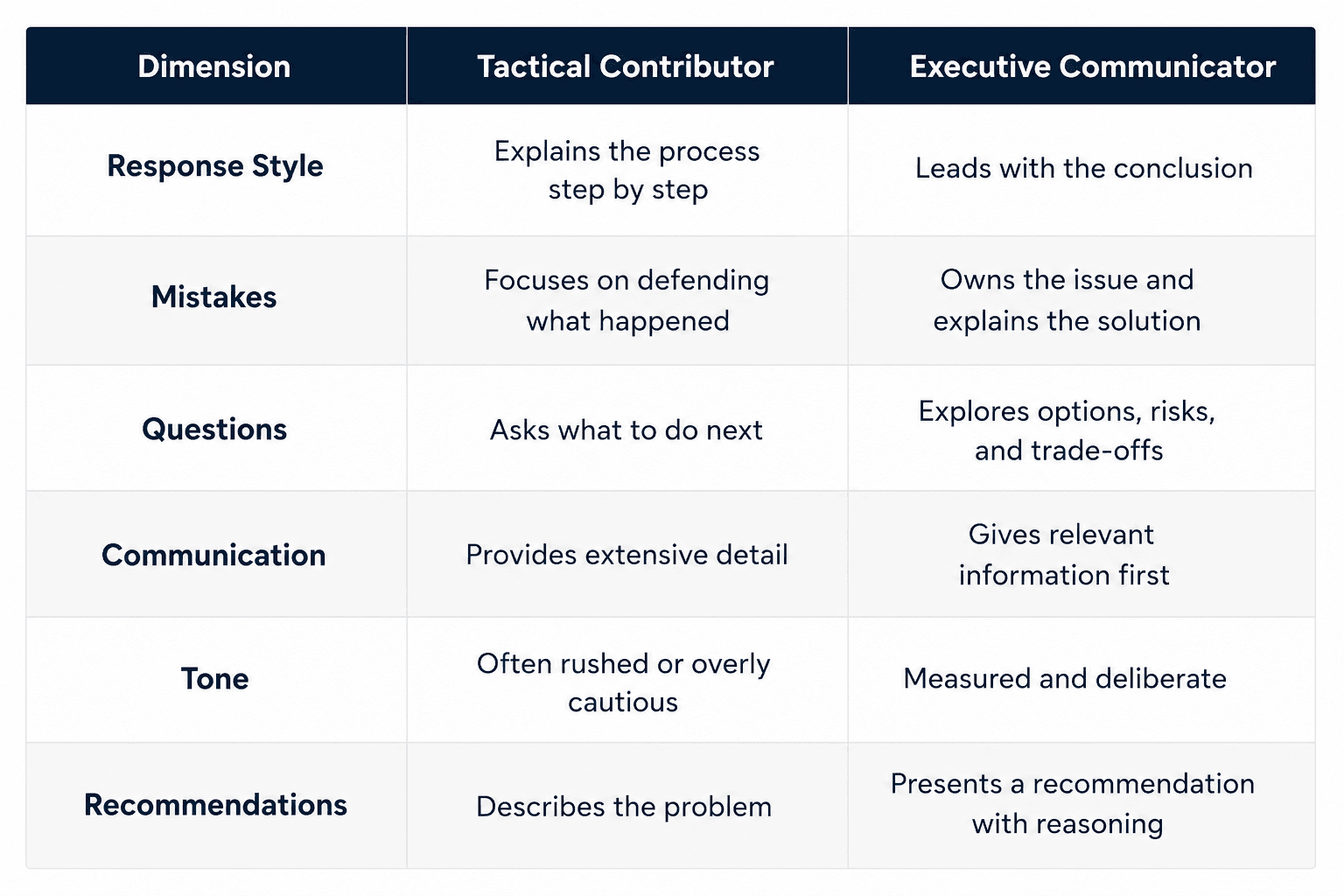
The goal is not to stop being detailed.
Details still matter. The difference is knowing which details the audience needs and when they need them.
Prepare Before Leadership Meetings
Confident communication often starts before the meeting begins.
If you know you will be discussing an important project, spend a few minutes preparing answers to these questions:
What is the main message?
If you could communicate only one thing, what should the leadership team remember?
What numbers matter?
Identify the metrics that demonstrate progress, performance, cost, risk, or business impact.
What could they challenge?
Think about the most likely objections or difficult questions.
What decision is required?
If you are asking leadership to make a decision, make the decision itself clear.
This preparation reduces the temptation to think through your entire answer while everyone is waiting for you to speak.
Don't Confuse Confidence With Certainty
One of the most important aspects of executive communication is being comfortable saying:
"I don't have that information yet."
Pretending to know something you do not know can damage credibility much more than admitting a knowledge gap.
Instead, respond with something like:
"I don't have the confirmed figure with me right now. I'll verify it and share the number after the meeting."
That communicates accountability without pretending to have an answer.
Confidence is not knowing everything.
Confidence is being comfortable handling what you don't know.
How to Build Executive Presence Over Time
Executive presence is not something you develop after reading one article or memorizing a few communication techniques.
Build it through repeated practice.
After important meetings, ask yourself:
Did I communicate the main point clearly?
Did I focus on business impact rather than unnecessary details?
Did I speak when I had something useful to contribute?
Did I handle disagreement without becoming defensive?
Did I listen carefully to other viewpoints?
Did I leave the meeting with clear next steps?
You can also ask a trusted manager or colleague for specific feedback.
Instead of asking:
"How was my presentation?"
Ask:
"What is one thing I could change about how I communicate in leadership meetings?"
Specific questions usually produce more useful feedback.
Final Thoughts
Executive presence is not about becoming louder, more aggressive, or more corporate.
It is about becoming clearer, calmer, and more intentional in situations where your judgment matters.
Lead with the conclusion. Support your recommendations with evidence. Stay composed when challenged. Listen before responding. Be honest when you do not know something. And make your contributions useful rather than simply trying to increase your speaking time.
Over time, these small changes can alter how colleagues and leaders experience your communication.
The objective is simple:
Don't just demonstrate that you can do the work. Demonstrate that you can communicate, make decisions, and handle responsibility at the next level.