
From Data Analyst to AI/ML Engineer: A Practical 90-Day Roadmap
Introduction
Working as a data analyst gives you a valuable understanding of business problems, customer behaviour, statistics, and data-driven decision-making. But if your daily routine revolves around SQL queries, spreadsheets, and dashboards, you might eventually want to build something more than reports.
That is where artificial intelligence and machine learning engineering become interesting career options.
The transition from data analyst to AI engineer does not mean starting from zero. Your existing analytical skills provide a useful foundation. What you need next is stronger programming knowledge, practical machine learning experience, and the ability to deploy reliable applications.
This guide explains the essential skills, portfolio projects, and a realistic 90-day learning plan to help you move towards AI/ML engineering.
1. Why Move Beyond Traditional Data Analytics?
Data analysts help businesses understand what happened and identify patterns that influence decisions. AI and machine learning engineers take related insights further by developing systems that can make predictions, automate tasks, and process information at scale.
For example, an analyst might prepare a monthly customer churn report. An ML engineer could develop a model that estimates which customers are likely to leave and makes those predictions available to a company's application.
The difference is not that analytics has become less valuable. Instead, engineering adds another layer: turning data and models into working products.
Before making the switch, research the responsibilities and salary ranges of your target roles in your country. Compensation varies considerably by location, experience, industry, and company.
2. The Four Skills You Need to Develop
A. Move from descriptive analytics to machine learning
Start by understanding how predictive models differ from traditional reporting.
Learn the fundamentals of supervised learning, including regression, classification, feature engineering, and model evaluation. Tools such as Python, pandas, and scikit-learn will help you practise these concepts.
Once you understand the basics, explore generative AI. Learn how embeddings represent information, how semantic search works, and how Retrieval-Augmented Generation (RAG) helps language models answer questions using external documents.
B. Strengthen your Python and software engineering skills
Knowing Python for data cleaning is a good start, but production engineering requires more structured code.
Focus on:
Functions, classes, modules, and object-oriented programming.
Git and GitHub for version control.
Type hints and data validation with Pydantic.
Automated testing using pytest.
Building APIs with FastAPI.
Managing project dependencies and configuration.
Organise your projects into reusable modules instead of keeping all your logic inside one Jupyter notebook. This makes your work easier to test, maintain, and extend.
C. Learn the mathematics behind machine learning
You do not need to master every area of advanced mathematics before building useful AI applications. However, understanding the core concepts will help you make better technical decisions.
Prioritise linear algebra, probability, statistics, and basic calculus. Learn how vectors and matrices represent data, how probability supports prediction, and how gradient descent helps optimise model parameters.
You should also understand evaluation metrics such as precision, recall, F1-score, and ROC-AUC. Different problems require different metrics, particularly when the cost of false predictions is high.
D. Understand deployment and MLOps
A model that works on your laptop is not automatically ready for real users.
Learn how to package applications with Docker, expose predictions through APIs, track experiments with MLflow, and automate testing and deployment through CI/CD workflows.
Cloud platforms such as AWS and Google Cloud offer tools for deploying and managing machine learning applications. Start with one platform rather than trying to learn everything simultaneously.
3. Data Analyst vs Data Scientist vs AI/ML Engineer
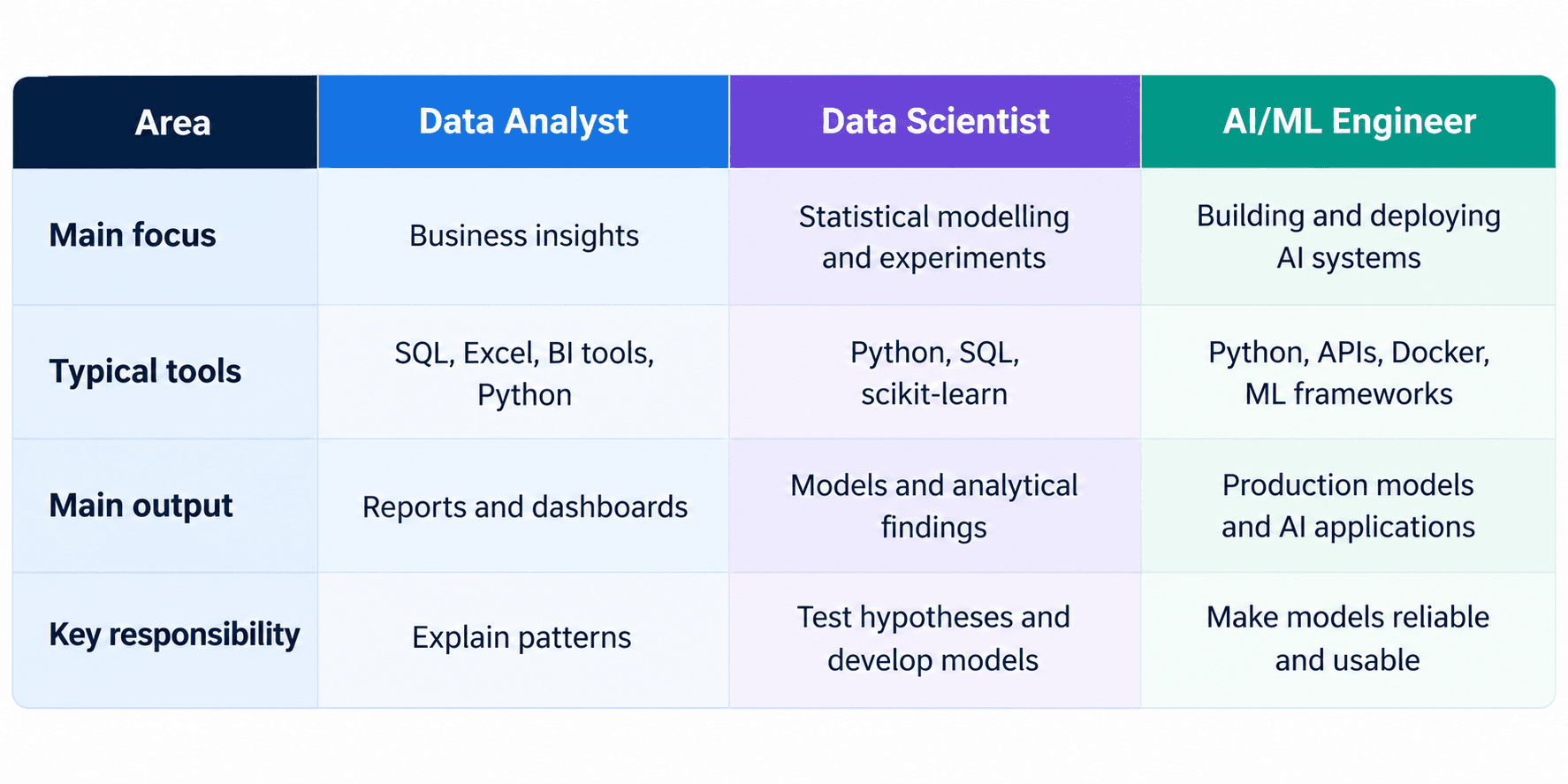
These roles overlap, and responsibilities vary between organisations. Some data scientists deploy models, while some AI engineers spend considerable time on data preparation and evaluation.
Choose your target role by examining actual job descriptions, not just job titles.
4. Three Portfolio Projects That Demonstrate Practical Skills
A strong portfolio should show that you can solve real problems, explain your decisions, and build applications that others can run.
Project 1: Document Question-Answering System
Build a RAG application that answers questions using a collection of documents.
Use an embedding model, a vector database such as Qdrant or pgvector, and a framework such as LangChain or LlamaIndex if it fits your design. Create an API with FastAPI and evaluate whether the retrieved information supports the generated answers.
Include source references in responses, document limitations, and test questions that the system should not answer confidently.
Project 2: Customer Churn Prediction API
Train a classification model to identify customers who may cancel a service. Use a suitable dataset, handle missing values, prevent data leakage, and evaluate the model using appropriate metrics.
Then package the application with Docker and create a prediction endpoint. Document how the model was trained, which features it uses, and where its predictions may be unreliable.
Project 3: Deploy and Monitor an ML Model
Choose a prediction problem and deploy your model to a cloud platform. Add input validation, logging, automated tests, and basic monitoring.
Track model versions and explain how you would detect changes in incoming data or declining model performance. This project demonstrates that you understand the work required after training a model.
5. Your 90-Day Transition Roadmap
Days 1–30: Python and software engineering
Strengthen Python fundamentals, practise Git, organise code into modules, and write unit tests. Build a small FastAPI application and package it with Docker.
Target outcome: A clean, tested Python application that another developer can run.
Days 31–60: Machine learning foundations
Learn regression, classification, feature engineering, model evaluation, and data leakage. Practise using scikit-learn and build a complete prediction pipeline.
Explore PyTorch fundamentals if your target roles require deep learning.
Target outcome: A documented machine learning project with meaningful evaluation results.
Days 61–90: Deployment and portfolio development
Build a small RAG application or deploy your prediction model. Add an API, testing, version control, and deployment documentation. Publish your projects on GitHub with clear READMEs, architecture diagrams, and instructions.
Target outcome: One or two polished, demonstrable projects and a clear plan for continued learning.
Ninety days is a starting framework, not a promise of job readiness. Your progress will depend on your existing Python skills, available study time, and the complexity of your target roles.
6. Common Mistakes to Avoid
Learning mathematics without building projects: Connect each concept to a practical exercise instead of delaying implementation until you understand everything.
Publishing unfinished notebooks: Clean your code, remove debugging output, document dependencies, and provide reproducible instructions.
Jumping between too many tools: Learn the fundamentals first. You do not need to master every cloud platform, vector database, or AI framework.
Ignoring data quality: Real-world systems must handle missing values, unexpected inputs, changing data, and unreliable sources.
Applying only to research roles: If you prefer building applications, consider Applied AI Engineer, Machine Learning Engineer, or MLOps Engineer positions that match your experience.
7. Frequently Asked Questions
Can a data analyst become an AI engineer without a master's degree?
Yes, it is possible. Requirements differ by employer and role. A strong foundation in programming, machine learning, deployment, and demonstrable projects can support your application, although some positions require advanced degrees.
What is the difference between an AI engineer and an ML engineer?
ML engineers often focus on training, deploying, and maintaining predictive models. AI engineers may focus more on integrating language models, retrieval systems, AI APIs, and generative AI features. The distinction varies between companies.
Which programming language should I learn first?
Start with Python. It is widely used for data analysis, machine learning, model development, and AI application development.
What should I learn after completing the roadmap?
Review job descriptions for your target roles, identify missing skills, improve your portfolio, and practise technical interviews. Continue learning through projects that resemble the problems those employers solve.
Final Thoughts
Moving from data analyst to AI/ML engineer is a progression from understanding data to building systems that use it. Your analytical background gives you a starting advantage, but software engineering, machine learning fundamentals, and deployment experience are essential parts of the journey.
Focus on practical skills, build projects that solve meaningful problems, and learn to explain both your results and your limitations. Consistent progress and demonstrable engineering ability will give you a stronger foundation for your next career move.
For more guidance, explore our career transition resources at UNIBLIP.