
Work-From-Home Burnout - 5 Daily Habits to Disconnect and Recharge
Working from home sounds ideal—no commute, more flexibility, and the freedom to work from your own space. But there is a downside many remote professionals eventually discover: when your home becomes your office, it can become difficult to know when work is actually over.
A laptop on the dining table can turn into one more email after dinner. A Slack notification can pull you back into work at 9 PM. And without a commute home, there may be no clear signal that the workday has ended.
Remote work itself is not the problem. The problem is when work has no clear boundary.
In 2025, about 35% of employed people in the U.S. did some or all of their work at home on days they worked, according to the U.S. Bureau of Labor Statistics. That makes healthy work-from-home habits increasingly important for professionals across the country—including major remote-work markets such as California, Texas, and New York.
The good news? You don't need to completely change your career or give up remote work. You need better boundaries and a routine that tells your brain when to work, pause, and switch off.
What Does Work-From-Home Burnout Feel Like?
Burnout doesn't always look like completely hating your job. Sometimes it looks like opening your laptop every morning and already feeling tired.
You might notice:
Checking work email during dinner or before bed
Feeling guilty when you are not working
Finding simple tasks unusually difficult
Becoming irritated by routine messages or meetings
Working longer hours without producing better results
Struggling to mentally leave work after closing your laptop
Losing interest in activities you normally enjoy
The American Psychological Association's recent Work in America research found that 67% of workers reported at least one experience commonly associated with workplace burnout, including low energy, lack of motivation, loneliness, or reduced effort at work.
The U.S. Surgeon General also identifies work-life harmony and adequate rest as important components of workplace well-being.
So if your workday constantly follows you into your personal time, it's worth taking that boundary seriously.
5 Habits to Prevent Remote Work Burnout
1. Create a “Fake Commute”
One advantage of commuting is that it creates a psychological transition between home and work. Remote workers can recreate that transition.
Before starting work, take a 10–15 minute walk. After finishing work, take another short walk before settling into your evening.
You don't need to call it exercise. Think of it as a transition ritual.
Morning:
Home → Walk → Work
Evening:
Work → Walk → Personal Time
That small gap can make your workday feel more contained.
2. Give Your Workspace a Clear Boundary
If possible, create a dedicated work area. It doesn't have to be a separate home office. A desk in a bedroom, dining area, or corner of the living room can work. The important part is consistency.
Try not to work from:
Your bed
Your relaxation couch
Your dining table during family time
Any place you normally associate with sleep or relaxation
If space is limited, create a simple visual signal.
For example:
Desk lamp ON = Work mode
Desk lamp OFF = Personal mode
You're creating a physical boundary even when your home cannot provide one.
3. Build a 10-Minute Shutdown Ritual
This may be the most useful habit on the list. Instead of simply closing your laptop when you're exhausted, deliberately finish your workday.
Spend the final 10 minutes doing three things:
1. Check unfinished work
Write down anything that still needs attention.
2. Choose tomorrow's top three priorities
Don't create a 20-item list. Pick three meaningful tasks.
3. Close everything
Close work applications, shut down unnecessary notifications, and physically close your laptop.
Then say something as simple as:
“Work is done for today.”
It sounds almost too simple, but creating a consistent end-of-day routine gives your brain a clear stopping point.
4. Stop Letting Notifications Control Your Evening
A notification does not have to become an obligation. If your job allows it, configure Do Not Disturb after your normal working hours.
Consider muting:
Slack
Microsoft Teams
Work email
Work WhatsApp groups
Project-management notifications
If you use your personal phone for work, create a separate work profile or notification schedule where possible. The goal isn't to ignore your responsibilities.
The goal is to stop allowing every notification to interrupt your personal time.
This matters because workplace boundaries are not a minor issue. APA's 2025 research found that many workers reported problems including work interfering with personal or family time, heavy workloads, long hours, and employers not respecting personal boundaries.
5. Take Real Breaks—Not Social Media Breaks
There is a difference between taking a break and switching from one screen to another. Scrolling Instagram for five minutes while sitting at your desk may not give your mind much separation from work.
Instead, try a screen-free micro-break.
Every 60–90 minutes:
Stand up
Stretch
Get water
Look outside
Walk around your home
Step outside for a few minutes
Your break doesn't need to be long. The important part is physically stepping away from work.
A Simple Work-From-Home Reset Routine
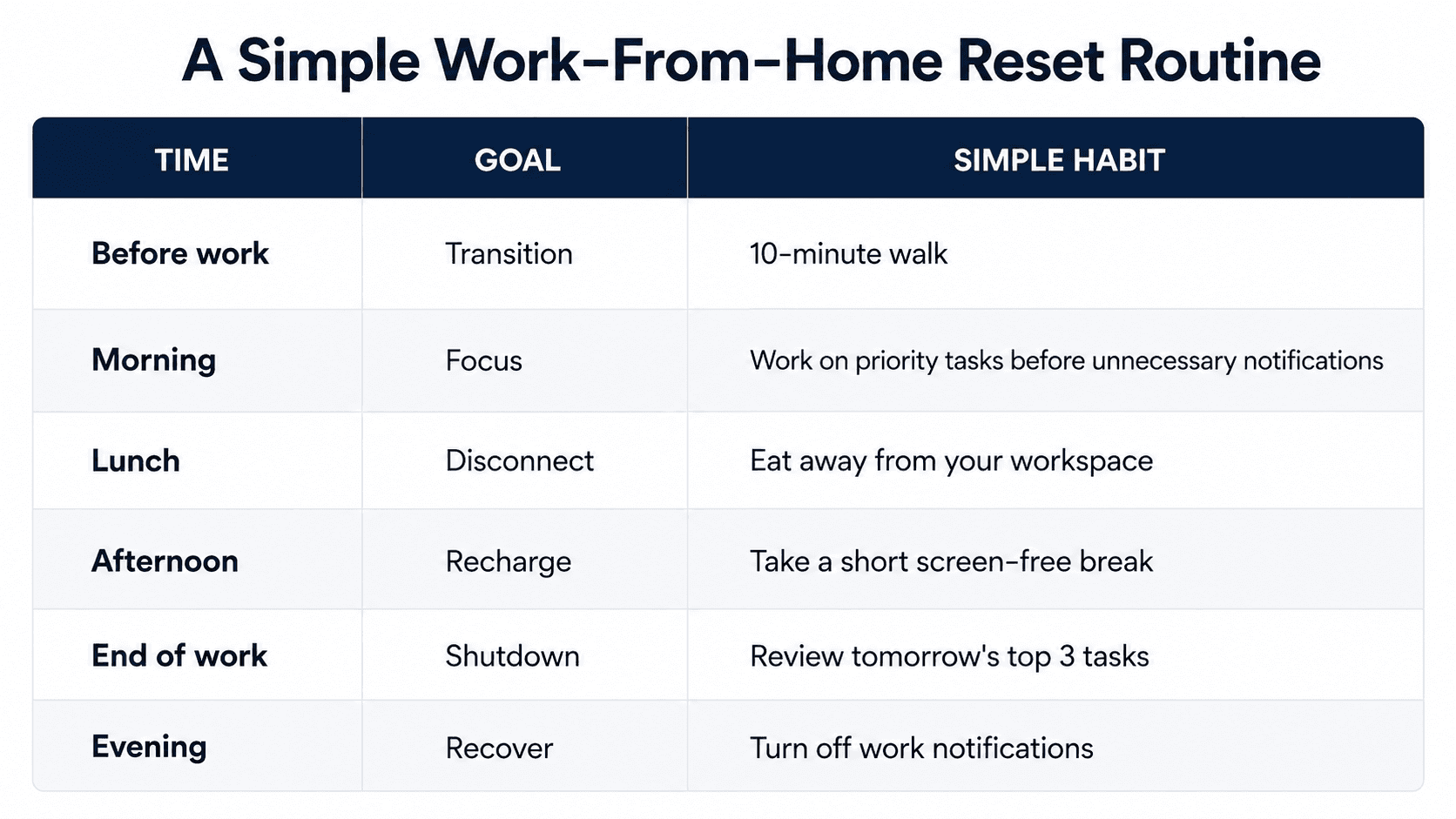
You don't need to follow this schedule perfectly.
The objective is to create predictable boundaries around unpredictable work.
What If Your Job Actually Requires You to Be Available?
This is where many remote-work articles oversimplify the problem.
You may work with clients across different time zones. A manager may operate from another state. Your team could be distributed across California, Texas, New York, or even different countries.
In that situation, “never check messages after 5 PM” may not be realistic.
Instead, establish availability rules.
For example:
“I'm generally available from 9 AM to 6 PM ET. For urgent matters after hours, please call me directly.”
Or discuss with your manager:
Expected response times
What counts as urgent
Which communication channels require immediate attention
When you are officially offline
How after-hours work should be handled
A healthy remote-work culture isn't simply about working fewer hours. It's about making expectations clear and sustainable.
Remote Work Burnout Is Not a Productivity Problem
One mistake is treating burnout as something you can solve by becoming more productive.
Sometimes the answer isn't another productivity app.
You may need:
Less unnecessary work.
Clearer priorities.
Better boundaries.
More recovery time.
More realistic expectations.
The Surgeon General's workplace framework specifically emphasizes protection from harm, connection and community, work-life harmony, mattering at work, and opportunities for growth.
That is an important reminder: employee well-being isn't only an individual responsibility. Employers and managers also influence workload, expectations, communication norms, and workplace culture.
Your 7-Day Work-From-Home Burnout Reset
Don't try to change everything tomorrow.
For the next seven days, start with just these five rules:
Day 1: Create a dedicated work area.
Day 2: Take a 10-minute walk before work.
Day 3: Turn off non-essential notifications after work.
Day 4: Take one screen-free break during the workday.
Day 5: Start your 10-minute shutdown ritual.
Day 6: Keep your laptop closed during personal time.
Day 7: Review which habits actually made you feel more refreshed.
Keep the habits that work. Change the ones that don't.
Final Takeaway
Working from home should give you more control over your day—not make you permanently available.
If your laptop stays open all evening, work messages follow you into bed, and you regularly feel exhausted despite being at home, the issue may not be your ability to manage time. You may simply need stronger boundaries between work time and personal time.
Start small.
Create a beginning-of-day ritual. Take genuine breaks. Define your availability. Shut down your workspace. Turn off unnecessary notifications.
Your goal isn't to become less committed to your career.
It's to build a remote-work routine that lets you perform well without making work your entire life.