

How to Master Managing Up at Work (Without Office Politics)
Doing good work is important. But in most workplaces, good work alone does not always determine who gets more responsibility, better projects, or greater independence.
You may be meeting deadlines, solving problems, and producing solid work, yet still find yourself constantly explaining what you are doing, responding to unnecessary check-ins, or waiting days for decisions.
Meanwhile, someone else seems to have more trust and freedom.
The difference is often not talent or office politics. It is how effectively they manage up.
Managing up does not mean flattering your manager, agreeing with everything they say, or doing their job for them. It means understanding how your manager works, keeping them informed about what matters, and making it easier for them to make decisions.
Done well, managing up can help you build trust, reduce unnecessary back-and-forth, and earn more autonomy.
What Does Managing Up Actually Mean?
Managing up is the practice of adapting the way you communicate and work so that your manager has the information they need to support you and your work.
Think about what most managers need from their team:
Clear priorities
Reliable deadlines
Early warning when something goes wrong
Decisions that are easy to make
Visibility into important work
Confidence that problems are being handled
You do not need to become your manager's personal assistant. You simply need to make it easier for them to understand what is happening, what needs their attention, and what you recommend doing next.
That is the foundation of managing up.
The 3-Step Framework for Managing Up
A simple way to approach managing up is:
1. Diagnose your manager
2. Align your priorities
3. Communicate before you are asked
Let's break each one down.
Step 1: Diagnose How Your Manager Works
Not every manager wants the same type of communication.
Some want short messages. Others want detailed context. Some want frequent updates, while others only want to hear from you when a decision is required.
Instead of complaining about your manager's communication style, learn how to work with it.
The Time-Starved Manager
This manager has too many meetings, emails, and decisions competing for their attention. They do not need a five-paragraph explanation when three sentences will do.
What works:
Lead with the issue.
Explain the impact.
Recommend the next step.
For example:
Problem: The vendor missed the API deadline by two days.
Impact: This could push Tuesday's launch.
Recommendation: I recommend switching to the backup integration today unless you see a reason not to.
You are not asking your manager to solve the problem from scratch. You are giving them a decision they can make quickly.
The Micromanager
A manager who constantly checks your work may be reacting to uncertainty. You cannot guarantee that proactive updates will eliminate micromanagement, but you can remove some of the uncertainty that causes unnecessary check-ins.
Try sending short, predictable updates:
Friday Project Update
Completed: Homepage redesign
In progress: Mobile layouts
Risk: Client feedback delayed by one day
Next: Final revisions Monday
Need from you: Approval on the revised deadline
Over time, consistent communication can make your manager more comfortable giving you space.
The Hands-Off Manager
Some managers give you a broad goal and expect you to figure out the details.
For example:
“We need to improve the client onboarding experience.”
Instead of replying, “What exactly should I do?”, turn the goal into a few realistic options.
Option A: Redesign the complete onboarding process in six weeks.
Option B: Improve the first three onboarding steps in two weeks.
Option C: Test a smaller change with 20 customers first.
Then ask:
“I recommend Option B because it gives us a quick improvement without committing to a full redesign. Are you comfortable with that direction?”
That is managing up.
You are taking ownership without making decisions that belong to your manager.
Step 2: Align Your Priorities With Your Manager's Priorities
One of the easiest mistakes employees make is assuming that their manager automatically knows what they are working on.
They usually don't.
Your manager may be responsible for multiple people, projects, deadlines, and leadership requests. If your priorities are not visible, they may not understand where your time is going.
Before starting important work, make sure you understand:
What matters most right now?
A useful question is:
“If I can only get three things done this week, which three would have the biggest impact?”
That question can prevent a lot of wasted effort.
Take Ownership of Your 1-on-1
Do not walk into your weekly 1-on-1 expecting your manager to create the agenda. Send a simple agenda beforehand.
A Practical 15-Minute Structure
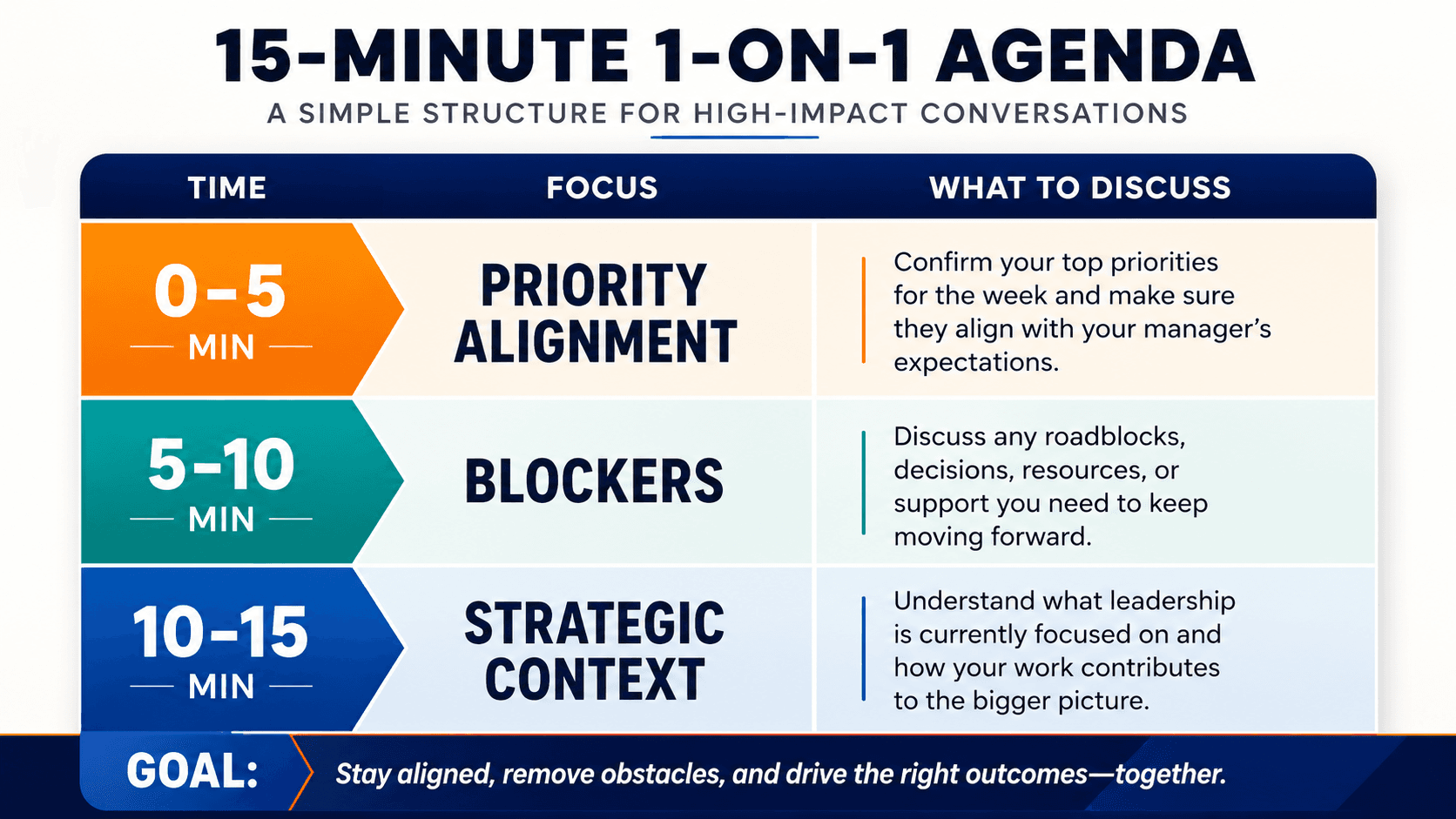
For example, your agenda could be:
This week's priorities
Finish campaign launch
Complete client presentation
Resolve reporting issue
Decisions needed
Approve revised campaign deadline
Confirm additional design support
One strategic question
“What is the main metric leadership is paying attention to this month?”
That last question is especially useful. It helps you understand the bigger picture instead of focusing only on your individual tasks.
Step 3: Communicate Before You Are Asked
Good managers should not have to chase you for basic information.
If something important changes, tell them.
If a deadline is at risk, tell them early.
If you need a decision, explain what you recommend.
This is where one of the most important rules of managing up comes in:
Follow the “No Surprises” Rule
Few things damage trust faster than a manager discovering a problem from someone else. Imagine a client asks your manager why a project is late, and your manager has no idea there is a problem. Even if the delay was not your fault, the communication failure becomes your problem. Instead, raise issues early.
A simple structure is:
Acknowledge → Impact → Remedy
Acknowledge: What happened?
Impact: What does it affect?
Remedy: What are you doing about it?
For example:
“Quick heads-up: we found a data-sync issue this morning, which will push QA back by one day. I’ve moved the fix to the development queue and added an extra QA slot tomorrow. I’ll update the project channel by 4 PM.”
Notice what is missing.
There is no long explanation. No blame. No panic.
The manager immediately knows:
What happened → What it means → What is being done.
That is exactly the kind of communication that builds trust.
Three Managing-Up Mistakes to Avoid
1. Bringing Problems Without Options
If you constantly tell your manager what is wrong but never suggest what could be done, they eventually become the person who has to solve every problem.
You do not need to have the perfect answer.
Bring at least one reasonable option.
Instead of:
“The client keeps changing the requirements.”
Try:
“The client has changed the requirements three times. I recommend freezing the scope after tomorrow's review and treating anything additional as a separate request.”
Now your manager has something to react to.
2. Assuming Your Manager Knows What You Do
This is especially important in hybrid and remote workplaces. Your manager may not see the work happening behind the scenes. Make your outcomes visible.
Instead of:
“Worked on the campaign.”
Say:
“Completed the campaign landing page, reduced the form from seven fields to four, and sent the final version for approval.”
The second update gives your manager evidence of progress.
3. Trying to Change Your Manager's Personality
You probably cannot turn a micromanager into a relaxed manager overnight. You cannot turn a detail-focused manager into someone who suddenly loves one-line updates. What you can change is how you communicate with them.
The goal is not to change who they are. The goal is to make the working relationship more effective.
A Simple Managing-Up Checklist
Before your next meeting or major project update, ask yourself:
What are my manager's top priorities right now?
Does my manager know what I am working on?
Is anything likely to become a problem?
Do I need a decision from them?
Can I present a recommendation instead of just a question?
Am I communicating in the format they actually prefer?
If something goes wrong tomorrow, will they hear it from me first?
If you can consistently answer these questions, you are already managing up more effectively than most employees.
Start With One Small Change
You do not need to completely change your working style. Start with your next 1-on-1. Send your manager a short message 24 hours beforehand with:
1. Your top three priorities
2. Any blockers or decisions you need
3. One question about the bigger picture
Then, during the week, practice one additional habit:
Never hide bad news until it becomes impossible to hide.
Tell your manager early, explain the impact, and bring a reasonable next step. Over time, these small habits create something much more valuable than constant praise from your manager: trust.
And when your manager trusts you to communicate clearly, handle problems, and stay aligned with priorities, they are far more likely to give you something every professional wants—more autonomy.
Key Takeaways
Managing up is not about pleasing your boss. It is about building a more effective working relationship.
Understand your manager's communication style and adapt without losing your own judgment.
Align your priorities with the outcomes your manager and organization care about.
Bring recommendations, not just problems.
Communicate bad news early and explain what you are doing about it.
Make your progress visible, especially when working remotely or across teams.
Use your 1-on-1s strategically instead of waiting for your manager to lead the conversation.
The best form of managing up is simple: make it easier for your manager to trust you.