
Escaping the Urgent-Important Trap: Energy Management for Tech Leaders
Introduction
A typical day for a technology leader can quickly become a series of interruptions. Slack messages arrive, production alerts demand attention, and colleagues request decisions that supposedly cannot wait. By the end of the day, you may have answered dozens of questions but made little progress on the strategic work that matters most.
The Eisenhower Matrix helps people prioritise tasks according to urgency and importance. However, prioritisation becomes difficult when every request arrives labelled as urgent.
The solution is not to abandon time management. It is to combine prioritisation with a realistic understanding of your attention, workload, and need for recovery. For tech leaders, this means protecting focused work, setting communication boundaries, and distinguishing genuine emergencies from tasks that can wait.
1. Why the Eisenhower Matrix Can Fall Short
The Eisenhower Matrix divides tasks into four categories: urgent and important, important but not urgent, urgent but less important, and neither urgent nor important.
It is a useful framework, but it cannot determine whether every incoming request deserves immediate attention. That decision requires context.
Imagine a Monday morning when a sales executive requests custom API documentation, a staging database generates an alert, and a product manager wants help resolving a dependency issue. Each request may sound urgent, but their actual business impact differs.
A production outage affecting customers deserves a different response from a presentation that could be completed later that afternoon.
When leaders treat every interruption as a priority, strategic work gets postponed. Architecture improvements, team development, documentation, and preventive maintenance receive attention only when something goes wrong.
Over time, this reactive pattern can contribute to stress and make it harder to maintain focus. The answer is to establish clear priorities and agree on what genuinely requires immediate escalation.
2. A Four-Zone Framework for Managing Energy
Use these four zones as a flexible daily planning method. Adjust them to your responsibilities, working hours, and personal concentration patterns rather than following a rigid schedule.
Zone 1: Strategic Deep Work
Reserve a protected period for work that requires sustained concentration and careful decision-making.
Examples include designing system architecture, preparing technical proposals, reviewing long-term product strategy, and developing team growth plans.
Try scheduling a 60–90-minute focus block when you tend to concentrate best. Close unnecessary applications, silence routine notifications, and define one specific outcome before beginning.
If your role involves production support, maintain a reliable escalation route for genuine emergencies.
Zone 2: Administrative and Asynchronous Work
Group routine tasks instead of allowing them to interrupt focused work throughout the day.
Examples include reviewing email, responding to non-urgent messages, approving routine requests, and checking project updates.
You might schedule two short communication windows daily. Let colleagues know when they can expect a response, and use written updates when a meeting is unnecessary.
This approach reduces context switching without requiring you to ignore important communication.
Zone 3: Collaboration and Decision-Making
Use designated periods for meetings, coaching, planning, and cross-functional discussions.
Where practical, group related meetings together and share agendas beforehand. Ask participants to identify the decision required, the relevant background, and any unresolved questions.
Not every conversation needs a meeting. A concise written proposal may be sufficient for a straightforward decision, while complex disagreements may benefit from a live discussion.
Zone 4: Recovery and Disconnection
Recovery is part of sustainable performance, not a reward for finishing every task.
Take short breaks between demanding activities, maintain reasonable working hours, and protect time for sleep, exercise, and personal commitments.
Leaders in on-call roles may not be able to disconnect completely. In that case, establish a rotation, define escalation thresholds, and ensure that responsibility does not fall permanently on one person.
3. How to Separate Genuine Urgency from Noise
Before interrupting planned work, ask three questions:
What happens if this waits? Identify the specific customer, financial, security, legal, or operational consequences of delaying the task.
Is immediate action necessary? Distinguish an active incident from a request that is important but can be scheduled.
What will be delayed? Make the trade-off visible so stakeholders understand the effect on existing commitments.
These questions encourage better decisions without dismissing colleagues' concerns.
A useful rule is to define response expectations with your team. For example, critical production incidents may require immediate escalation, while routine documentation requests can wait for the next communication window.
4. Comparing Three Approaches to Work
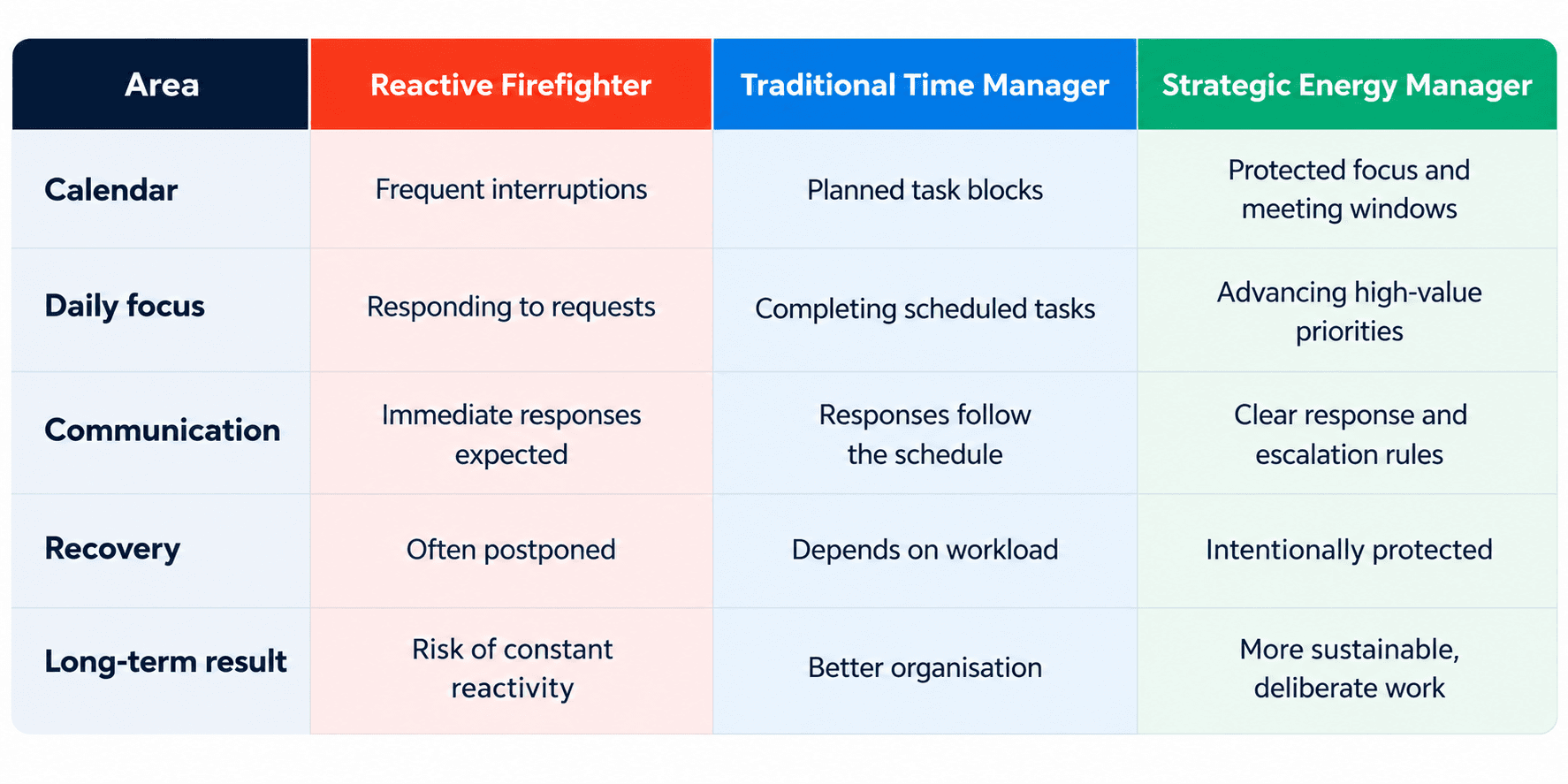
These are illustrative working styles, not fixed personality types. Most leaders will use elements of all three depending on the situation.
5. Scripts for Protecting Focus Without Creating Conflict
Script A: Responding to an Urgent Request
“Hi [Name], I’ve seen your request and understand its importance. I’m currently working on a committed priority, so I can review this during our 2:00 PM triage window and send you an update by 4:30 PM. If this affects a live customer incident or another critical deadline, please share the immediate impact so we can reassess priorities.”
Script B: Replacing an Unnecessary Meeting
“Thanks for including me. To keep our current commitments on track, could you send a short summary of the issue and the decision you need? I’ll review it and provide feedback by the end of the day. If the topic requires discussion, we can schedule a focused meeting.”
Both messages acknowledge the request, explain the next step, and leave room for genuine urgency.
6. Common Energy Management Mistakes
Scheduling every minute: A full calendar leaves little room for unexpected work. Build reasonable buffers between meetings and protect some unscheduled time.
Treating every message as an emergency: Establish shared escalation rules instead of relying on constant availability.
Ignoring personal concentration patterns: Morning focus blocks work well for some people, while others concentrate better later. Track your experience and adjust your schedule.
Using breaks to consume more information: Constantly checking news or messages may not provide a meaningful mental break. Try walking, stretching, or stepping away from your screen.
Confusing boundaries with unavailability: Focus time should be predictable to colleagues, with a clear way to reach you when something genuinely critical happens.
For more guidance on handling workplace pressure, explore our guide to corporate anxiety and imposter syndrome.
7. Frequently Asked Questions
How can tech leaders use the Eisenhower Matrix more effectively?
Review tasks according to their actual impact and deadlines. Protect time for important long-term work, delegate suitable tasks, and establish clear criteria for emergencies.
What if my manager expects immediate Slack responses?
Discuss response expectations and demonstrate how protected focus time supports agreed deliverables. Propose a trial period, define exceptions for urgent incidents, and review the results together.
How much deep work should I schedule each day?
Start with one realistic focus block and increase it only if your workload allows. There is no universal number of productive hours that applies to every person or task.
How should leaders handle production emergencies during focus time?
Use documented incident priorities, reliable alerts, and a clear escalation process. Critical incidents should interrupt planned work when necessary; routine questions should follow normal communication channels.
Does energy management work for remote and office-based teams?
Yes. Remote teams may need clearer notification and availability rules, while office-based teams may need meeting boundaries and fewer unplanned interruptions. The principles are similar, but implementation should reflect the team's environment.
Final Thoughts
Effective leadership is not measured by how quickly you answer every message. It is reflected in the decisions you make, the systems you improve, and the support you provide your team.
The Eisenhower Matrix can help you identify priorities, while energy-aware planning helps you protect the attention needed to complete them. Start with one focused work block, clearer escalation rules, and a realistic recovery routine.
Small, consistent changes can help you move away from constant firefighting and towards a more deliberate, sustainable way of leading.