

Critical Thinking at Work: How to Make Data-Backed Decisions Under Pressure
When something goes wrong at work, the pressure to act immediately can be intense.
A key performance metric suddenly drops. A client escalates a complaint. A project deadline is slipping. A team member reports a serious problem. In these moments, the easiest response is often to do something quickly.
But quick action is not always good decision-making.
A rushed decision may fix the visible problem while leaving the real cause untouched. The same issue then returns, consuming more time, money, and team effort.
This is where critical thinking at work becomes valuable.
Critical thinking helps professionals slow down just enough to separate facts from assumptions, identify the root cause, evaluate possible consequences, and choose an appropriate response—even when the clock is running.
This guide explains a practical framework for using critical thinking and data-driven decision-making in the workplace, particularly when decisions need to be made under pressure.
Table of Contents
What Is Critical Thinking at Work?
Critical Thinking vs. Problem-Solving
Why Critical Thinking Matters Under Pressure
The 4-Step Critical Thinking Framework
Reactive vs. Analytical Decision-Making
3 Questions to Ask Before a Major Decision
How to Build Critical Thinking Skills at Work
Final Thoughts
What Is Critical Thinking at Work?
Critical thinking at work is the ability to examine information objectively, question assumptions, evaluate evidence, consider alternatives, and reach a reasoned conclusion before taking action.
It doesn't mean overthinking every decision.
Instead, it means knowing when a decision deserves deeper analysis.
For example, imagine website leads suddenly fall by 20%.
A reactive response might be:
"The sales team isn't generating enough leads. Increase cold calls."
A critical-thinking approach asks:
Did website traffic actually decrease?
Did conversion rates change?
Did a landing page stop working?
Was there a tracking issue?
Did the quality of incoming traffic change?
Did a recent website update affect the funnel?
The second approach takes slightly more investigation, but it has a better chance of addressing the actual problem.
Critical Thinking vs. Problem-Solving
These skills are closely related, but they aren't identical.
Problem-solving focuses primarily on finding a solution to a problem.
Critical thinking focuses on determining what is actually happening, whether the information is reliable, what assumptions are being made, and which solution makes the most sense.
For example:
Problem-solving:
A server is failing, so the team restarts it.
Critical thinking:
The team investigates why the server keeps failing, examines logs and system behavior, identifies the underlying vulnerability, and decides whether the process or infrastructure needs to change.
You often need both skills.
Critical thinking helps you choose the right problem to solve; problem-solving helps you solve it.
Why Critical Thinking Matters Under Pressure
Pressure can affect judgment.
When deadlines are tight, people may rely on familiar solutions, emotional reactions, incomplete information, or the loudest opinion in the room.
Critical thinking creates a structured pause between the problem and the response.
It can help professionals:
Reduce decisions based on assumptions
Identify root causes
Compare alternatives objectively
Recognize potential risks
Use evidence more effectively
Avoid repeating temporary fixes
Communicate decisions more clearly
Make better use of limited time and resources
This doesn't mean every decision needs a lengthy meeting.
The skill is knowing how much analysis the decision actually requires.
The 4-Step Critical Thinking Framework
Step 1: Challenge the Core Assumption
Start by asking:
"What are we assuming is true?"
This question can expose weaknesses in an initial diagnosis.
Suppose a customer complains that a product is too expensive. The immediate assumption may be that price is the problem.
But perhaps customers don't understand the product's value, the onboarding experience is poor, or a competitor recently introduced a better offer.
Don't automatically treat the first explanation as the correct one.
Look for evidence that confirms—or contradicts—it.
Useful questions include:
What do we know for certain?
What are we assuming?
What evidence supports the assumption?
What evidence challenges it?
What information are we missing?
This is one of the most important critical thinking techniques for workplace decision-making.
Step 2: Separate Signal From Noise
Workplace problems often generate a lot of information.
Some of it is useful. Some isn't.
A frustrated customer may provide an important clue, but one complaint doesn't necessarily prove that an entire product is failing.
Similarly, one employee's opinion may be valuable, but it shouldn't automatically replace measurable evidence.
Depending on the situation, examine relevant data such as:
Conversion rates
Error rates
Customer complaints
Revenue changes
Delivery times
Productivity metrics
Retention rates
Project costs
Quality measurements
The objective isn't to ignore opinions.
It's to combine qualitative information with reliable evidence instead of allowing one emotional or anecdotal observation to determine the entire decision.
Step 3: Use Second-Order Thinking
A solution can create another problem.
That's why strong decision-makers don't only ask:
"What happens if we do this?"
They also ask:
"What happens next?"
This is called second-order thinking.
Consider a project that is running behind schedule.
First-order thinking:
"Make the team work overtime so we can meet the deadline."
Second-order thinking:
"Will overtime increase errors, reduce morale, create technical debt, or cause another delay?"
A better option might be to remove lower-priority features and protect the quality of the core release.
Before implementing a major solution, consider:
Immediate effect → Secondary consequence → Longer-term impact
This approach is particularly useful for strategic decision-making under pressure.
Step 4: Decide Whether the Decision Is Reversible
Not every decision deserves the same level of analysis.
A useful way to think about decisions is:
Reversible Decisions
These can be changed or rolled back relatively easily.
Examples include:
Testing a new workflow
Running a small marketing experiment
Changing a meeting format
Trialing a software tool
These decisions can often be made quickly.
Difficult-to-Reverse Decisions
These may involve significant financial, operational, legal, or reputational consequences.
Examples include:
Making a major budget commitment
Permanently deleting important data
Signing a significant long-term contract
Making a major structural change
Launching a high-risk product change
These decisions deserve more evidence, stakeholder input, and risk assessment.
The key principle is simple:
Move quickly when the cost of being wrong is low. Slow down when the cost of being wrong is high.
Reactive vs. Analytical Decision-Making
The difference becomes clearer with real workplace examples:
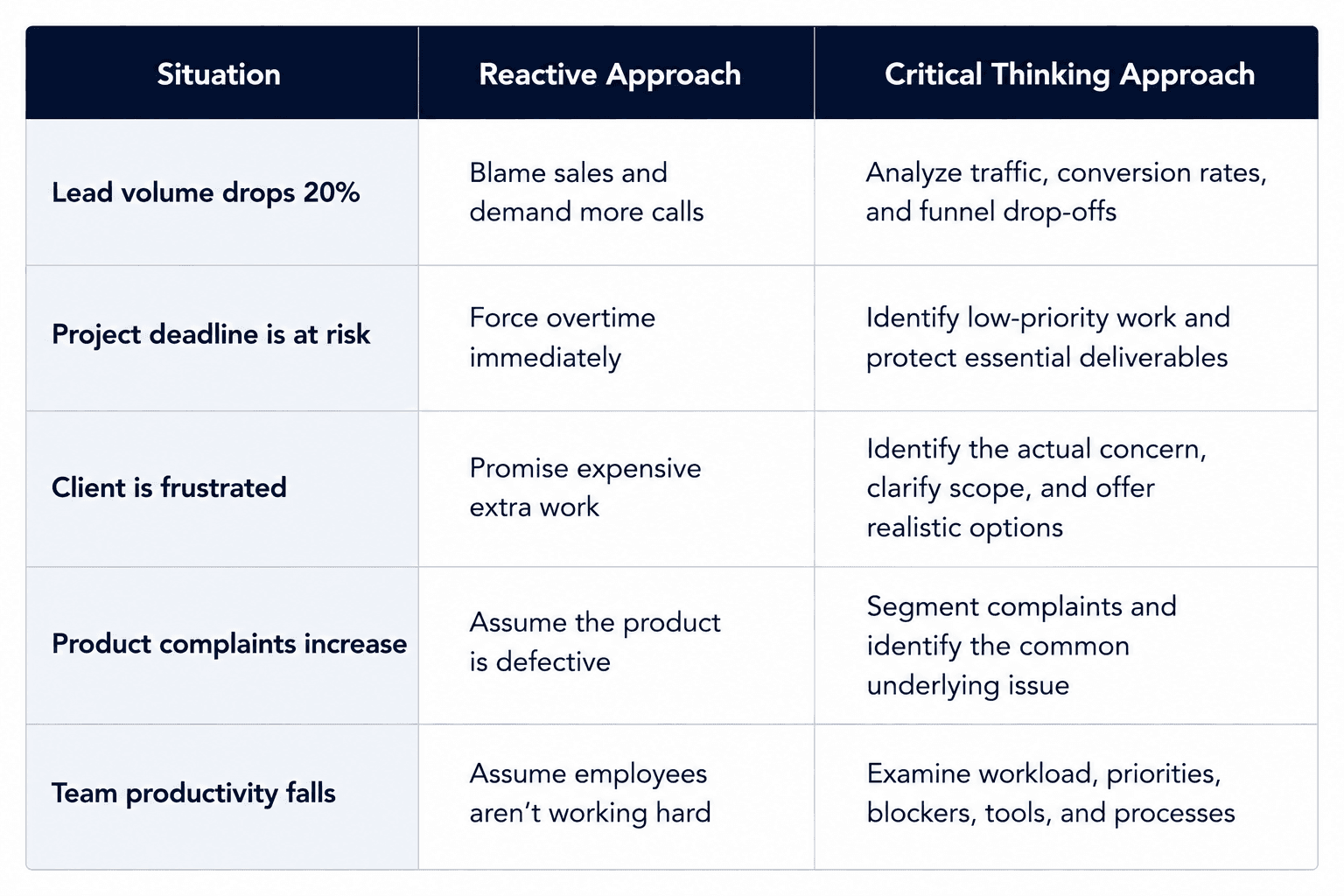
The critical-thinking approach isn't necessarily slower.
In many cases, a few minutes of structured analysis can prevent hours or days of solving the wrong problem.
3 Questions to Ask Before a Major Decision
When you're under pressure, these three questions can improve the quality of your reasoning.
1. What Evidence Contradicts My Preferred Solution?
This question helps reduce confirmation bias.
Instead of searching only for information that supports your idea, deliberately look for evidence that could prove you wrong.
2. If This Solution Fails, What Will Probably Be the Reason?
Think about the most likely failure point before implementation. This allows you to prepare safeguards instead of discovering the weakness afterward.
3. Am I Fixing the Cause or Only the Symptom?
A temporary workaround can be useful during an emergency. But if the same problem repeatedly returns, the organization needs to investigate the underlying cause.
How to Build Critical Thinking Skills at Work
Critical thinking isn't something you switch on during emergencies. It improves through regular practice.
Make Evidence a Habit
Before making an important claim, ask:
"What evidence do we have?"
Practice Asking Better Questions
Instead of asking only:
"How do we fix this?"
also ask:
"Why is this happening?"
and:
"What would happen if we did nothing?"
Consider Alternative Explanations
When you have one explanation, deliberately create two or three alternatives. This prevents you from becoming attached to the first plausible answer.
Review Your Decisions
After an important decision, look back.
Ask:
What did we predict?
What actually happened?
Which assumption was wrong?
What would we do differently next time?
This creates a valuable decision-making feedback loop.
Separate Speed From Urgency
Not every urgent-looking problem requires an immediate permanent solution.
Sometimes the best response is:
Stabilize → Investigate → Decide → Implement → Review
That sequence allows you to protect the situation while still making a thoughtful decision.
Final Thoughts
Critical thinking at work isn't about being skeptical of everything or delaying decisions until you have perfect information.
Perfect information rarely exists.
The real skill is learning how to make a reasonable decision with the information available while understanding the assumptions, risks, alternatives, and possible consequences.
When pressure rises, don't automatically ask:
"What can we do right now?"
Ask:
"What is actually happening, what evidence do we have, and what happens if we choose this solution?"
That small change in thinking can prevent reactive decisions and help you focus on solutions that address the real problem.
The strongest workplace decision-makers aren't necessarily the people who respond first.
They're the people who can stay clear-headed when everyone else is reacting.