

How to Run a Blameless Postmortem: A Practical Guide for Engineering Teams
A production outage can be stressful for everyone involved. Customers may be unable to use an important service, support teams may suddenly receive hundreds of complaints, and engineering teams may spend hours trying to restore normal operations.
Once the incident is resolved, another important question appears:
What should we do to make sure this doesn't happen again?
This is where a blameless postmortem becomes valuable.
A good postmortem isn't about finding someone to punish. It's about understanding what happened, why the system allowed it to happen, and what can be improved before the same type of failure happens again.
For engineering leaders, learning how to run a blameless postmortem can help create stronger systems while also building psychological safety within the team.
What Is a Blameless Postmortem?
A blameless postmortem is a structured review conducted after an incident, outage, failed deployment, or serious production problem.
The goal is to understand the incident without turning the discussion into a search for a person to blame.
This doesn't mean that accountability disappears. Instead, the focus moves from:
"Who made the mistake?"
to:
"What conditions allowed this mistake to cause an incident?"
For example, imagine that an engineer deploys a database query that performs badly under production traffic. The query eventually contributes to a service outage.
A blame-focused review might ask why the engineer didn't notice the problem.
A blameless review asks broader questions:
Was the query tested with realistic data?
Did staging accurately represent production?
Were database performance alerts configured?
Did the deployment process have a safe rollback mechanism?
Could a canary deployment have limited the impact?
The difference is important because fixing the system can prevent many future mistakes, while simply blaming one person usually fixes nothing.
Why Traditional Postmortems Often Fail
When an incident happens, it's natural for people to look for a clear cause — and sometimes a person to hold responsible.
But software systems are rarely that simple.
A production failure can involve code, infrastructure, monitoring, deployment processes, testing, documentation, third-party services, communication gaps, and unexpected user behavior.
If engineers believe that honest mistakes will result in punishment, they may become less willing to report problems or discuss what actually happened.
That creates a dangerous situation.
Instead of learning from failures, organizations begin hiding them.
A strong blameless engineering culture creates the opposite environment. Engineers can explain what they saw, what they believed at the time, and what information was available to them without immediately becoming defensive.
That information is often exactly what the organization needs to improve its systems.
The 5-Part Blameless Postmortem Framework
A useful postmortem should be structured rather than becoming an informal conversation about what went wrong.
A practical framework contains five key sections.
1. Incident Summary and Business Impact
Start by explaining what happened and how the incident affected customers and the business.
Include information such as:
When the incident started
How long it lasted
Which services were affected
Percentage of users impacted
Revenue or operational impact
Customer support impact
Any relevant SLA or compliance consequences
Keep this section factual.
The purpose isn't to assign responsibility. It's to establish a shared understanding of the incident.
2. Build a Clear Timeline
Next, create a chronological timeline of the incident.
Include important events such as:
Deployment or configuration change
First warning or alert
Detection of the problem
On-call response
Incident escalation
Investigation
Rollback or mitigation
Service recovery
Final verification
A timeline helps separate facts from assumptions.
It can also reveal important gaps. For example, an issue may have started at 2:10 PM but not generated an alert until 2:35 PM. That delay could point toward a monitoring problem worth fixing.
3. Find the Root Cause
The visible failure isn't always the root cause.
One useful approach is the 5 Whys technique.
Suppose an application becomes unavailable because a database connection pool is exhausted.
You might ask:
Why did the connection pool become exhausted?
Because a query consumed excessive database resources.
Why was the query allowed into production?
Because the testing environment didn't expose the performance problem.
Why didn't testing expose it?
Because production-scale data wasn't available in staging.
Continue asking why until the investigation reaches the underlying process or system weaknesses.
The objective is not to prove that a person made a mistake. It's to discover which missing guardrails, testing gaps, architecture decisions, or process weaknesses contributed to the incident.
4. What Went Well — and Where Did You Get Lucky?
Postmortems often focus entirely on failures.
That's a mistake.
Document what worked, too.
Perhaps the on-call engineer detected the problem quickly. Maybe the team had good dashboards, a useful runbook, or an automated rollback that reduced the recovery time.
Also identify areas where the team simply got lucky.
For example, a backup system may have happened to remain available during the incident even though the architecture didn't guarantee that outcome.
These details matter because they show which practices should be strengthened and which risks should no longer depend on luck.
5. Turn Lessons Into Actionable Work
A postmortem has little value if the resulting action items are forgotten.
Every important action should have:
A clear owner
A priority
A tracking ticket
A realistic deadline
A measurable outcome
For example, instead of writing:
"Improve database monitoring."
Write:
"Add an alert for abnormal database connection usage and test it before the next production release."
Specific action items are easier to track and much harder to ignore.
How to Facilitate a Blameless Postmortem Meeting
The facilitator has an important responsibility: keeping the discussion focused on learning.
One of the simplest rules is to avoid questions that directly attack an individual's decision.
Instead of asking:
"Why didn't you check the database before merging?"
ask:
"What database information was visible to the engineer at the time?"
The second question encourages people to explain the environment in which the decision was made.
This is especially important during cross-functional postmortems, where engineers, product managers, customer support, and business leaders may all have different concerns.
Business stakeholders need to understand the customer impact. Engineers need enough space to explain the technical conditions.
A good facilitator connects both sides:
"This incident affected customer trust. Let's identify which engineering safeguards can prevent the same failure from affecting customers again."
That keeps the conversation constructive.
Blameless Postmortem vs. Punitive Postmortem
The difference between the two approaches is significant.
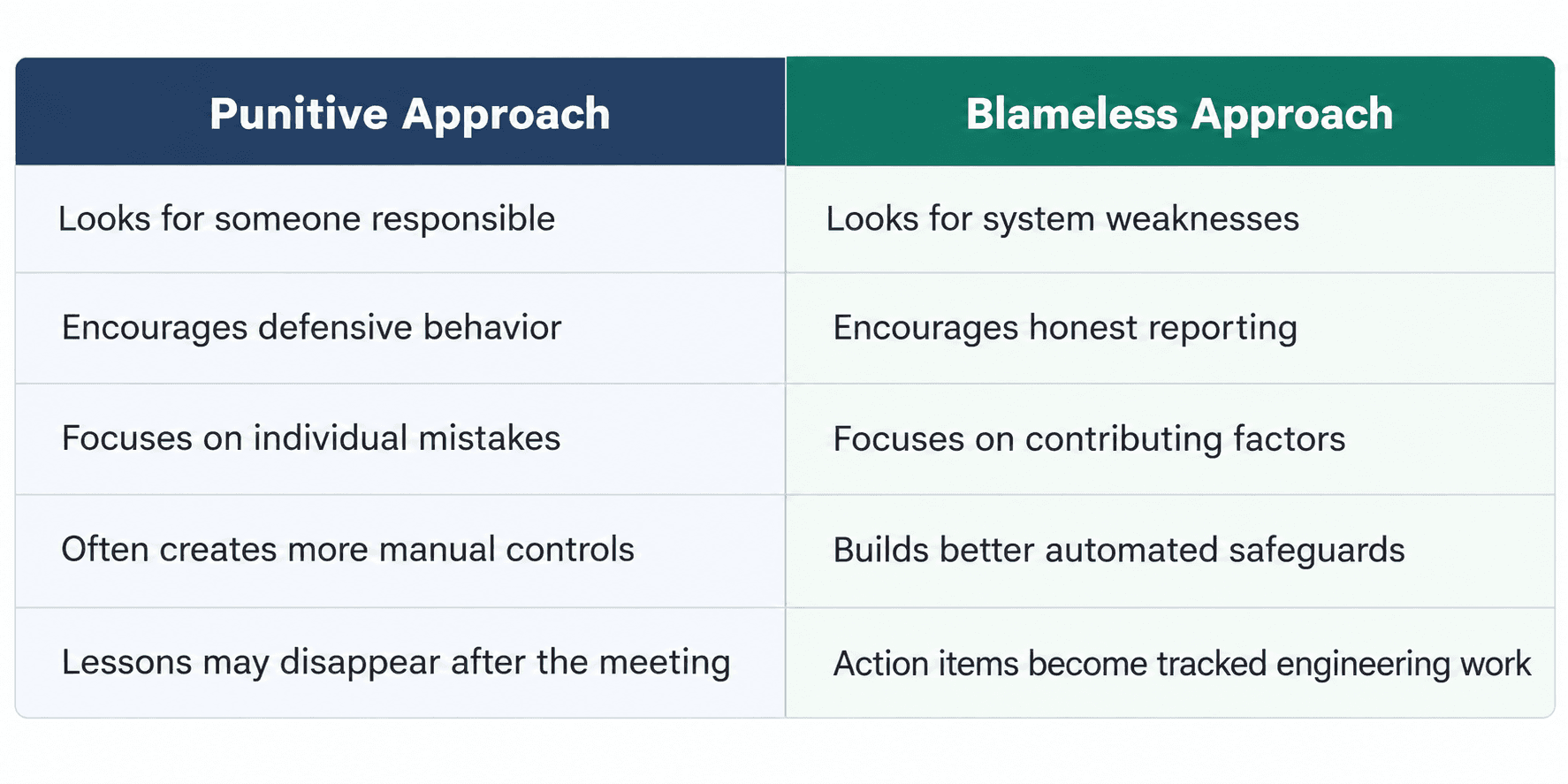
The goal isn't to eliminate accountability.
Intentional misconduct, serious security violations, or repeated disregard for established safety procedures are different situations.
Blamelessness applies primarily to understanding honest mistakes within complex systems.
Use Pre-Mortems to Prevent Problems Before They Happen
Postmortems happen after something goes wrong.
But engineering teams can use a similar mindset before deployment through a pre-mortem.
Before approving a major architecture change, ask the team to imagine that the project has failed six months from now.
Then ask:
"What caused the failure?"
This exercise can uncover concerns that might otherwise remain unspoken.
A junior engineer may notice a fragile dependency. Another team member may identify an untested third-party API. Someone else may recognize that the architecture has no effective fallback mechanism.
The value of a pre-mortem is that it creates space for constructive disagreement before the system reaches production.
Frequently Asked Questions
Does blamelessness mean nobody is accountable?
No.
Blamelessness means that honest mistakes should be investigated without automatically turning the incident into a disciplinary exercise.
Organizations still need clear expectations around security, safety, and professional conduct.
When should a postmortem happen?
Ideally, conduct the review soon after the incident has been resolved, while the timeline and decisions are still fresh.
For many teams, 24 to 48 hours after resolution is a practical target.
Who should attend?
Keep the meeting focused.
Typically, this includes the engineers involved in the incident, the technical lead, engineering manager, relevant product stakeholders, and representatives from other directly affected teams.
A large audience isn't necessarily better. The written report can be shared more widely afterward.
How do you make sure action items don't get forgotten?
Treat important postmortem actions as real engineering work.
Give each item an owner, priority, tracking ticket, and deadline. Review overdue items during regular engineering leadership or team meetings.
If the same action keeps being postponed, that is itself a useful signal that the organization needs to address its process.
Final Thoughts
A blameless postmortem isn't simply a document created after an outage.
Done properly, it becomes a learning mechanism for the entire engineering organization.
The best postmortems answer three questions:
What happened?
Why did the system allow it to happen?
What will we change so that the same class of failure becomes less likely in the future?
When teams can answer those questions honestly, incidents become opportunities to strengthen architecture, improve processes, and build better engineering practices.
The goal isn't to create a workplace where mistakes don't happen.
The goal is to create systems and teams that learn from mistakes instead of repeating them.