

How to Write a LinkedIn "About" Section (Templates & Guide)
When a recruiter lands on your LinkedIn profile, they do not read your entire work history line by line. They scan your headline, glance at your current title, and jump straight to your About section to answer one core question:
"What makes this person worth a 15-minute introductory call?"
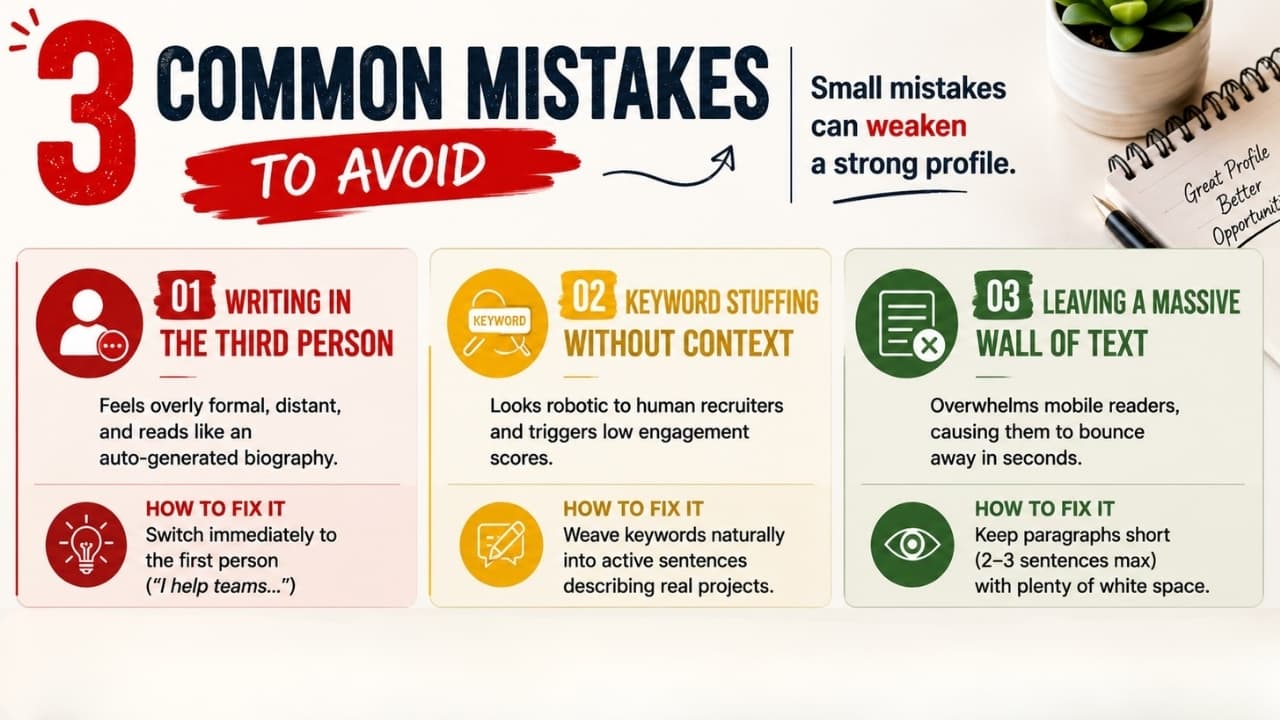
If your summary is blank, written in stiff third-person corporate prose, or packed with keyword-stuffed buzzwords like "synergistic thought-leader," you lose their attention instantly.
Writing an effective LinkedIn bio requires shifting away from a dry list of credentials and toward a structured professional narrative.
The Anatomy of a High-Conversion LinkedIn Summary
Recruiters read profiles on both desktop monitors and mobile screens. Your summary must be structured so that the first three lines hook the reader before they have to click "see more."
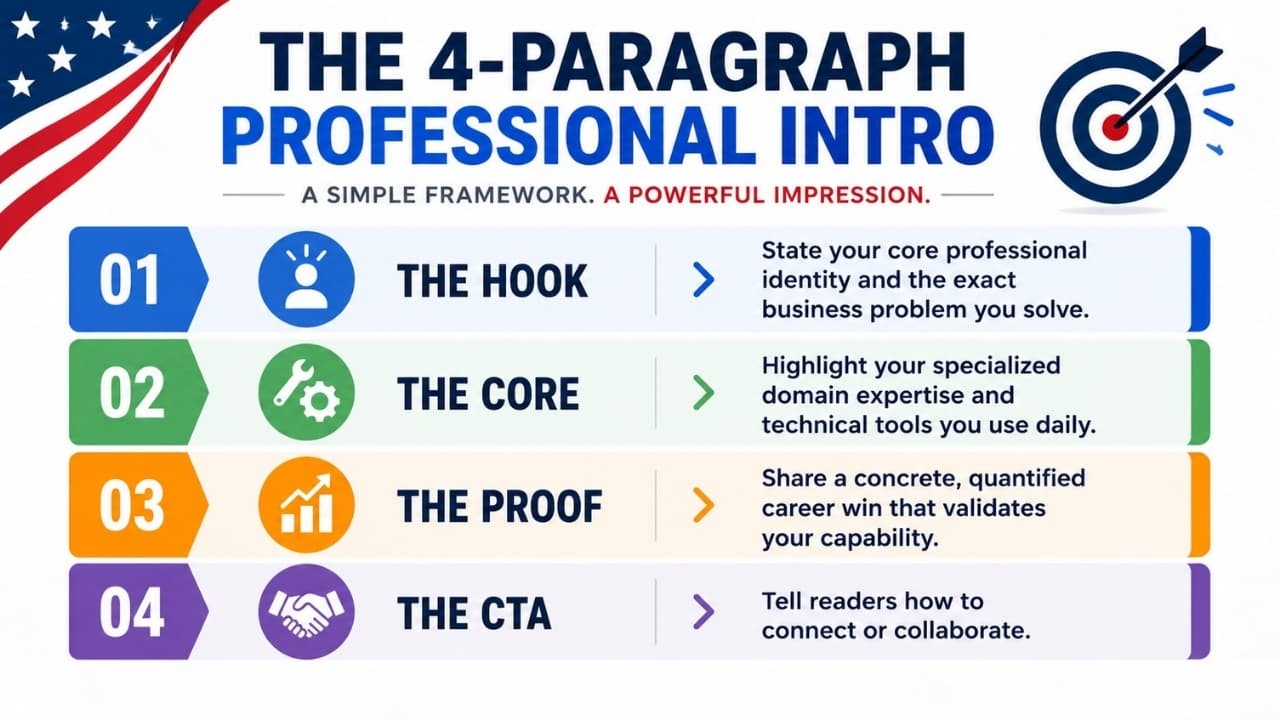
Use the 4-paragraph Hook-Core-Proof-Call framework:
Two Proven LinkedIn Summary Templates
Template 1: For Mid-to-Senior Specialists & Operators
Best for professionals with 5+ years of experience looking for lateral or advanced corporate roles.
[Hook Statement]: For the past [Number] years, I’ve helped [Target Industry / Companies] solve a recurring challenge: [Name the specific problem, e.g., scaling outbound sales pipelines without inflating customer acquisition costs].
[Core Competencies]: My work bridges the gap between [Skill A] and [Skill B]. On any given day, you’ll find me managing [Key Tool or Workflow], optimizing [Metric], and aligning cross-functional teams to hit aggressive quarterly targets.
[Quantified Proof]: Most recently, I led a product migration that reduced deployment cycle times by 35% and saved $120k in operational overhead across our UK and US divisions.
[Call to Action]: I’m always open to connecting with fellow leaders in [Industry] or discussing new opportunities in [Specialty]. Drop me a message here or reach out at [Email].
Template 2: For Career Changers & Returning Professionals
Best for professionals pivoting industries or returning after an extended career pause.
[Hook Statement]: Throughout my career in [Previous Field], I developed a deep expertise in [Transferable Skill, e.g., complex data analysis and stakeholder management]. Now, I bring that strategic foundation directly into [New Target Field].
[Core Competencies]: I specialize in [Core Skill 1], [Core Skill 2], and translating messy operational datasets into clear, actionable executive dashboards using [Tools].
[Quantified Proof]: During my recent transition, I built an end-to-end inventory tracking simulation that automated weekly reporting, eliminating manual auditing errors for local retail partners.
[Call to Action]: I'm actively connecting with engineering and operations teams hiring in [City / Remote]. Let’s chat about how my background can support your upcoming product roadmap.
3 Common Mistakes to Avoid
What to Do Next
Open your LinkedIn profile right now and review your current About section.
Check if your first three lines immediately state what problem you solve and who you help.
Break up any dense blocks of text into digestible paragraphs.
Add one measurable business metric that proves your real-world impact.
A polished, human summary turns your profile from an online resume into a passive lead generator for your career.
Key Takeaways
Hook readers immediately: Your opening three lines must capture attention before the reader has to click "see more."
Write in the first person: Speak directly to the recruiter using "I" and "my" to establish an authentic human voice.
Follow a clear narrative structure: Move logically from your core expertise to proof points and a direct call to action.
Quantify your impact: Include at least one verified metric, dollar amount, or percentage improvement in your summary.
Optimize for mobile scanning: Keep paragraphs short and scannable since over 60% of recruiters view profiles on phones.