
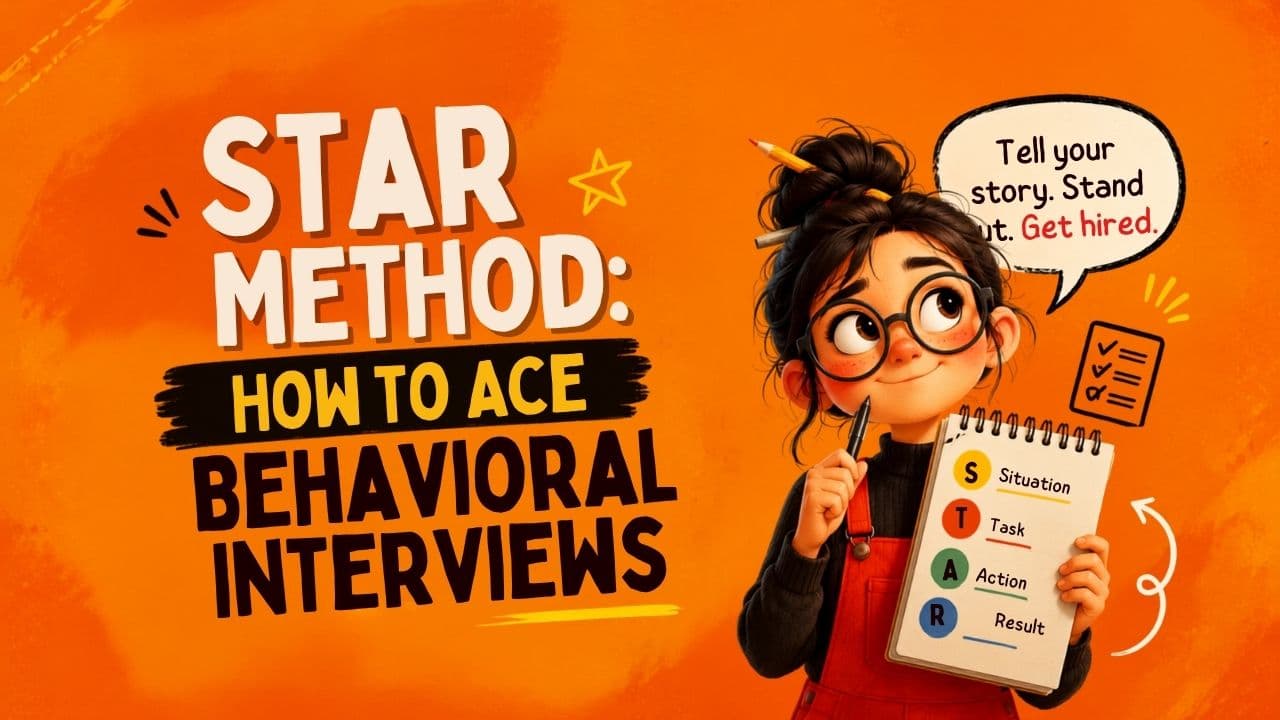
STAR Method: How to Ace Behavioral Interviews
“Tell me about a time you handled a difficult situation.”
“Describe a conflict you had with a teammate.”
“Give me an example of when you worked under pressure.”
These are behavioral interview questions. Instead of asking what you would do, the interviewer wants to understand how you handled a real situation in the past.
One of the easiest ways to answer these questions clearly is the STAR method.
STAR stands for Situation, Task, Action, and Result. It helps you tell a structured story without rambling or giving vague answers.
What Is the STAR Method?
The STAR method breaks your interview answer into four parts:
Situation: What was happening?
Task: What were you responsible for?
Action: What did you personally do?
Result: What happened because of your actions?
The framework is designed to keep your answer focused on a specific example rather than general statements about your skills.
For example, instead of saying:
“I am good at handling pressure.”
You can provide evidence:
“Our team had to complete a client project three weeks earlier than planned. I reorganized the task priorities, automated part of the testing process, and introduced short daily check-ins. We completed the project two days before the revised deadline without any critical issues.”
The second answer demonstrates the skill instead of simply claiming it.
How Each Part of STAR Works
1. Situation
Give the interviewer brief context. Explain the project, problem, or circumstances you faced.
Example:
“A major client moved our product launch forward by three weeks.”
Keep this section short. The interviewer does not need the entire history of the project.
2. Task
Explain your specific responsibility.
Example:
“As the lead developer, I was responsible for making sure the essential features were ready without compromising testing standards.”
This makes your personal role clear.
3. Action
This is the most important part of your answer. Explain what you actually did. Mention your decisions, methods, tools, and problem-solving approach.
Example:
“I reviewed the feature backlog, removed lower-priority tasks from the release, automated parts of our testing pipeline, and introduced short daily updates to identify blockers quickly.”
Avoid relying only on “we.” Interviewers want to understand your contribution.
4. Result
End with the outcome. Whenever possible, use a measurable result.
Example:
“We completed the release two days ahead of the revised deadline with no critical bugs during the initial launch.”
If you do not have a number, explain the practical outcome or what you learned.
STAR Method Example
Question:
“Tell me about a time you had to work under a tight deadline.”
Situation:
“Our client moved a product launch forward by three weeks.”
Task:
“I was responsible for preparing the core features for release while maintaining our testing requirements.”
Action:
“I prioritized essential features, postponed non-critical improvements, automated testing tasks, and introduced short daily progress updates.”
Result:
“The team delivered the release two days ahead of the new deadline without any critical launch issues.”
This answer works because the interviewer can quickly see what happened, what you were responsible for, what you did, and what changed.
Common STAR Interview Mistakes
1. Talking Too Much About the Situation
Do not spend most of your answer explaining background information. Keep the setup short and move quickly to your actions.
2. Saying “We” Too Much
Teamwork matters, but the interviewer is assessing your abilities.
Instead of:
“We solved the customer problem.”
Say:
“I analyzed the complaint, identified the issue, and proposed a solution that the team implemented.”
3. Forgetting the Result
Never end your story without explaining what happened.
Ask yourself:
“What changed because of what I did?”
The answer might be increased sales, reduced errors, faster delivery, better customer satisfaction, or simply successful completion of a project.
4. Giving a Generic Answer
Avoid statements such as:
“I am a good team player.”
Replace them with a real example that demonstrates teamwork.
5. Memorizing Every Word
Prepare your stories, but do not memorize a perfect script. Interviewers may ask follow-up questions, and a memorized response can sound unnatural.
Remember the four stages instead:
Situation → Task → Action → Result
What If You Have No Work Experience?
You can still use the STAR method.
Your examples can come from:
College projects
Internships
Freelance work
Part-time jobs
Volunteering
Student organizations
Personal projects
For example, a student could answer a teamwork question using a college project:
Situation: A four-person team had two weeks to complete a presentation.
Task: You were responsible for researching the market data.
Action: You organized the research, created a shared document, and coordinated review sessions.
Result: The team completed the presentation before the deadline and received positive feedback.
Your example does not need to come from a corporate job. It needs to be real, specific, and relevant.
5 STAR Stories You Should Prepare
Before an interview, prepare a small collection of stories rather than trying to predict every question.
Prepare examples involving:
A difficult problem — shows problem-solving.
A tight deadline — shows prioritization.
A team conflict — shows communication.
A mistake or failure — shows accountability and learning.
A successful project — shows execution and initiative.
One story can often answer several different behavioral questions.
Simple STAR Template
Use this template while preparing:
Situation: What was happening?
Task: What were you responsible for?
Action: What specific steps did you take?
Result: What happened afterward?
Try to keep your final response around 60–120 seconds for most behavioral questions. Keep the Situation and Task concise and spend more time explaining your Actions and Result.
Final STAR Interview Checklist
Before your interview, ask yourself:
Do I have at least five real stories prepared?
Is my personal contribution clear?
Have I focused more on Action than background?
Can I explain the Result clearly?
Do I have numbers or measurable outcomes where they genuinely exist?
Have I prepared examples for teamwork, conflict, pressure, and failure?
Can I tell each story naturally without memorizing it?
Final Takeaway
The STAR method is not about making your interview answers sound scripted. It is about making your experience clear, specific, and easy to evaluate.
When an interviewer asks about a difficult situation, do not simply say you are hardworking, adaptable, or a good team player.
Tell the story.
Set the Situation. Explain the Task. Show your Action. Finish with the Result.
A strong STAR answer does not just tell the interviewer what you can do—it gives them evidence of how you have done it before.